 India GO
Pushkar Camel Fair: a livestock fair and a pilgrimage in one
Where camels and pilgrims share the same sacred dust
The Pushkar Fair (Pushkar Camel Fair, locally Pushkar Mela) is an annual camel and livestock fair in the town of Pushkar in Rajasthan, held between October and November. Rajasthan Tourism calls it one of the world's largest camel fairs. It shares its days with a pilgrimage: the fair ends on Kartik Purnima, the full moon of Kartika, when pilgrims bathe in Pushkar Lake. Dates: 17–24 November 2026, from Rajasthan Tourism's official calendar.
The world's largest camel fair, a desert spectacle unlike any other
Rajasthan Tourism publishes the fair dates years ahead (the current list runs to 2030); the fair ends on Kartik Purnima.
The legend
In a tale from the Padma Purana, Brahma, the creator god, lets a lotus flower fall to earth.

Where it lands, a lake appears. The place is named Pushkar: in Sanskrit, pushkara is a blue lotus.
Here Brahma holds a great fire sacrifice. His wife Savitri is late, so he marries a local girl, Gayatri, to complete the rite.

Savitri, wounded, curses him: he will be worshipped nowhere but Pushkar. Her temple stands on the hill above town.
So on the full moon of Kartika pilgrims come to bathe in the lake and pay homage to Brahma in his temple.
Meaning
Pilgrims
Scripture calls Pushkar Tirtha Raj, king of pilgrimage places: no pilgrimage is thought complete without a dip here.
Herders
For Rajasthan's herders it is a market: camels, horses, cows, sheep and goats are brought here to be sold.
Sikhs
Pushkar has gurdwaras of Guru Nanak and Guru Gobind Singh, and Gobind Ghat on the lake marks where the tenth Guru stayed.
Customs
Holy dip
At dawn on the full moon, pilgrims step into the water from the lake's 52 ghats.
Deepdaan
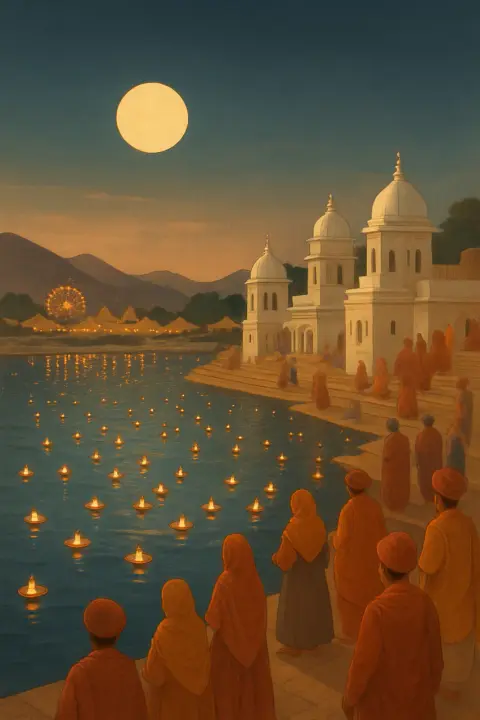
The fair opens with deepdaan: thousands of clay lamps glow around the lake, and a maha aarti is held at Brahma Ghat.
Brahma temple
After the dip, pilgrims go on to the Brahma temple: a red spire and a carved hamsa, the creator's swan.
Savitri temple
Savitri's temple on Ratnagiri hill is 970 steps up, or a ropeway ride. Inside stand both Savitri and Gayatri.
Contests
On the fairground men compete for the longest moustache, teams pull a rope, and matka phod ends in smashed clay pots.
Roses
Pushkar is called the rose garden of Rajasthan: its roses become rose essence and gulkand, a petal jam.
What people eat
Malpua
a thick pancake fried in ghee and soaked in syrup
Gulkand lassi
yoghurt blended with jam of Pushkar roses
Dal baati churma
ember-baked dough balls with lentils
Words of the festival
मेला
mela
a fair; locally the festival is the Kartik Mela
तीर्थ
tirtha
a sacred place by water; Pushkar is called their king
घाट
ghat
steps down to the water; the lake has 52
दीपदान
deepdaan
an offering of light: lamps lit by the water
हंस
hamsa
the swan that carries Brahma, carved on his temple
How to greet
खम्मा घणी
Khamma ghani!
Rajasthan's respectful hello, roughly "many greetings". The reply is "ghani ghani khamma".
True or myth
❌ Myth. It is often called that, but there are Brahma temples at Asotra in Rajasthan and Khedbrahma in Gujarat. Pushkar's is the best known.
✅ True. The mela starts in the month of Kartika and ends on Kartik Purnima, the holiest day for a dip in the lake.
❌ Myth. Pushkar is a holy town: meat, fish, eggs and alcohol are not sold here.
Where to celebrate
Pushkar ⭐
Worth the trip
A livestock fair and a pilgrimage sharing the same eight days: the trading and the contests come first, and the fair ends with the Kartik Purnima bath in the holy lake.
The camel and livestock fair
At its core the fair is a market: camels and other livestock are brought to Pushkar to be bought and sold. Around that trade, Rajasthan Tourism notes, the fair has become an important tourist attraction that draws thousands of visitors.
Rajasthan Tourism names the competitions that draw the crowds:
- Matka phod: a pot-breaking contest.
- Longest moustache: men compete with their moustaches.
- Bridal competition.
- An exhibition match between the local Pushkar Club and a team of foreign tourists.
The contests take place at the Mela Ground on the western edge of town, and watching is free. Rajasthan Tourism also lists camel safaris, which start in villages across the desert and end at sunset on the dunes, and hot air balloon rides over the fair. Most campsites are near the fair grounds, at the edge of the desert.
The pilgrimage side: the lake and Brahma
Hindu scripture calls Pushkar Lake Tirtha Raj, the king of pilgrimage places, and no pilgrimage is thought complete without a dip in it. The lake is semicircular, about 8–10 metres deep, and surrounded by 52 bathing ghats and more than 400 temples. Pilgrims bathe from Kartik Ekadashi to Kartik Purnima, and the full-moon dawn is the holiest moment of the fair.
After the dip many go on to the Brahma temple, one of the few temples of Brahma, the creator god, in India and the best known: marble, a red spire and the hamsa, Brahma's swan, with a four-faced image in the sanctum. On Kartik Purnima its queue runs all day. Behind it, on a hill, stands the temple of Savitri, Brahma's first wife, reached by a long flight of steps or by the ropeway that opened in 2016, with a view over the lake, the town and the dunes.
On the ghats, take your shoes off and do not photograph people bathing. Men offering flowers "for the lake" or a puja may ask for money afterwards: agree a price first or decline politely.
Getting there and where to stay
Fair week is the busiest of Pushkar's year, and room rates rise steeply for it.
- Book about four months ahead
Rooms by the lake and the better tent camps go first. Even RTDC's Hotel Sarovar, the state tourism hotel in the old Man Mahal guest palace by the lake, switches to special fair rates.
- Pick a base
In town, guesthouses around the lake keep the ghats and the Mela Ground within walking distance, but the lanes are packed and loud all week. Tent camps on the edge of the fairground are beside the dunes and the contests, a longer walk from the lake. Ajmer, over the hills, has ordinary hotels, but the road in is the bottleneck on Ekadashi and Purnima. More in where to stay in Pushkar.
- Book trains on the day sales open
Ajmer Junction is the railhead. Trains go on sale 60 days ahead and sell out for the Purnima days. Pushkar Terminus, connected to Ajmer station 14 km away, has been open since 2012, and buses run from the Ajmer bus stand.
- Arrive four days before the full moon
That catches the last days of trading, the contests, the start of the pilgrims' baths on Kartik Ekadashi and the Purnima dawn. Three nights is the minimum, five is better.
Etiquette and safety
Pushkar is a holy town, and on the Purnima days the crowd runs into the lakhs.
- Vegetarian town — Pushkar offers only vegetarian food: meat, fish, eggs and alcohol are not sold. Try the malpua and the gulkand (rose-petal jam) lassi.
- Crowds on Purnima — The UK government's travel advice for India notes that stampedes have occurred at large religious gatherings and that pickpockets target tourist areas. Agree a meeting point, keep valuables in a front pocket and follow police instructions on the ghats. See is India safe.
FAQ
When is the Pushkar Camel Fair?
Next: 17–24 November 2026. It is held between October and November and ends on Kartik Purnima; Rajasthan Tourism publishes the dates years ahead.
In which state is the Pushkar Fair held?
In Rajasthan, in the town of Pushkar near Ajmer.
Is there an entry fee for the Pushkar Fair?
No. The fairground, the contests at the Mela Ground and the lake ghats are free.
What are the main events of the Pushkar Fair?
The camel and livestock trading, and the competitions Rajasthan Tourism lists: matka phod (pot-breaking), the longest moustache, a bridal competition and an exhibition match between Pushkar Club and foreign tourists. The fair ends with the Kartik Purnima bath in the lake.
Is Pushkar's the only Brahma temple in India?
No. It is often called the only one, but there are Brahma temples elsewhere, for example at Asotra in Rajasthan and Khedbrahma in Gujarat. Pushkar's is one of the few and the best known.
Sources (7)
Facts checked: 21 October 2026. Prices and hours are approximate; check locally.