 India GO
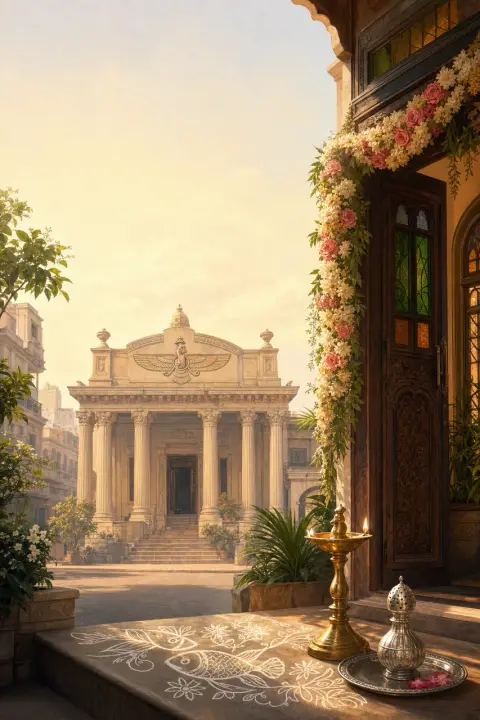
Parsi New Year (Navroz): the August new year of India's Parsis
Fire, flowers and sweet vermicelli for the new year
Parsi New Year, or Navroz, is the new year of India's Parsis, the Zoroastrian community descended from Persians who settled in Gujarat more than a thousand years ago. It is the first day of the month Farvardin in the Shahenshahi calendar, which most Indian Parsis follow, and it now falls in mid-August: next, 15 August 2027. It is not the spring Nowruz of Iran and Central Asia, although many Parsis keep that day too.
Navroz of India's Parsi Zoroastrians: fire-temple prayers, flowers on the door and a festive table
The Shahenshahi calendar has no leap day, so the date moves a day earlier every four years. The central government's restricted list, issued around July of the year before, confirms it.
The legend
Tradition says Zoroastrians fleeing Persia sail to Gujarat and ask Raja Jadi Rana for refuge.
The raja fears his kingdom is full, so a priest dissolves sugar in a vessel of milk: the newcomers will not overflow it, only sweeten life.
Granted land at Sanjan, in 721 they kindle a sacred fire that has burned without going out ever since.
Meaning
Udvada
The Sanjan fire has burned here since 1741; it is one of India's eight Atash Behrams, and outside India the only other is in Yazd.
Mumbai
By 1891 more than half of India's Parsis lived in Bombay, where many were merchants and shipowners.
Customs
Muktad
The last ten days of the year honour the ancestors: the house is made ready for their souls, and a lamp burns throughout.
Gifts for the fire
Fruit, flowers, incense, wood and money are brought to the temple fire while a priest prays.
Toran and chalk
A toran of fresh flowers goes over the door, and patterns in white chalk powder are drawn at the threshold.
What people eat
Sev
sweet vermicelli that starts the Navroz morning
Words of the festival
نوروز
Navroz
"new day" in Persian
અગિયારી
agiary
"house of fire", the Parsis' Gujarati word for a fire temple
કુસ્તી
kusti
the sacred girdle of 72 white woollen threads, one for each chapter of the Yasna
How to greet
સાલ મુબારક
Sal Mubarak!
"Blessed New Year!": saal means year, mubarak blessed.
True or myth
✅ True. An Atash Behram takes fire from lightning, a smithy, a bakery, a potter and more, each purified, and consecration can take up to a year.
✅ True. His other conditions were Gujarati as their language, saris for the women and no weapons.
❌ Myth. The Shahenshahi calendar has no leap years, so the festival slowly drifts through the year: it now falls in August.
Why August, not March
The Zoroastrian year has 365 days: twelve months of thirty days plus five extra days at the end. Iran and most of the Persian-speaking world keep the new year on the spring equinox, around 20 or 21 March. The Parsis' Shahenshahi calendar has no leap day, so against the Gregorian calendar its new year slips back by one day every four years. Over the centuries it has drifted back through the year from spring to August, and it keeps moving.
There are in fact three Zoroastrian calendars in use. A minority of Parsis follow the Kadmi (Qadimi) calendar, adopted by some Parsis around Surat in 1745, whose new year comes about a month before the Shahenshahi one, in July. The Fasli calendar, proposed in Bombay in 1906, adds leap days and keeps the new year at the spring equinox; this spring day, Jamshedi Navroz, is also celebrated by many Parsis, which is why some families mark two new years.
Where Navroz is celebrated
Most of India's Parsis live in Mumbai; by 1891 more than half of them already lived in Bombay. On Navroz the city's Parsi colonies and agiaries (fire temples) are at the centre of the day, and Parsi families also live in Pune, Gujarat and other cities.
The holiest place of the community is Udvada, a small coastal village in Valsad district of Gujarat, about 200 km north of Mumbai. Its temple keeps the Iranshah, the oldest sacred fire in India, consecrated at Sanjan after the first Parsis arrived and housed at Udvada since the 18th century. It is one of eight Atash Behrams in India; outside India the only other is in Yazd, Iran. Like all fire temples, it is open only to Zoroastrians.
Parsi New Year is a public holiday in Maharashtra and Gujarat and on the central government's restricted holiday list. See also Mumbai festivals.
Sharing the day at the table
Navroz is a family and community festival, and fire temples are closed to visitors, so for a traveller the table is the way in. Parsi cooking is meat-, fish- and egg-led; vegetarians should ask what the kitchen has without them. More options in Mumbai restaurants.
Britannia & Co., Ballard Estate
A Parsi-Irani café opened in 1923 in a colonial building, known for berry pulav, rice with tart Iranian barberries, a recipe the family is credited with inventing.
Jimmy Boy, Fort
A Parsi café near Horniman Circle; on request it lays out the full wedding feast, lagan nu bhonu, on a banana leaf.
Ideal Corner, Fort
A small family-run Parsi bistro in a Fort side lane, with daily-changing home-style specials and lagan nu custard.
A Parsi bhonu at home
Some Parsi hosts in Nana Chowk and the old Parsi colonies (baugs) serve a full sit-down meal, bhonu, in their homes by arrangement, for about ₹1,500–3,000 per person in a small group; book several days ahead.
FAQ
When is Parsi New Year?
Next: 15 August 2027. Navroz is the first day of Farvardin in the Shahenshahi calendar; because that calendar has no leap day, the Gregorian date moves a day earlier about every four years.
Is Parsi New Year the same as Nowruz?
It has the same name and roots, but not the same date. Iran's Nowruz is the spring equinox in March; the Parsi Navroz of the Shahenshahi calendar has drifted to August. Many Parsis also celebrate the spring day as Jamshedi Navroz.
Are Parsis Muslims?
No. Parsis are Zoroastrians, followers of the prophet Zarathushtra. Their ancestors left Persia for India after the Arab conquest of Iran in the 7th century.
What does Navroz mean?
"New day" in Persian. The usual greetings are "Navroz Mubarak" and "Sal Mubarak", blessed new year.
Can visitors enter a fire temple on Navroz?
No. Fire temples (agiaries and Atash Behrams) are open only to Zoroastrians; their facades can be admired from the street, without photographing worshippers at the entrance.
Is Parsi New Year a holiday?
Yes, in Maharashtra and Gujarat, and it is on the central government's restricted holiday list. Elsewhere in India it is a normal working day.
Sources (6)
Facts checked: 21 October 2026. Prices and hours are approximate; check locally.