 India GO
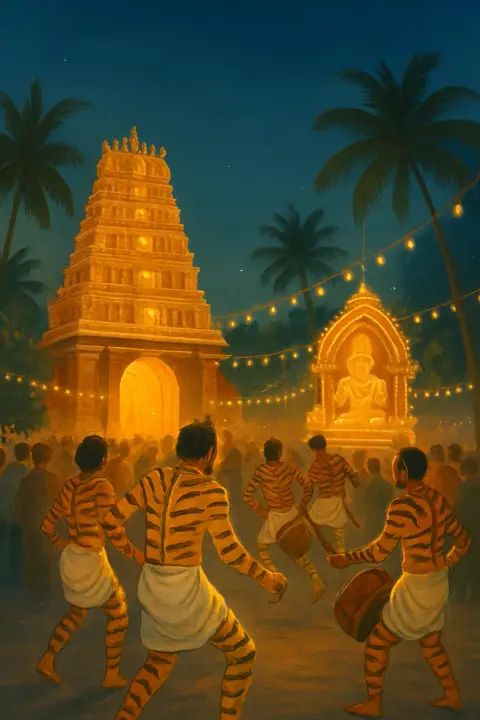
Mangaluru Dasara: nine nights at Kudroli and a procession until dawn
Painted tiger dancers lead the goddesses through the city all night
Mangaluru Dasara is the Navaratri festival of the coastal city of Mangaluru, centred on the Kudroli Sri Gokarnanatha temple: 30 September – 9 October 2027 (expected). For nine nights the temple worships Sharada, Mahaganapati and the nine forms of Durga, while troupes of young men painted as tigers, the Pili Vesha, dance through the streets. On the evening of Vijayadashami, 9 October 2027 (expected), the idols leave the temple in the Shobha Yatra, a procession of tableaux, bands and dancers that crosses the city all night and returns at dawn for the immersion in the temple tank. It is all free to watch.
The days follow the lunar calendar and Karnataka's Vijayadashami, fixed by the state holiday list in mid-November of the previous year; the temple committee announces the programme in late August or early September.
The legend

The Gokarnanatha temple at Kudroli was built in 1912 by the Billava community under Koragappa, and consecrated by Sree Narayana Guru.

In 1908 Billava elders asked Narayana Guru to help them build a temple of Shiva, and he himself chose the site at Kudroli.
For nine nights Sharada, Mahaganapati and the nine Durgas are worshipped. The tiger dancers honour the goddess, whose favoured animal is the tiger.
Customs
Pili vesha
Young men painted as tigers roam in troupes to thaase drums, stopping at homes and shops to dance for ten minutes and collect coins.
Gangavatarana
All nine days the temple's Gangavatarana fountain runs: jets from four figures of Shiva meet in the shape of a lingam.
The night procession
On Vijayadashami evening the idols tour the city with tableaux, bands, Yakshagana and tigers, and at dawn are immersed in the temple tank.
Where to celebrate
Mangaluru
Nine nights of Navaratri at the Kudroli Gokarnanatha temple end in an all-night procession of the Navadurga idols with tableaux and Pili Vesha tiger dancers, and a dawn immersion in the temple tank.
Nine nights at Kudroli
At the start of Navaratri the priests install the idols of Sharada (the goddess of learning, as Saraswati is called here), Mahaganapati and the nine Navadurgas in the temple's Swarna Kalamantapa, and pujas are performed before them every day. The temple stays lit and open late, and the city's main roads are decorated with lights for the ten days.
Throughout the nine days the Gangavatarana fountain runs in the temple grounds: four painted figures of Shiva, each about 13 feet high, send up jets of water that rise to around 100 feet and meet in the shape of a lingam, representing the Ganges flowing from Shiva's crown.
Out in the city the Pili Vesha (huli vesha in Kannada) is the sound of Dasara. Troupes of five to ten young men, painted and costumed as tigers, roam with thaase drummers, stop at homes, shops and street corners to dance for about ten minutes and collect money from the onlookers. The tiger is honoured as the favoured animal of the goddess. Lion and bear dancers join them.
The Shobha Yatra on Vijayadashami
The procession leaves Kudroli in the late afternoon or evening of Vijayadashami (in a recent year at about 4 pm). The idols of the Navadurgas, Mahaganapati and Sharada ride on decorated tableaux, with bands, chende drums, Yakshagana characters, Dollu Kunitha drummers and the tiger troupes.
The route runs from Kudroli through Mannagudda, Ladyhill, Lalbagh, K S Rao Road, Hampankatta, Car Street and Alake, and then back to Kudroli through the night. At daybreak the idols are immersed in the Pushkarini, the pond inside the temple complex (in a recent year at about 6:30 am). The police divert traffic in the centre for the procession.
Where to watch
There are no tickets or stands. Choose by the time of night.
Kudroli temple, any of the nine evenings
The Navadurga idols, the Gangavatarana fountain and the lit temple. Shoes off inside.
K S Rao Road and Hampankatta
The city centre, for the tableaux and the tiger troupes in the evening.
Car Street
Where the procession passes late at night.
Kudroli at daybreak
The procession's return and the immersion in the temple pond.
Any street corner during Navaratri
Pili Vesha troupes stop to perform all over the city; they collect small tips.
A temple built for those kept out
The Kudroli temple was founded by the Billava community at a time when they were barred from many temples. In 1908 a delegation of Billava elders led by Koragappa, a Mangaluru businessman, invited the social reformer Sree Narayana Guru to guide them; he chose the site at Kudroli and brought the Shiva lingam himself, and the temple of Gokarnanatha, a form of Shiva, was built in 1912. Under a later leader, B. R. Karkera, the temple opened its doors to Dalits (then called Harijans), and Karkera also started the Sharada procession that became the heart of the Dasara. The temple was rebuilt in the Chola style, with a 60-foot gopuram, and reopened in 1991.
Kudroli is the best known Dasara in the city, but not the only one. At the Mangaladevi temple in Bolar, of the goddess who gave Mangaluru its name, the goddess's chariot is pulled to Marnamikatta on Mahanavami, the day before Vijayadashami. At the Sri Venkataramana temple on Car Street the Mangaluru Sharadotsava ends with its own Sharada procession and an immersion in the Mahamaya temple tank before dawn.
Planning the trip
Mangaluru has plenty of hotels, but Vijayadashami falls in Karnataka's Dasara holidays, when much of the state travels.
- Book two to three weeks ahead
An ordinary city hotel is fine. Trains and buses from Bengaluru are busy over the holidays, even with KSRTC's extra Dasara buses, so take tickets about a month ahead.
- Arrive by the morning of Vijayadashami
One night covers the procession; a second lets you sleep after it, or come the day before for the Mangaladevi chariot on Mahanavami.
- Choose between the Dasaras
Mysuru Dasara falls on the same days, with its royal elephant procession; Mangaluru's tigers are the coastal alternative. For more tiger dancers out of season, see Vittla Pindi in Udupi.
- In the crowd
The night procession draws big crowds. The UK Foreign Office advises following the local authorities at large religious gatherings and watching your belongings.
FAQ
When is Mangaluru Dasara?
30 September – 9 October 2027 (expected), the nine nights of Navaratri at Kudroli, ending with the Shobha Yatra on Vijayadashami, 9 October 2027 (expected). The temple committee announces the programme in late August or early September.
When did Mangalore Dasara start?
The Kudroli temple was built in 1912. The Sharada procession at the heart of the Dasara was started by B. R. Karkera, who led the temple after its founder Koragappa.
What is Pili Vesha?
The tiger dance of coastal Karnataka: troupes of young men painted as tigers dance to thaase drums at homes, shops and street corners during Navaratri, in honour of the goddess whose animal is the tiger.
What route does the Mangaluru Dasara procession take?
From Kudroli through Mannagudda, Ladyhill, Lalbagh, K S Rao Road, Hampankatta, Car Street and Alake, and back to Kudroli by dawn for the immersion.
What is Kulasai Dussehra?
A different Dasara, at the Mutharamman temple in Kulasekarapattinam in Tamil Nadu, known for devotees in costume. See Kulasekarapattinam Dasara.
Sources (5)
Facts checked: 21 October 2026. Prices and hours are approximate; check locally.