 India GO
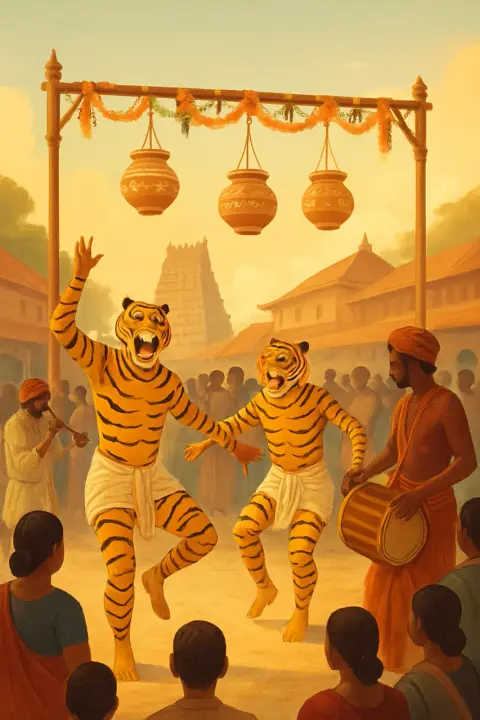
Vittla Pindi and Huli Vesha, Udupi
Men painted as tigers dance to drums as pots of curd break overhead
The matha announces the day only days ahead; the press previews it one or two days before.
The legend
In legend, little Krishna grew up among cowherds in Gokul and stole butter and curd from pots hung up high out of reach.
Udupi counts Krishna's birthday by the solar calendar, in the month of Simha. People fast all day, and at midnight moonrise water and milk are offered to Krishna.

Next day comes Vittla Pindi, the festival of Krishna's play: a clay Krishna leaves the Matha in a golden palanquin and mounts the golden chariot.
As in Gokul, pots hang over Car Street and men dressed as cowherds smash them with sticks, while painted tiger dancers lead the procession.
Meaning
Tulu Nadu
The tiger dance began in Udupi, danced at Ashtami and Ganesha Chaturthi across Tulu Nadu; in Mangaluru it now peaks at Dasara.
A vow
Tiger paint used to be a vow: a mother promised the goddess that a child, once well, would dance the pili vesha.
Customs
Cowherds' offering
By custom, cowherds from the nearby villages themselves offer water and milk to Krishna at the Matha on the night of his birth.
Mosaru kudike
Clay pots of water tinted with turmeric and kumkum hang from wooden poles, and costumed men try to break them with sticks.
Tiger paint
Dancers are painted head to toe in yellow with black stripes, about three hours each. In Udupi a kachche wrap goes over the shorts.
To the tase
A troupe of a few tigers dances to two or three tase drummers. The faster the drum, the higher the leaps and somersaults.
The swamis' gifts
The costumed dances count as service to Krishna on his birthday, and the swamis of all the mathas reward the performers.
What people eat
Chakkuli
crisp spirals of rice dough, Krishna's favourite treat in Udupi
Unde
laddu, Kannada style; the Matha makes several kinds for Ashtami
Semige
fine rice noodles, made in Tulu homes on the eve of Ashtami
Words of the festival
ವಿಟ್ಲಪಿಂಡಿ
Vittla Pindi
Udupi's festival of Krishna's childhood play, the day after Ashtami
ಪಿಲಿ ವೇಷ
pili vesha
Tulu for "tiger guise": the dance of men painted as tigers; huli vesha in Kannada
ಮೊಸರು ಕುಡಿಕೆ
mosaru kudike
"curd pot": the pot hung up and smashed at the festival
ತಾಸೆ
tase
the Tulu drum the tigers dance to
ಅಸ್ಟೆಮಿ
astemi
the Tulu name for Krishna's birthday
True or myth
❌ Myth. Udupi counts by the solar month of Simha, so in some years it falls a month later.
✅ True. "To eat adye, wait for Ashtami": adye, festive rice dishes, were traditionally eaten on that very day.
❌ Myth. The tigers are young men in paint with fake-fur tails; the troupes dance to drums.
Where to celebrate
Udupi
The day after Udupi's own Janmashtami, a clay Krishna rides the golden chariot around Car Street, pots of curd are broken overhead and tiger dancers drum their way through town.