 India GO
Mandi International Shivratri Fair: the week the village gods come to town
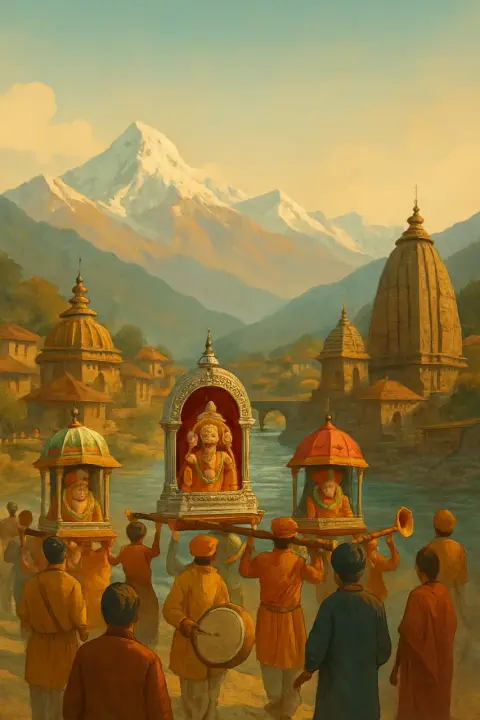
Village gods on palanquins walking into town in order of rank
The Mandi International Shivratri Fair is a seven-day gathering of the gods in Mandi, a temple town on the Beas in Himachal Pradesh. For Shivaratri more than two hundred village deities of the Mandi valleys are carried into town on palanquins to pay their respects to Madho Rai, the town's protector, and to Shiva at the Bhootnath temple, then process through the old town in order of rank. Dates: 7–13 March 2027 (expected), beginning straight after Maha Shivaratri; the district administration and the fair committee confirm them in January or February.
The Mandi district administration and the fair committee announce the dates in January or February.
The legend

In the 16th century Raja Ajbar Sen, Mandi's first great ruler, built the Bhootnath temple of Shiva in the town centre, one of the festival's two focal shrines.
Raja Suraj Sen, who had no heir, built a Vishnu temple, and in 1705 a silver image of Radha and Krishna, Madho Rai, was made king of Mandi.
From then on the rajas ruled as Madho Rai's servants. At Shivaratri the village gods come to honour him, the raja and Shiva.
Customs
Gods in palanquins
Village deities in glittering embroidered drapes are carried into Mandi on palanquins, each going first to the Madho Rai temple.
The jaleb procession
Then the gods move in a colourful procession to the palace. Madho Rai is said to leave his temple only once a year, to lead it.
Kamru Nag on the hill
Rishi Kamru Nag, god of rain, is said to honour Madho Rai and then go up to the temple on Tarna hill to watch the fair for seven days.
Where to celebrate
Mandi
Mandi's week of the gods: more than two hundred village devtas come into town for Shivaratri, pay their respects to Madhav Rai and Bhootnath, and process through the old town in order of rank.
How the week runs
The festival gets under way with the arrival of Kamru Nag, the god of rain, who comes as the guest of honour; by tradition he then withdraws to the temple on Tarna hill above the town and watches the fair from there for seven days. The other deities arrive on palanquins with their own folk bands, the devta (deity) in glittering embroidered drapes, carried by their villagers. Each goes first to the Madho Rai temple.
The great moments are the jalebs, the processions of the deities through the old town to the palace, led by Madho Rai himself, who by tradition leaves his temple only for this. The deities walk in a fixed order of rank and status, and their bearers sway the palanquins to the drums. In recent years the fair has had three jalebs, the last, the Shahi Jaleb, on its final day.
Between processions the deities sit for the week on the Paddal ground, a large open space at the confluence of the Beas and the Suketi, each in its assigned place, and anyone can come to them for worship. Around them runs a fair where hill traders sell wool, honey, walnuts, ghee and jewellery, and in the evenings there are cultural programmes. On the eve of the last day a night vigil, the jagaran, is held, at which a guru and his disciple pronounce prophecies for the coming year. On the final day chadars (cloth offerings) are presented, the governor of the state usually joins the worship, and the deities set off home.
Where it happens
Everything is free to watch. Mandi is small, and the main places are a short walk apart in the old town.
Raj Madhav Rai temple
The temple of Madho Rai, the form of Vishnu made king of Mandi, near Chauhatta square. Every deity pays its respects here, and every jaleb starts here.
Bhootnath temple
Shiva's temple in the heart of town, dated to the 1520s, where the Shivaratri worship itself is held. Nandi faces the god from the ornamented double-arched entrance.
Paddal ground
The large ground by the river where the jalebs end and the deities sit through the week, with the fair around them. Ask the deity's attendants before photographing it up close.
Seri Manch
The open-air stage a short walk from Madhav Rai and Chauhatta, for the nightly cultural programmes.
Why the gods gather at Shivaratri
Mandi, with some 81 temples in and around the town, is called the Chhoti Kashi or the Varanasi of the hills, and its fair joins the worship of Shiva and Vishnu. The custom of holding it at Shivaratri is traced to Raja Ishwari Sen. He lost his kingdom in the war waged by Raja Sansar Chand in 1792 and was held prisoner for twelve years; when the Gurkhas restored him, the raja invited all the hill deities of his state to celebrate his return, and the day happened to be Maha Shivaratri. The deities have come every year since.
The same week of village gods gathering around a royal deity is seen in autumn at Kullu Dussehra, in the next valley.
Planning the trip
Mandi lies on the Chandigarh–Manali highway. Rooms fill with the fair's own crowd rather than with tourists.
- Book about six weeks ahead
Stay in Mandi town, on the Beas, within walking distance of the old town and Paddal.
- Take the night bus
HRTC (Himachal Road Transport) buses from Delhi and Chandigarh run through the night on the Manali highway; tickets go on sale 60 days ahead, and a month's notice is a comfortable margin.
- Arrive before Shivaratri
Come the day before, for Kamru Nag's arrival and the deities coming in. Two nights is the minimum to see the first jaleb; three give you an evening at the Seri Manch.
- Add a side trip
Rewalsar lake, about 24 km from Mandi, is the usual side trip.
Etiquette with the deities
For the villages, the devtas are not statues on display but gods visiting the town. Treat each palanquin as you would a shrine.
- Give way to a jaleb — Step aside when a procession comes through and do not cut across it; the order of the deities matters.
- Ask before photographing — At Paddal, ask the attendants before taking close-up photos of a deity.
- In the crowd — The UK Foreign Office advises following the local authorities at large religious gatherings and taking care of possessions in crowds.
FAQ
When is the Mandi Shivratri Fair?
7–13 March 2027 (expected): seven days beginning straight after Maha Shivaratri. The Mandi district administration and the fair committee announce the dates in January or February.
What is a jaleb?
The procession of the visiting deities through Mandi's old town to the palace, led by Madho Rai and walking in order of rank. In recent years there have been three, the last being the Shahi Jaleb on the final day.
Why is it called the International Shivratri Fair?
"International" is part of the fair's official name, reflecting its renown beyond Himachal. It is held at Mandi, a town of about 81 temples known as the Chhoti Kashi, with over 200 deities of the district taking part.
In which district of Himachal Pradesh is Mandi?
Mandi is the headquarters of Mandi district, on the Beas river and the Chandigarh–Manali highway.
Is it free to attend?
Yes. The jalebs, the deities at Paddal and the fair are all free to see; you watch the processions from the streets of the old town.
Sources (5)
Facts checked: 21 October 2026. Prices and hours are approximate; check locally.