 India GO
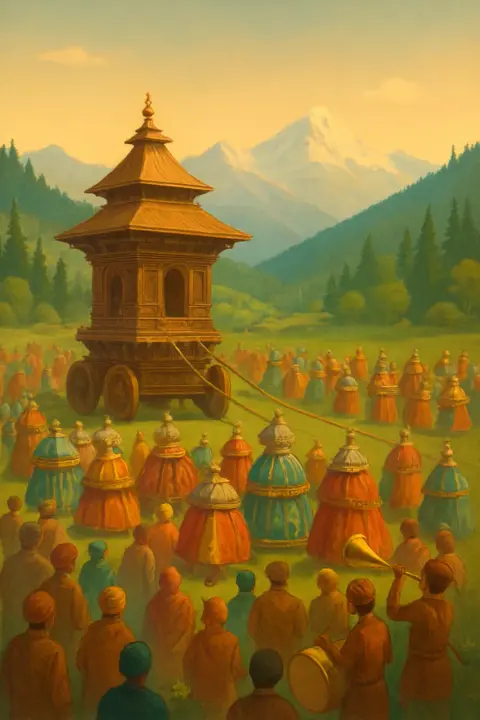
Kullu Dussehra: a week when the valley's gods camp on one meadow
A valley's village gods carried down on palanquins to camp on one meadow
Kullu Dussehra is the week-long gathering of the Kullu valley's village gods on Dhalpur maidan in Kullu, Himachal Pradesh. It begins on Vijayadashami, the day Dussehra ends in most of India, and runs for seven days: dates 21–27 October 2026. Deities are carried down from their villages on palanquins, Raghunath, the valley's ruling deity, is pulled across the maidan in a wooden chariot, and the festival closes with Lanka Dahan by the Beas.
The Kullu Dussehra Utsav Samiti and the district administration fix the dates between July and September.
The legend
Legend says the sage Jamadagni was carrying a basket of eighteen images of gods to Malana when a storm on the Chanderkhani pass scattered them across the hills.
Hill people find the images, which take form as gods: that, it is said, is how the Kullu valley got its village deities.
In the 17th century King Jagat Singh brings a Brahmin's curse on himself and, to lift it, has an image of Raghunath, Rama, brought from Ayodhya.
The people of Ayodhya try to take their god back, but he grows heavy towards Ayodhya and light towards Kullu.

Drinking the water that bathed the god's feet, the king is freed of the curse and gives his kingdom to Raghunath, ruling only as his regent.
Meaning
Naggar
Naggar was the capital of the Kullu rajas for some 1,400 years, and in the 20th century Nicholas Roerich spent his last years and died here.
Customs
Raghunath's chariot
On the first day the crowd hauls Raghunath's chariot across the Dhalpur meadow by rope.
A camp of gods
Village gods are carried down from their valleys on palanquins and camp together on one meadow for a week.
Kullu shawls
The valley is known for its shawls: bright, with geometric bands at both ends.
Words of the festival
देवता
devta
"deity"; the word also used for the valley's village gods
रघुनाथ
Raghunath
one of Rama's names; in Kullu he is held to be the valley's ruler
Kulvi
the indigenous people of the Kullu valley
True or myth
❌ Myth. The Kulvi once wove plain shawls; patterns came into fashion with craftsmen from Bushahr in the early 1940s.
✅ True. It opens on Vijayadashami itself and runs for seven days more.
Where to celebrate
Kullu
Worth the trip
For a week Dhalpur maidan is a camp of village gods: over three hundred devtas are invited down from their valleys, and on the first day the crowd hauls Raghunath's chariot across it by rope.
Naggar
Stand on the Dhalpur maidan as village after village carries its own deity down from its own temple on a palanquin, until some three hundred gods are gathered around one wooden chariot pulled by hand.
How Kullu's Dussehra differs
Elsewhere in India, Dussehra (see our Dussehra page) closes the nine nights of Navratri, often with Ram Lila plays and the burning of Ravana effigies. Kullu does neither. Its Dussehra starts on Vijayadashami itself, on the day the tenth lunar day of the bright half of Ashvin holds at sunrise in Kullu, so it sometimes begins a day after the national holiday. Instead of Ram Lila, the official festival account mentions Ras Lila.
The heart of the festival is the devtas, the village deities of the valley. Each has its own temple, a face of beaten metal, a wooden palanquin and a team of bearers, and they walk down to Kullu on foot with drummers ahead of them. The administration now sends the invitations: more than three hundred deities are invited, and the official festival site counts about two hundred attending. For the week they camp in tents around the maidan, and visitors can walk among the camps.
The state government gives the festival international status, and evening cultural programmes, including an International Folk Dance Festival, run at the Lal Chand Prarthi Kala Kendra, the open-air theatre at Dhalpur.
The week, day by day
The official festival site describes the order of rites; exact times are announced locally each year.
- Before the opening
Deities from distant villages set out days early, and palanquins with their drummers walk the valley roads into Kullu. Raghunath receives special worship at his temple in Sultanpur, Kullu's old town, from the first day of Navratri.
- Day 1: the rath yatra
The goddess Hidimba is escorted to the Raghunath temple and the palace, and in the afternoon the images of Rama and Sita are carried in a palanquin to the wooden chariot on Dhalpur. The crowd then hauls the chariot across the maidan by rope. This is the day with every deity present.
- The middle days: Jaleb
During the first six days the raja's palanquin, the Jaleb procession, visits the deities camped on the maidan.
- Penultimate day: Mohalla
The liveliest day of the festival: the deities pay homage to Raghunath and performances go on into the night.
- Last day: Lanka Dahan
The chariot is pulled to lower ground on the Beas towards Bhuntar, where grass and brushwood are burned to stand for Lanka. In the traditional rite, as the official festival site describes it, animals were also sacrificed here; The Tribune reports that since the Himachal Pradesh High Court banned animal sacrifice at religious gatherings in 2014, coconuts and other symbolic offerings are made instead. Hidimba then returns home and Raghunath is taken back to Sultanpur.
Why Raghunath rules the valley
The festival goes back to King Jagat Singh of Kullu in the 17th century (sources give 1606 or 1637 as the starting point). By the legend, the king brought a Brahmin's curse on himself and, to lift it, had an image of Raghunath, a name of Rama, brought from Ayodhya. Drinking the water that had bathed the god's feet, he was freed of the curse, gave his kingdom to Raghunath and ruled from then on as his regent. That is why the village deities come to Kullu each year: to pay homage to the ruler of the valley.
An older legend explains where those deities came from. The sage Jamadagni was carrying a basket of eighteen images of gods to Malana when a storm on the Chanderkhani pass scattered them over the hills; the hill people who found them began to worship them, and so the valley got its village gods.
Etiquette and crowds
The festival draws several hundred thousand people into a small town; Wikipedia puts attendance at 400,000 to 500,000.
- The camps are open, the palanquins are sacred — Everyone can walk among the deity camps for free. Ask the attendants before photographing a palanquin up close.
- Watch the chariot pull from the edge — On day 1 stand at the edges of the maidan, not in the path of the rope and the chariot.
- Crowd advice — FCDO notes that stampedes have happened at large religious gatherings in India and advises following the local authorities. In an emergency call 112.
Getting there and where to stay
Kullu town sells out for the week, so most visitors stay up the valley.
- Book about two and a half months ahead
Rooms across the valley fill for Dussehra week. Naggar, about 20 km up the valley, and Manali, about 40 km, take the overflow; Naggar, with its castle and the Roerich estate, is quieter than Kullu in the festival week.
- Trains and buses
The nearest major railhead is Chandigarh; trains there and HRTC buses into the valley go on sale 60 days before departure. The few flights into Bhuntar, about 10 km from Kullu, depend on the weather, so do not build the trip on them.
- Arrive two days early
The valley road is the only way in, and it is busiest on the opening day. Be settled the evening before and leave early for Dhalpur. Three nights is the minimum; five add the deity camps and the evening programmes.
FAQ
When is Kullu Dussehra?
Next: 21–27 October 2026. It starts on Vijayadashami as observed in Kullu and runs seven days; the Kullu Dussehra Utsav Samiti and the district administration fix the dates between July and September.
How many days does Kullu Dussehra last?
Seven days, from Vijayadashami to Lanka Dahan on the last day.
How is Dussehra celebrated in Kullu?
Village deities are carried down on palanquins and camp for a week on Dhalpur maidan, Raghunath's chariot is pulled across it on the first day, and the festival ends with Lanka Dahan by the Beas. There are no Ravana effigies.
When did Kullu Dussehra start?
In the 17th century, under King Jagat Singh, who installed the image of Raghunath as the valley's ruling deity. Sources give 1606 or 1637.
Is there a Dussehra festival in Manali?
The festival is held in Kullu, about 40 km from Manali, and many visitors stay in Manali or Naggar and travel down for the day.
Sources (8)
- Kullu Dussehra official site: rituals and traditions
- Kullu Dussehra
- Himachal Tourism: fairs and festivals
- FCDO: India, safety and security
- 347 deities invited for Kullu Dasehra festival, The Tribune
- The Tribune: week-long Kullu Dasehra concludes
- Kullu Dussehra of Himachal Pradesh, Sahapedia
- HRTC FAQ (advance booking)
Facts checked: 21 October 2026. Prices and hours are approximate; check locally.