 India GO
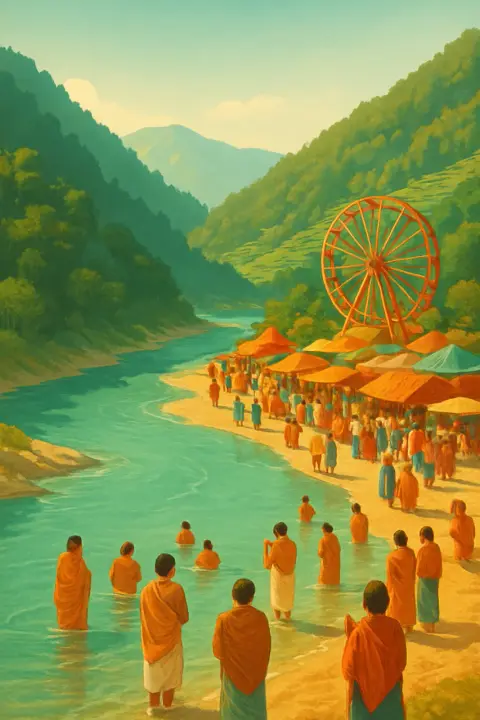
Maghey Sankranti at Jorethang: a river dip and a winter fair in Sikkim
A winter dip where the Teesta meets the Rangit, then a fair on the bank
Maghey Sankranti, Maghe Sankranti in Nepali, is the first day of the month of Magh, when the Sun enters Capricorn; it is one of the main festivals of Sikkim's Nepali community and a state holiday. The day begins with rites at dawn on the riverbanks, and fairs gather at river confluences, the biggest at Jorethang in Namchi district. Dates: 15–18 January 2027; the mela runs for several days from Magh 1.
The Sikkim government fixes the holiday in its notification for the year, published in October or November of the previous year; the organising committee and the Namchi district announce the mela programme in late December or early January.
The legend

Maghe Sankranti is the first day of the month of Magh in the Nepali calendar, and it heralds the turn to warmer weather.

In Sikkim the day is marked with a ritual dip where the Teesta meets the Rangit.
The Jorethang fair is said to have grown out of an agricultural fair first held there in 1955.
Customs
Rites at dawn
The rites begin at dawn on the riverbanks. Fairs gather at confluences: Jorethang, Saramsa, Rorathang and Triveni.
Riverside fair
The biggest fair is at Jorethang, where hundreds of stalls sell and show all kinds of goods.
What people eat
Chaku and sweet potato
Chaku, ghee and sweet potatoes are shared on the day.
Words of the festival
माघे सङ्क्रान्ति
Maghe Sankranti
The Nepali name of the festival: the Sankranti of Magh.
The day and the fairs
In the Nepali calendar Magh 1 heralds the turn towards warmer weather. In Sikkim the rites are held from dawn on the banks of the rivers, with a ritual dip, and the district administration describes them as a rare sight. Large fairs are organised along the riverbanks and at the confluences: Jorethang, Saramsa, Rorathang and Triveni are the main places.
Jorethang, a town on the Rangeet river, a tributary of the Teesta, has the biggest of them: a mela of hundreds of stalls selling and showing all kinds of goods, grown out of an agricultural fair and held for more than sixty years. At home and at the fairs people share chaku, ghee and sweet potatoes.
How the date is set
Maghey Sankranti is a solar date: Magh 1 falls on 14 or 15 January. It can fall a day after the Makar Sankranti of other Indian calendars, which marks the same entry of the Sun into Capricorn: see Makar Sankranti.
The Sikkim government fixes the holiday in its list for the year, published in October or November of the year before. The organising committee and the Namchi district announce the Jorethang mela programme in late December or early January.
Practical notes
What to know before going to Jorethang.
- Foreign nationals need a Sikkim permit — Every foreigner, except people of Bhutanese origin, needs a Restricted Area Permit to enter Sikkim. Sikkim Tourism says it is free and valid for up to 30 days, and is issued by Indian missions abroad, airport immigration at Bagdogra and Pakyong, the Tourist Information Centre in Siliguri and the Tourism Department offices at Melli and Rangpo, among others; foreigners must also register within 24 hours of arrival. Its list of places open on the permit names Namchi in the south but not Jorethang by name, so ask at the Melli office, on the road to Jorethang. Nationals of some countries, including China and Pakistan, need prior approval from the Ministry of Home Affairs. The UK Foreign Office (FCDO) notes that permit rules can change at any time.
- Getting there — Jorethang is on the road to Pelling from Darjeeling, Siliguri and Kalimpong, so it fits a route into West Sikkim.
- Come for the morning — The rites begin at dawn, so the riverbank is the place to be early on Magh 1; the fair fills the following days.
- Another Sikkim festival nearby in time — The Lepcha and Bhutia new year, Losoong and Namsoong, falls in winter too: 7–14 December 2026.
FAQ
When is Maghey Sankranti?
Next: 15–18 January 2027. It falls on Magh 1 of the Nepali calendar, 14 or 15 January, and the Jorethang mela runs for several days from it.
Is Maghey Sankranti the same as Makar Sankranti?
It marks the same entry of the Sun into Capricorn, but by the Nepali calendar, as Magh 1; it can fall a day after the Makar Sankranti date of other Indian calendars.
Where is Maghey Sankranti celebrated in Sikkim?
Fairs are held at river confluences and banks: Jorethang, Saramsa, Rorathang and Triveni. The biggest is at Jorethang in Namchi district.
What do people eat on Maghey Sankranti?
Chaku, ghee and sweet potatoes are shared on the day.
Sources (4)
Facts checked: 22 October 2026. Prices and hours are approximate; check locally.