 India GO
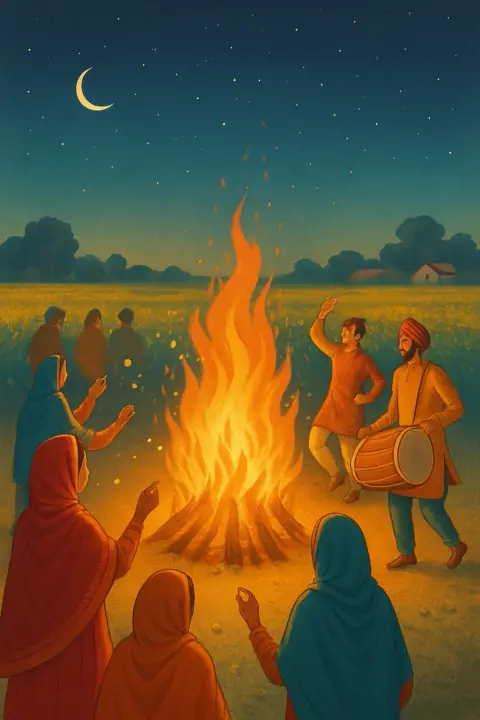
Lohri: Punjab's January bonfire night
A courtyard bonfire fed with sesame, jaggery and popcorn on a January night
Lohri is the bonfire night before Maghi, as Punjab calls Makar Sankranti: families and neighbours gather round a fire, feed it sesame, jaggery sweets and popcorn, and sing the Lohri songs. Punjab keeps it on 13 January. It is a festival of homes and courtyards rather than a public show, so an invitation matters more than a ticket.
Punjab keeps a fixed 13 January in its holiday list, issued in December of the previous year.
The legend

Lohri is older than any legend: a winter bonfire that sees off the solstice and welcomes the longer days.
The songs tell of Dulla Bhatti, a rebel in Akbar's Punjab who took from the rich and gave to the poor.
He is remembered as a protector of girls: he stopped them being carried off for sale, then arranged their weddings and paid their dowries.
Among those he saved were two girls, Sundri and Mundri, still sung about in Punjab.
So on Lohri children go door to door with the Sundri-Mundri song: one leads, the rest shout "Ho!", and the household gives them sweets.
Meaning
Jammu
Children go house to house with a chajja, a model peacock, dance the hiran dance and wear garlands of groundnuts and sweets.
Sindhis
For some Sindhis it is Lal Loi: children bring sticks from grandparents and aunts and burn them in a fire at night.
Customs
The bonfire
At sunset a bonfire is lit; sesame, jaggery and rewri go into it, and people sit around singing until it dies down.
Gathering the wood
Ten to fifteen days before, children and teenagers go round the neighbourhood collecting logs for the fire.
A first Lohri
The loudest celebrations are in homes with a recent wedding or a new baby.
Bhangra and giddha
People wear their brightest clothes and dance bhangra and giddha to the dhol drum.
For the guests
Guests at the fire are offered sesame, gajak, jaggery, peanuts and popcorn or puffed rice.
What people eat
Gajak
sesame cooked in jaggery and set in thin layers
Rewri
small sugar or jaggery candies coated with sesame
Sarson da saag, makki di roti
mustard greens with maize flatbread, the main Lohri dinner
Words of the festival
ਲੋਹੜੀ
Lohri
the bonfire on the night of the last day of Poh, and the festival itself
ਮਾਘੀ
Maghi
the first day of Magh, the morning after Lohri, known across India as Makar Sankranti
ਦੁੱਲਾ ਭੱਟੀ
Dulla Bhatti
Punjab's folk hero, whose name runs through the Lohri songs
ਗੱਚਕ
gajak
thin slabs of sesame and jaggery, the Lohri sweet
Sundri-Mundri
the Lohri song about the two girls Dulla Bhatti saved
True or myth
✅ True. In the late 19th century it fell on 11 January, in the mid-20th on the 12th or 13th, and now on the 13th or 14th.
❌ Myth. He is absent from the records of his time; all that survives of him is in Punjabi folk songs.
✅ True. The first city celebration was in Faisalabad in 2013, followed by Lahore, Multan and Kasur.
Where to celebrate
Chandigarh
Lohri is the bonfire on the evening before Makar Sankranti, and in Chandigarh it burns in courtyards, campuses and institutions rather than at a single public venue.
What happens on Lohri night
Everything happens after dark. In a courtyard, a colony ground or on a rooftop a pile of wood is lit, and people walk around the fire throwing in handfuls of sesame, popcorn, groundnuts and rewari (small sesame and jaggery sweets). The smell is of woodsmoke and caramelised sugar, the sound is dhol drums and singing.
Many Lohri songs tell the folk tale of Dulla Bhatti, a Punjabi outlaw of Akbar's time who, by tradition, rescued girls from being sold. Children still go from house to house singing them, one voice leading and the rest answering with a loud "Ho", and are given sweets or money. A household with a new marriage or a newborn celebrates its first Lohri more loudly than the rest.
The days before are the one public part of the festival: markets fill with gajak (brittle sesame sweets), rewari and peanuts, and the trade is visible well ahead of the night. The next morning is Maghi, the Punjabi Makar Sankranti.
Where to experience Lohri
Lohri belongs to Punjab, and in the cities around it the fires burn in courtyards rather than on one public stage.
Chandigarh
The most visible Lohri for a visitor. Sector parks and open grounds light neighbourhood bonfires after dark; Panjab University in Sector 14 holds a campus Lohri with prayers, folk songs and dance near the Single Window Enquiry Cell, the most open of the institutional functions. The official function at Punjab Lok Bhawan is by invitation. In neighbouring Mohali the district administration lights a "Daughters' Lohri" bonfire in honour of newborn girls.
Delhi
Lohri in Delhi happens inside residential colonies and on rooftops, organised by residents' associations, and there is no public venue to go to. If Punjabi friends or hosts invite you to their fire, go. The markets selling rewari, gajak and groundnuts in the days before are the part anyone can see. More: Lohri in Delhi.
At someone else's fire
Lohri is a home festival, so the etiquette is that of a guest.
- Come invited — Colony grounds and rooftops are private. Watch a public bonfire in a sector park from the edge, and join a circle only when asked.
- Bring something sweet — A box of gajak or rewari is the natural thing to carry, and some of it goes into the fire.
- Dress for a cold night — It is mid-January in north India: layers, and nothing synthetic or loose near open flames.
- Ask before photographing — Families with a first Lohri for a baby or a bride often welcome photos, but ask first.
Booking ahead
Lohri does not fill hotels. It sends people home to Punjab, and that loads the trains.
- Train towards Punjab
Book the Delhi–Chandigarh or Punjab-bound train about three weeks ahead.
- Room
About two weeks ahead in Chandigarh, ten days in Delhi. Prices barely move.
- Arrive
On the day itself. There is no daytime programme, and the fire is lit after dark.
FAQ
Is Lohri on 13 or 14 January?
Punjab keeps Lohri on a fixed 13 January in its holiday list; the list for the coming year is issued each December. Almanacs that tie it to the eve of Makar Sankranti sometimes give 14 January, so the date can differ outside Punjab.
Are Lohri and Makar Sankranti the same?
No, they are neighbours. Lohri is the bonfire on the night before; the next day is Maghi, Punjab's name for Makar Sankranti.
Why is Lohri celebrated?
It is a midwinter harvest festival marking the end of winter and the longer days that follow the solstice. Many of its songs retell the Punjabi folk tale of Dulla Bhatti.
What food is eaten on Lohri?
Sesame, jaggery and peanuts in every form: gajak, rewari, popcorn and roasted groundnuts, some of which go into the fire. Sarson da saag with makki di roti (mustard greens with maize bread) is the usual Lohri dinner in Punjab.
Can I attend a Lohri celebration as a visitor?
Yes, but mostly as someone's guest: the bonfires are private. In Chandigarh you can watch neighbourhood fires in sector parks and the campus function at Panjab University.
Sources (3)
Facts checked: 8 October 2026. Prices and hours are approximate; check locally.