 India GO
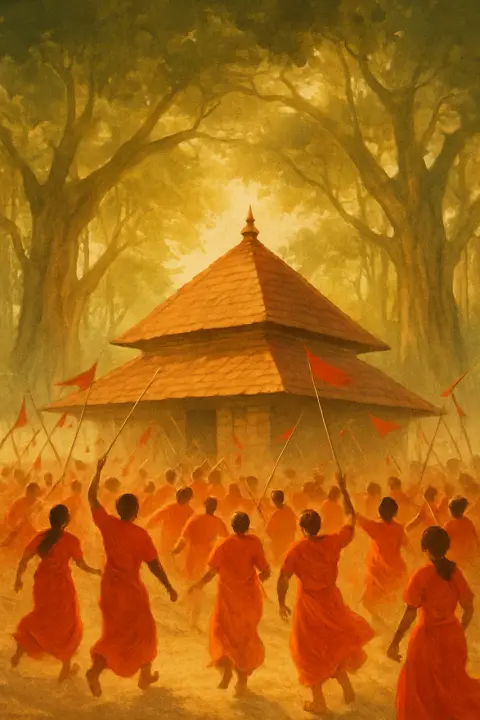
Kodungallur Bharani: a month of red, songs and oracles
A sea of red and songs no other temple would allow
Kodungallur Bharani is the month-long festival of the Sree Kurumba Bhagavathy temple in Kodungallur, Thrissur district, dedicated to the goddess Bhadrakali. It runs from the Bharani star in the Malayalam month of Kumbham to about a week after the Bharani star in Meenam, usually from late February into early April. The climax is the Kavu Theendal, the day before Meena Bharani, when oracles in red run around the temple. Dates: 13 March – 15 April 2027 (expected); Kavu Theendal: 8 April 2027 (expected).
The Cochin Devaswom Board and the police issue the notices for the festival about two months ahead.
The legend
Legend says the demon Daruka tormented the land, until fierce Bhadrakali sprang from Shiva's eyes and slew him.

Kodungallur worships her in this fierce form, eight-armed, one hand holding Daruka's head. She is Sri Kurumba, or Kodungallur Amma, the Mother of Kodungallur.
Another legend ties the temple to Kannaki, heroine of a Tamil epic, who burned Madurai in fury after her innocent husband was put to death.
One tradition says the Bharani songs recall how Shiva's host sang and danced to calm Kali's wrath after her victory over Daruka.
So on Aswathi day people in red circle the temple in song, and next morning the goddess, healed after the battle, is offered sweet payasam.
Meaning
Old communities
The festival is seen as a gathering of the old communities that held rights in the temple: Kudumbis, Pulayas, Arayas, Vishwakarmas and others have their own roles.
North Kerala
Most pilgrims come from northern Kerala: groups from Wayanad, Kannur, Kozhikode and Kasaragod walk the way, each led by its own oracle.
Customs
Flags on banyans
The temple has no flagstaff: banners hang on the gateways and the banyans around. The season opens as silk and a tali are offered to the goddess, a goldsmith's right.
Revathi Vilakku
On Revathi day tens of thousands come to the temple, the song of Daruka's slaying is sung, and at dusk the stone lamp is lit to announce Bhadrakali's victory.
The red umbrella
On Aswathi day the head of the Kodungallur royal house takes his seat on a platform, and a red silk umbrella is raised: the sign that the Kavu Theendal begins.
Kavu Theendal
Oracles in red silk, with swords, anklets and garlands, run three times round the temple, beat its copper roof sheets with bamboo, then sing and dance.
Pepper and turmeric
On the way pilgrims collect rice as alms from houses, and bring rice, millet, sesame, coconuts and, above all, black pepper and turmeric.
Seven quiet days
After the Kavu Theendal the temple stays shut for seven days. It reopens on Pooyam day, the goddess in full adornment, and the crowds return.
What people eat
Vari payasam
rice payasam with jaggery, coconut, banana and ghee
Words of the festival
ഭരണി
bharani
a lunar mansion; the festival runs from Bharani in Kumbham to Bharani in Meenam
കാവുതീണ്ടൽ
kavu theendal
the Aswathi day rite; theenduka means to defile
വെളിച്ചപ്പാട്
velichappadu
the goddess's oracle, in red, with sword and anklets
ഭരണിപ്പാട്ട്
bharanippattu
the Bharani songs; a group from Vallachira is the first to sing them
ചെമ്പട്ട്
chempattu
red silk, the colour of the goddess and her oracles
True or myth
✅ True. Instead, banners are hung on the gateways and on the banyan trees around the temple.
❌ Myth. Bharani day itself has no festivities: the goddess is offered payasam. The climax, Kavu Theendal, falls the day before, on Aswathi.
❌ Myth. Today hymns to the goddess such as Amme Narayana are heard most, and some pilgrims sing to her of their own hardships.
Where to celebrate
Kodungallur
For weeks groups led by oracles in red come to sing the Bharani songs to Kodungallur's goddess; on Aswathy day they run around her temple in the Kavu Theendal, and the shrine closes.
How the month runs
The season opens on Kumbha Bharani with a rite called Kozhikkallu moodal. It once involved the sacrifice of roosters over the stones around the shrine. Kerala law (the Kerala Animals and Birds Sacrifices Prohibition Act, 1968) bans the sacrifice of animals and birds at temples, and the rite has long been reduced to covering the stones with red silk.
For the next weeks groups of pilgrims arrive, many from northern Kerala, each led by its own oracle, the velichappadu, in red silk with a sword and anklets. They sing the Bharani songs (Bharani pattu) in the temple grounds. Some of these songs are deliberately bawdy, addressed to the goddess herself; many more are hymns, and some pilgrims sing of their own hardships.
The peak is the afternoon of Aswathy, the day before Meena Bharani. The head of the Kodungallur royal house takes his seat on a platform and a red silk umbrella is opened. The temple describes this as permission for people of every caste to enter the temple precincts. Then the Kavu Theendal begins: the oracles run three times around the temple, strike its roof with bamboo staves and throw offerings such as turmeric and coconuts into the inner courtyard, ritually 'defiling' it. Theenduka means to defile.
After this the temple closes for about a week of purification. Bharani day itself is quiet: the goddess is offered sweet payasam. When the temple reopens, she is shown in full adornment and the crowds return.
The temple and its goddess
Kerala Tourism calls the Sree Kurumba Bhagavathy temple one of the oldest in Kerala. Its image of Bhadrakali, carved from jackfruit wood, has eight arms; one holds the severed head of the demon Daruka. In legend Bhadrakali sprang from Shiva's eye to destroy Daruka. Another legend links the temple to Kannaki, heroine of the Tamil epic Silappadikaram, and says the Chera king Chenguttuvan built it in her honour.
The temple is the head of 64 Bhadrakali shrines (kavus) in Malabar, and has no flagstaff: festival banners hang on its gateways and the banyans around it. It was managed by the Kodungallur royal family until 1950 and is now run by the Cochin Devaswom Board. The Bharani season is seen as a gathering of the old communities that held rights in the temple, among them Kudumbis, Pulayas, Arayas and Vishwakarmas, each with its own role.
Etiquette and safety
Bharani is a living ritual, not a show staged for visitors, and it is not for everyone: the songs and the trance are the point.
- Inside the temple: Hindus only — The temple admits Hindus only. The grounds and streets around it, where the singing groups gather, are open to everyone.
- Ask before photographing oracles — Photographing the oracles is resented. Ask the temple administration first, and keep a respectful distance from anyone in trance.
- Dress modestly — The UK Foreign Office (FCDO) advises respecting local dress codes, particularly at religious sites.
- Crowds on Kavu Theendal — Kavu Theendal draws dense crowds into the temple grounds. FCDO notes that stampedes have occurred at events with large crowds in India: follow police instructions, keep to the edge of the crowd and watch your belongings.
Plan your visit
Kodungallur is a small town with few rooms. No tickets are needed.
- Stay in Kochi or Thrissur
Thrissur is about 35 km away, as is Kochi airport. Book about a month ahead. See how to get to Kochi.
- Getting there
The nearest railway stations are Irinjalakuda (about 20 km) and Thrissur (about 35 km); Kochi airport is about 35 km away.
- Arrive on the morning of Kavu Theendal
One night nearby is enough to be in Kodungallur by morning; a second night lets you see the quiet Bharani day that follows.
- Watch for the official notices
The dates follow the Malayalam calendar. The Cochin Devaswom Board and the police issue the festival notices about two months ahead.
FAQ
When is Kodungallur Bharani?
Next: 13 March – 15 April 2027 (expected), with the Kavu Theendal on 8 April 2027 (expected). The festival follows the Malayalam calendar, so the dates move each year, usually between late February and early April.
What is the story behind Kodungallur Bharani?
In legend the goddess Bhadrakali killed the demon Daruka, and the Bharani songs recall how Shiva's host sang and danced to calm her afterwards. Another legend links the temple to Kannaki of the Tamil epic Silappadikaram.
What is Kavu Theendal?
The climax of the festival, on Aswathy day before Meena Bharani: after the red umbrella is raised, oracles in red run three times around the temple, strike its roof and throw offerings into the courtyard. The temple then closes for about a week.
Can non-Hindus attend?
The temple itself admits Hindus only, but the grounds and streets around it, where the singing groups gather, are open to all.
Where should I stay for Kodungallur Bharani?
In Kochi or Thrissur (Thrissur is about 35 km away); Kodungallur itself has few rooms. Book about a month ahead.
What is Kodungallur famous for?
Above all for the Sree Kurumba Bhagavathy temple, one of the oldest in Kerala, and its Bharani festival. The temple also holds the four-day Thalappoli festival in the month of Makaram.
Sources (7)
- Kerala Tourism: Kodungalloor Kaavutheendal and Bharani
- Kodungallur Sree Kurumba Bhagavathy Temple: Festivals
- Kodungallur Bharani festival
- Kodungallur Sree Kurumba Bhagavathy Temple
- FCDO: India, safety and security
- India Code: The Kerala Animals and Birds Sacrifices Prohibition Act, 1968
- Kerala Kaumudi: chicken sacrificed at Kodungallur temple in violation of ban, two held
Facts checked: 21 October 2026. Prices and hours are approximate; check locally.