 India GO
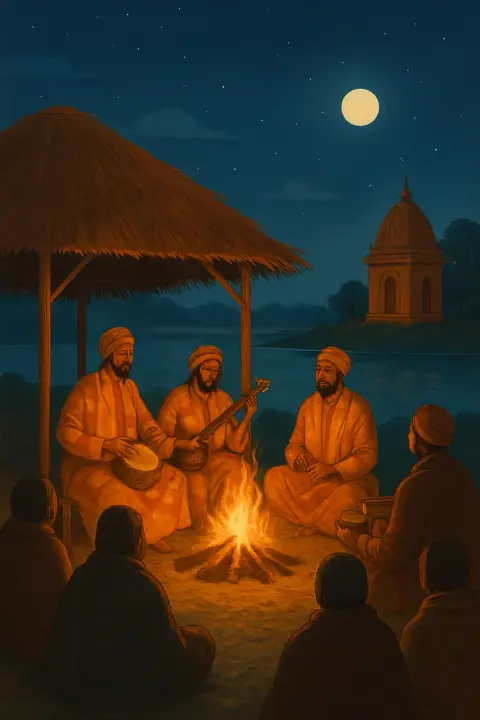
Joydeb Kenduli Mela: the Baul fair on the Ajay
Baul songs around riverside fires until the winter dawn
Joydeb Kenduli Mela is the largest yearly gathering of Bauls, the wandering singer-mystics of Bengal, held at Kenduli village on the Ajay river in Birbhum district, West Bengal. Dates: 14–16 January 2027 (expected). It is held at Poush Sankranti, or Makar Sankranti, and runs about three days, from the last day of the Bengali month of Poush to 2 Magh. The music happens in the akharas, riverside camps where singers sit around fires through the night, and visitors may sit and listen.
The Bengali almanac fixes the bath; the Birbhum district administration and the mela committee announce the fair days in December.
The legend

Kenduli is held to be the birthplace of Jayadeva, the 12th-century poet of the Gita Govinda, the poem of Krishna's love for Radha.

The fair recalls the day Jayadeva is said to have bathed in the Ajay river. It may have been held for some 800 years.
At Makar Sankranti thousands of Bauls, the wandering singer-mystics of Bengal, gather here, seen as heirs to Jayadeva's songs.
Customs
Songs in the akharas
The Bauls stay in temporary akharas on the bank and sing round the fires through the night to the one-stringed ektara.
Bathing in the Ajay
At dawn on Sankranti people bathe in the Ajay river, as Jayadeva once did.
Radhabinod temple
In the village stands the terracotta Radhabinod temple of 1683, where the poet's house is locally believed to have stood.
Where to celebrate
Kenduli
On the Ajay riverbank at Kenduli, Baul and Vaishnav singers gather in hundreds of akharas from Makar Sankranti and sing around fires through the night.
Bauls and Jayadeva
Kenduli is a village in the Illambazar block of Birbhum, on the bank of the Ajay. It is held to be the birthplace of Jayadeva, the 12th-century poet of the Gita Govinda, who is believed to have been a court poet of the Sena king Lakshmana Sena. Scholars still debate this: Kenduli Sasan in Odisha also claims him. The fair recalls the day Jayadeva is said to have bathed in the Ajay at Makar Sankranti.
The Bauls who gather here are mystic minstrels of rural West Bengal and Bangladesh. UNESCO, which inscribed Baul songs on its list of the Intangible Cultural Heritage of Humanity in 2008 (for Bangladesh), describes them as standing apart from organised religion, caste, special deities and temples, and seeing the human body as the place where God resides; their tradition draws on Vaishnavism and Sufi Islam among others. They sing to the one-stringed ektara, the dotara lute and a small drum, the dubki. Alongside them come Vaishnav kirtan singers, who by a 2008 account had come to outnumber the Bauls.
How the fair runs
At dawn on Makar Sankranti pilgrims bathe in the Ajay and then offer worship at the Radhabinod temple, a custom described as very old. The busiest singing comes on the night between the first and second days.
The akharas are the heart of it. Some are permanent ashrams of Vaishnav and Baul orders, others are temporary camps put up along the bank for the fair; at a recent edition there were about 175 permanent and some 350 temporary ones. Each has its own circle of singers around a fire, and some Bauls stay on for weeks. By day the fair itself spreads along the bank, with stalls selling everything from cooking pots to fishing nets. Since 1982 the fair has been managed by the district authorities, and at a recent edition about 3,000 police were deployed.
The Radhabinod temple
The village's landmark is the Radhabinod temple, built in 1683 by the rulers of Bardhaman (by one account Maharani Brajakishori, at the request of the court poet Jugal Kishore Mukhopadhyay), on the spot where Jayadeva's house is locally believed to have stood. It is a navaratna temple with nine turrets, and its terracotta panels include scenes from the Ramayana. The village grew into a religious centre after the Nirbak ashram was founded around 1860–70, and many more ashrams followed.
Sitting in an akhara
The singing is the Bauls' own practice, which visitors are allowed to join as listeners, not a concert staged for them.
- Sit at the edge — Sit quietly at the edge of the circle and wait to be invited closer.
- Leave an offering — A small offering to the camp is customary.
- Ask before filming — Ask before photographing or recording singers, especially at night by the fire.
- Bathing in the Ajay — If you join the dawn bath, stay where others bathe: the UK Foreign Office warns of strong currents in Indian rivers.
- Crowds — Expect very large crowds on the bathing morning. Agree a meeting point; the emergency number is 112, more in emergency numbers in India.
How to reach Kenduli and where to stay
There is almost no accommodation in Kenduli itself; pilgrims camp. The practical base is Bolpur or Santiniketan, 30–40 km away by road, the same as from Durgapur. Book rooms there about six weeks ahead. Trains from Howrah to Bolpur go on sale 60 days before travel and are worth buying as soon as they open. For the full night of singing, plan to arrive on the morning of Makar Sankranti and stay one or two nights nearby.
Two other festivals fall close by in the calendar. Poush Mela in Santiniketan starts on 7 Poush, a few weeks earlier, and Gangasagar Mela takes place on the same Sankranti at the mouth of the Hooghly, so you have to choose between the two. More on the day itself: Makar Sankranti.
FAQ
When is Kenduli Mela?
Next: 14–16 January 2027 (expected). It runs about three days around the Makar Sankranti bath, from the last day of Poush to 2 Magh; the district administration and the mela committee announce the days in December.
Where is Joydev Mela?
At Kenduli village in the Illambazar block of Birbhum district, West Bengal, on the bank of the Ajay river.
How to reach Joydev Kenduli Mela?
Take a train from Howrah to Bolpur, then go 30–40 km by road; Santiniketan and Durgapur are at a similar distance.
Where can I stay for Kenduli Mela?
In Bolpur or Santiniketan; Kenduli has almost no rooms. Book about six weeks ahead.
Can visitors join the akharas?
Yes, as listeners. Sit quietly at the edge, wait to be invited closer, and leave a small offering to the camp.
Who was Jayadeva?
A 12th-century Sanskrit poet, author of the Gita Govinda, the poem of Krishna and Radha. Kenduli is held to be his birthplace, though a village in Odisha makes the same claim.
Sources (6)
Facts checked: 21 October 2026. Prices and hours are approximate; check locally.