 India GO
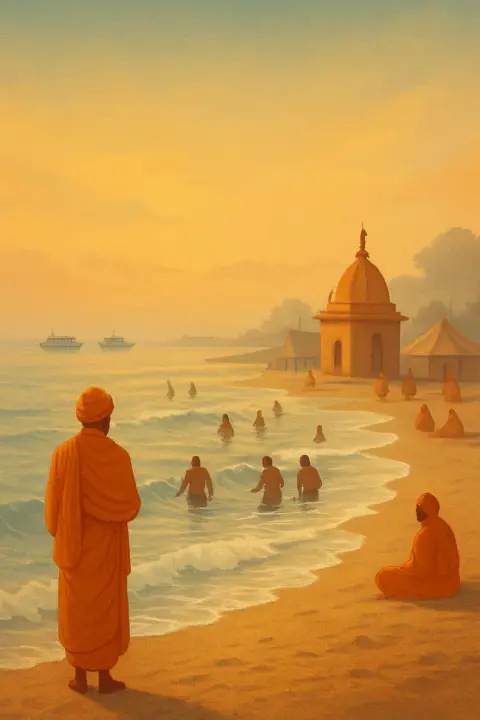
Gangasagar Mela: crossing to Sagar Island for the Makar Sankranti dip
A boat across the estuary to bathe where the Ganga meets the sea
Gangasagar Mela is the pilgrimage to the southern tip of Sagar Island, in West Bengal’s South 24 Parganas district, where the Hooghly, the last stretch of the Ganga, meets the Bay of Bengal. The holy dip is on Makar Sankranti, 14 or 15 January, and the fair runs for about a week around it; it is described as the second largest Hindu fair after the Kumbh Mela. Next fair: 10–16 January 2027 (expected). The island is reached only by boat, and the crossing shapes the whole trip.
The South 24 Parganas district administration announces the fair dates and the auspicious bathing hours in December.
The legend
King Sagara's sacred horse goes missing. In the legend the god Indra hides it in the underworld, where the sage Kapila sits in meditation.
Sagara's sixty thousand sons find the horse and disturb the sage with their noise. Kapila's fiery gaze turns them to ash.
Sagara's descendant, King Bhagiratha, prays for the Ganga to come down to earth. Shiva catches the falling river in his matted hair.

The Ganga reaches the sea, washes over the ashes and frees the souls of Sagara's sons. The sea has been called sagara ever since, after the king.

The place where Kapila meditated is identified with Sagar Island. So on Makar Sankranti pilgrims bathe here, then go on to the Kapil Muni temple.
Meaning
Mahabharata
In the Mahabharata the Pandavas reach the Gangasagara-sangama, the meeting of the Ganga and the sea; the site is still understood that way.
A solar date
Sankranti is the day the Sun enters Capricorn, so the date barely moves: usually 14 January, and 15 January in a leap year.
Customs
The holy dip
From early morning pilgrims step into the water where the Hooghly meets the Bay of Bengal and make offerings to the Sun with the Surya mantra.
A lamp for Kapila
After bathing, people pray to the sage Kapila at the temple by the shore and light a lamp of ghee.
The crossing
Pilgrims reach the island by vessel across the Muriganga channel. It is dredged every year, and crossings are timed to the tide.
Sadhus from the hills
Sadhus who live in the Himalayas come down to the fair, and for a few days the shore becomes their camp.
Pilgrim's certificate
The district administration hands pilgrims a certificate with their photo and a greeting from the state government.
Words of the festival
গঙ্গাসাগর
Gangasagar
"the Ganga and the sea": where the river meets the Bay of Bengal
সাগরদ্বীপ
Sagardwip
the Bengali name of Sagar Island, at whose southern tip the fair is held
পৌষ সংক্রান্তি
Poush Sankranti
the Bengali name for Makar Sankranti, the day of the main dip
তীর্থস্নান
tirthasnan
a bath at a holy site, the reason for the journey to the island
কপিল মুনি
Kapil Muni
the sage held to be the founder of Samkhya philosophy; his temple is the heart of the fair
True or myth
✅ True. The saying dates from medieval times, when the way to the island through the mangrove creeks was long and hard.
❌ Myth. Earlier temples were lost to the sea and the bamboo one to cyclones; the first brick temple dates from 1961, the present one from 1974.
✅ True. It is described as the second largest Hindu fair after the Kumbh Mela.
Where to celebrate
Sagar Island
At the mouth of the Hooghly, pilgrims cross by boat to Sagar Island to bathe where the Ganga meets the sea on Makar Sankranti, then pray at the Kapil Muni temple.
The dip and the temple
From early morning pilgrims walk into the sea at the Gangasagar point, make offerings to the Sun with the Surya mantra, then go on to the Kapil Muni temple just behind the beach to pray to the sage Kapila and light a lamp of ghee. In legend Kapila meditated here, and the Ganga, brought down by King Bhagiratha, reached the sea at this spot to free the souls of King Sagara’s sons; the story is told above. The auspicious bathing window is set by the almanac and can run from one day into the next. The South 24 Parganas district administration announces the fair dates and the bathing hours in December.
Around the dip the shore becomes a fair. Sadhus from the Himalayas camp on the beach, and an evening Sagar aarti is held on the beach in the days before Sankranti. The beach and the temple are open to all with no entry ticket.
An old and difficult pilgrimage
The Mahabharata describes the Pandavas reaching the Gangasagara-sangama, the meeting of the Ganga and the sea, and the site is still understood that way; Kalidasa’s Raghuvamsha mentions the pilgrimage too. In medieval times the way through the mangrove creeks was long and dangerous, with tigers, pirates and disease, which gave Bengal the saying ‘all pilgrimages again and again, Gangasagar just once’. The sea took earlier temples; the present Kapil Muni temple was completed in 1974 with help from the West Bengal government.
Getting there: Kolkata, bus, vessel, road
The crossing is the bottleneck, not the island, and it depends on the tide, so arrive at least a day before Sankranti. A 4.8 km bridge, the Gangasagar Setu, is being built between Kakdwip and Kachuberia and will one day replace the ferry.
- Kolkata
Most pilgrims start in Kolkata, where transit camps are set up at Babu Ghat and Outram Ghat. Take long-distance trains to Kolkata as soon as sales open, 60 days out. See getting to Kolkata.
- Bus or local train to the jetty
Buses run from Babu Ghat, Outram Ghat or Howrah to Lot 8 (about 95 km) or Namkhana (about 109 km); suburban trains go to Kakdwip and Namkhana. This leg is paid on the day.
- The vessel across the Muriganga
From Lot 8 vessels cross to Kachuberia, 30–45 minutes in normal times; from Namkhana they cross to Chemaguri. The channel is shallow and dredged every year, crossings follow the tide, and that is why timings slip and queues build at the jetties.
- The road to the beach
From Kachuberia it is about 30 km by road to the Gangasagar point.
Where to stay
The island has few permanent rooms, among them West Bengal Tourism’s lodge at Gangasagar. Most pilgrims stay in government or trust tent camps booked ahead, or make a very long day trip from Kolkata. Book a tent or a room about two months ahead. A night on the island before the dip, and another after it, saves you from joining the return queue at its peak.
Crowds, safety and help on the ground
The fair is one of the largest pilgrim gatherings in India, and the district administration runs it as a large operation. In an emergency call 112. See also is India safe and emergency numbers.
- Control room and helpline — In recent editions the administration has run a central control room watching the fair through CCTV cameras and drones, tracked every vessel by GPS and linked a central helpline to its site, gangasagar.in.
- QR wristbands — Waterproof wristbands with a QR code link the wearer to family details, so that lost children and elderly pilgrims can be reunited. Ask for them for children and elderly companions.
- Pilgrim’s certificate — The district administration gives pilgrims a certificate with their photo and a greeting from the state government.
- Crowds and the sea — The FCDO notes that stampedes have occurred at large religious gatherings and that there are strong currents in rivers and off many coasts, where people drown every year. Bathe near the shore where others bathe, follow police directions and agree a meeting point with your group.
- January weather — Kolkata averages about 14°C at night and 26°C by day in January; bring a warm layer for the crossing.
FAQ
When is Gangasagar Mela?
Around Makar Sankranti, 14 or 15 January, for about a week: 10–16 January 2027 (expected). The main dip is on Sankranti itself.
Where is the Gangasagar Mela held?
At the southern tip of Sagar Island (Sagardwip), in the South 24 Parganas district of West Bengal, where the Hooghly meets the Bay of Bengal.
Why is Gangasagar Mela celebrated?
A dip at the meeting of the Ganga and the sea on Makar Sankranti is believed to cleanse sins. In legend this is where the Ganga freed the souls of King Sagara’s sons, near the sage Kapila’s hermitage.
How long does the Gangasagar Mela last?
About a week around Makar Sankranti; most pilgrims spend one or two nights on or near the island.
How do you reach Gangasagar from Kolkata?
By bus or local train to Lot 8 or Namkhana, then by vessel across the Muriganga to Kachuberia or Chemaguri, then about 30 km by road to the beach. The crossing depends on the tide.
Is there an entry fee?
No. The beach and the Kapil Muni temple are open to all without a ticket; you pay only for transport and accommodation.
Sources (5)
Facts checked: 21 October 2026. Prices and hours are approximate; check locally.