 India GO
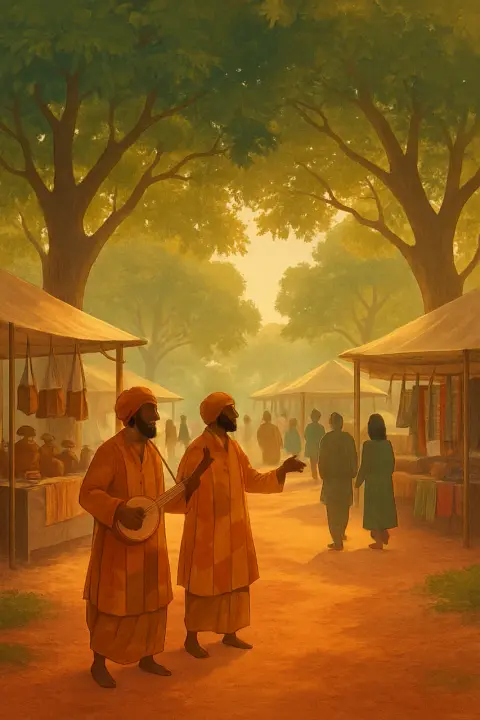
Poush Mela, Santiniketan: Baul songs and Birbhum crafts in midwinter
Baul songs drifting over craft stalls on Birbhum's red earth in midwinter
Poush Mela is the winter fair of Santiniketan, Rabindranath Tagore's university town in West Bengal's Birbhum district. It opens on the 7th day of Poush in the Bengali calendar, in late December, with songs at dawn and a prayer under the trees at Chhatimtala, then fills the Purbapalli ground with craft and food stalls and Baul singing. Dates: 23–28 December 2026 (expected); Visva-Bharati confirms the dates and the ground in November.
Visva-Bharati and the Santiniketan Trust announce the dates and the ground in November.
The legend

On 21 December 1843, the 7th of Poush, Debendranath Tagore and twenty followers accepted the Brahmo creed. That day became the basis of the Poush Utsav.

On the same date in 1891 a Brahmo temple opened at Santiniketan, and in 1894 a small fair was held on the field opposite to mark its anniversary.
It has been held every year since, in the harvest season. It outgrew its homely beginnings and moved to the large Purbapalli field.
Customs
Dawn at Chhatimtala
The fair opens at dawn with songs around the ashram and a Brahmo prayer under the trees at Chhatimtala.
Bauls and kirtan
Around the edges of the ground Bauls sing day and night, alongside kirtan and kobigan, the sung duels of Bengali poets.
Birbhum crafts
Makers from Birbhum and across Bengal sell kantha embroidery, dokra metal casting, batik and leatherwork.
Words of the festival
পৌষ মেলা
Poush Mela
"The fair of Poush", a winter month of the Bengali calendar; it opens on the seventh day.
Where to celebrate
Santiniketan
For six days from 7 Poush, Santiniketan's Purbapally ground fills with Birbhum crafts, food stalls and Baul singing; the fair opens at dawn with songs round the ashram and a prayer at Chhatimtala.
What you see at the fair
The first morning. At dawn on 7 Poush the Vaitalik singers go round the ashram, and a Brahmo prayer is held at Chhatimtala, under the chhatim trees where Debendranath Tagore meditated. This is a service, not a show: watch quietly from the side.
The fairground. The fair itself is on the Purbapalli ground (also written Purbapally), free to enter by day and night. Makers from Birbhum and across Bengal sell kantha embroidery, dokra metal casting, batik and leatherwork, alongside rows of food stalls. Encyclopedia figures put it at about 1,500 stalls.
The music. Folk music runs through the fair: Baul songs above all, with kirtan (devotional singing) and kobigan, the sung duels of Bengali poets. Beyond the stage programme, Baul singers sit in their own circles round the edges of the ground late into the night. Leaving a few rupees or buying a recording is the custom; ask before filming close up.
Officially the fair lasts three days, the 7th, 8th and 9th of Poush, but vendors stay longer, and in recent years it has run for about six days. The opening two days are the busiest.
From a Brahmo anniversary to a fair for all Bengal
On 21 December 1843, the 7th of Poush, Debendranath Tagore, the poet's father, and about twenty followers accepted the Brahmo creed. When he drew up the Santiniketan Trust Deed in 1888, it provided for a fair on that date. The glass-walled Brahmo temple, the Upasana Griha, was consecrated on 7 Poush 1891, and the fair grew up on the field north of it: Visva-Bharati dates its formal start to 1892, the encyclopedia to 1894. As it grew it moved to the larger field at Purbapalli.
The fair has been held almost every year since. It was not held during the Bengal famine of 1943, after Direct Action Day in 1946 and during the COVID-19 pandemic, and after a further break of several years it has returned to the Purbapalli ground.
Getting there and where to stay
Santiniketan is an easy trip from Kolkata, but the fair falls in the Christmas holidays, the busiest days for visitors from the city, so both trains and rooms run out.
- Book about two months ahead
Guesthouses in Bolpur and Santiniketan fill weeks before the fair. Trains from Howrah to Bolpur fill too, so book when the 60-day reservation window opens; Eastern Railway has run a special Howrah–Bolpur train for the fair days before.
- Take the train to Bolpur
Bolpur Santiniketan station is on the line from Howrah, about two and a half hours by express. From the station a toto (e-rickshaw) takes you to the ground.
- Arrive the day before
To be at Chhatimtala for the dawn prayer on the first morning, come the evening before. Two nights cover the opening days; a third gives you another evening with the Bauls.
Two more Birbhum gatherings
Poush Mela pairs with two other gatherings in the district: the Joydeb Kenduli Mela, a fair of Baul singers, and Basanta Utsav, Santiniketan's spring festival.
FAQ
When is Poush Mela in Santiniketan?
Next: 23–28 December 2026 (expected). It opens on the 7th day of Poush in the Bengali calendar, in late December; Visva-Bharati confirms the dates in November.
How many days does Poush Mela last?
Officially three days, from 7 to 9 Poush, but stalls stay on and in recent years the fair has run for about six days.
Is there an entry fee for Poush Mela?
No. The fairground is free to enter, day and night.
Why is Poush Mela celebrated?
It marks 7 Poush, the day in 1843 when Debendranath Tagore accepted the Brahmo creed, and the anniversary of Santiniketan's Brahmo temple, consecrated on the same date in 1891. It is also a harvest-season fair.
How do I get to Poush Mela from Kolkata?
By train from Howrah to Bolpur Santiniketan, about two and a half hours by express, then a toto to the ground. Book when the 60-day window opens.
Facts checked: 21 October 2026. Prices and hours are approximate; check locally.