Jhanda Ji Mela: the flag that gave Dehradun its name
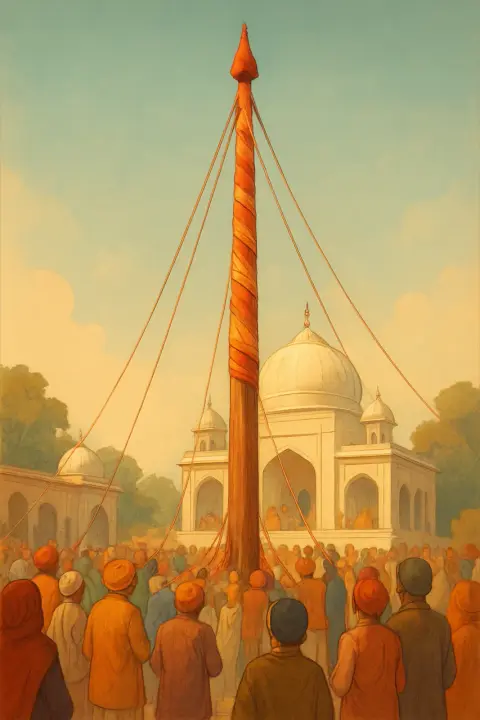
A towering flagstaff dressed in new cloth and raised again before the crowd
Jhanda Ji Mela is Dehradun's oldest fair: on the fifth day after Holi a new flag, the Jhanda Ji, is raised on a tall wooden mast at Shri Guru Ram Rai Darbar Sahib, the shrine the city grew around, and a fair fills the precinct for about three weeks, until Ram Navami. Dates: 27 March – 15 April 2027 (expected). The flag-hoisting day is the one to aim for; the Darbar Sahib and the district administration confirm it a few weeks ahead.
Countdown27 March – 15 April 2027
When27 March – 15 April 2027
The mela marks the arrival of Baba Ram Rai in the Doon valley and is centred on the ceremonial re-clothing and re-hoisting of the Jhanda Ji, the sacred flag, at Shri Guru Ram Rai Darbar Sahib. It draws devotees from Uttarakhand, Punjab, Haryana and western Uttar Pradesh and is one of Dehradun's oldest institutions.
The dates follow Holi and the lunar calendar; the Darbar Sahib management and the Dehradun district administration announce the flag-hoisting day a few weeks ahead.
The legend
👑
Ram Rai is the eldest son of Guru Har Rai, the seventh Sikh Guru. His father sends him to explain himself at the court of Emperor Aurangzeb.
There Ram Rai alters words of a scripture verse so as not to offend the emperor. His father disowns him and makes his younger son, Har Krishan, heir.
⛺
In 1675 Ram Rai arrives in the Doon valley. The Raja of Garhwal grants him seven villages, and Ram Rai sets up his camp, his dera, here.
"The Dera of Guru Ram Rai in the Doon" was gradually shortened to "Dehradun": that, it is believed, is how the city got its name.
🚩
In memory of his arrival, it is believed since 1676, a new flag, the Jhanda Ji, is raised at the Darbar on the fifth day after Holi.
Meaning
Udasis
The flag ceremony is closely tied to the Udasin community: Ram Rai founded a following counted among the Udasis.
Customs
Bathing the mast
The old flag is lowered, and the wooden mast is bathed in milk, curd and Ganga water and wrapped in cloth again.
Three coverings
First 41 layers of plain cloth, then 21 layers of velvet, and on top the ornate darshani gilaf.
Raised by many hands
Pilgrims stand in rows and together raise a mast some 30 metres tall.
Scarves of wishes
Many scarves are tied around the mast as pilgrims pray for their wishes to come true.
Langar
The Darbar's community kitchen has fed all comers for over 300 years, and during the fair several more langars open.
Welcome at the Yamuna
Pilgrims come from Punjab and Haryana; the mahant goes out to welcome them on the Yamuna bank at Raianwala, 45 km from the city.
Words of the festival
झंडा
jhanda
"flag"; ji is an honorific added to names and titles
डेरा
dera
"camp"; believed to be the first half of the name Dehradun
संगत
sangat
company, community; the name for pilgrim groups at the fair
महंत
mahant
the head of the Darbar, who leads the fair's rites
लंगर
langar
a free communal meal where all cook and eat together
True or myth
The Sikh guru's shrine in Dehradun looks like a mosque.
✅ True. The Darbar has minarets, domes and a Mughal-style garden, and its central tomb was modelled on Jahangir's.
The top covering of the flag is booked decades in advance.
✅ True. In 2009 the velvet cover for the top of the mast was booked in advance up to the year 2075.
The Jhanda Ji mast has been the same trunk for centuries.
❌ Myth. The wooden mast is replaced every three years and usually comes from the nearby Dhudli forests.
How the flag day runs
The whole ceremony takes one day, led by the mahant, the head of the Darbar.
The old flag comes down
The mast is lowered and the old coverings are removed.
The mast is bathed
The wooden mast is bathed in milk, curd and Ganga water.
Three coverings
It is wrapped again: first 41 layers of plain cloth, then 21 layers of velvet, and on top the ornate darshani gilaf. The top covering is offered by devotees and booked many years in advance.
Raised by many hands
Pilgrims stand in rows and together raise the mast, about 30 metres tall, back to upright. Many tie scarves to it as they pray for a wish.
The fair
After the flag is up, the fair runs in the precinct for weeks, and the Darbar's langar, the free community kitchen that has fed all comers for over 300 years, is joined by several more.
Guru Ram Rai and the camp in the Doon
Ram Rai was the eldest son of Guru Har Rai, the seventh Sikh Guru. Sent to the court of the emperor Aurangzeb, he altered the words of a scripture verse so as not to offend the emperor; his father disowned him and named the younger son, Har Krishan, as heir. Ram Rai came to the Doon valley in the 1670s, the Raja of Garhwal granted him villages, and he pitched his dera, his camp, there. "The dera in the Doon" is believed to be how the city got its name.
The Ministry of Tourism's festival portal gives the origin of the fair: the fifth day of Chaitra, the fifth day from Holi, is Guru Ram Rai's birthday and the day of his arrival in the Doon, and since Samvat 1733 (1676 AD) the Jhanda Ji has been hoisted on that day. The Darbar holding his tomb was built around the turn of the 18th century under the supervision of his wife, Mata Punjab Kaur; its central tomb was modelled on Jahangir's, and the shrine is linked to the Udasi tradition. Pilgrims come from Punjab, Haryana, Delhi and Uttar Pradesh, some on foot, and on Ekadashi before the flag day the mahant goes to the Yamuna bank at Raianwala, about 45 km away, to welcome the sangat, the pilgrim groups.
Visiting the Darbar during the mela
The Darbar Sahib is in Jhanda Mohalla in the old city; details are on the Guru Ram Rai Darbar Sahib page, and the city guide is on Dehradun.
Dress — Head covered, modest clothes, shoes off at the entrance.
Langar is for everyone — The community meals are free and open to all; sit where you are shown and eat what is served.
Traffic on flag day — Police close the roads around the Darbar Sahib on the hoisting day and issue a diversion plan; come on foot for the last stretch.
Come early — The mast is lowered and dressed over several hours and raised again later in the day; the courtyard fills well before.
FAQ
When is Jhanda Ji Mela?
27 March – 15 April 2027 (expected). It begins on Rang Panchami, the fifth day after Holi, with the flag hoisting, and runs for about three weeks to Ram Navami.
How long does the Jhanda Mela last?
About three weeks: from the flag day five days after Holi until Ram Navami.
What is the Jhanda Ji?
The sacred flag of Shri Guru Ram Rai Darbar Sahib, raised every year on a wooden mast about 30 metres tall; jhanda means flag, and ji is an honorific.
Why is the fair connected with the name Dehradun?
Guru Ram Rai set up his dera, his camp, in the Doon valley in the 1670s, and the fair marks his arrival; the city's name is believed to come from that camp.
Can anyone attend Jhanda Ji Mela?
Yes. The Darbar and its langar are open to all; cover your head, dress modestly and take off your shoes at the entrance.
 India GO