 India GO
Jagaddhatri Puja in Chandannagar
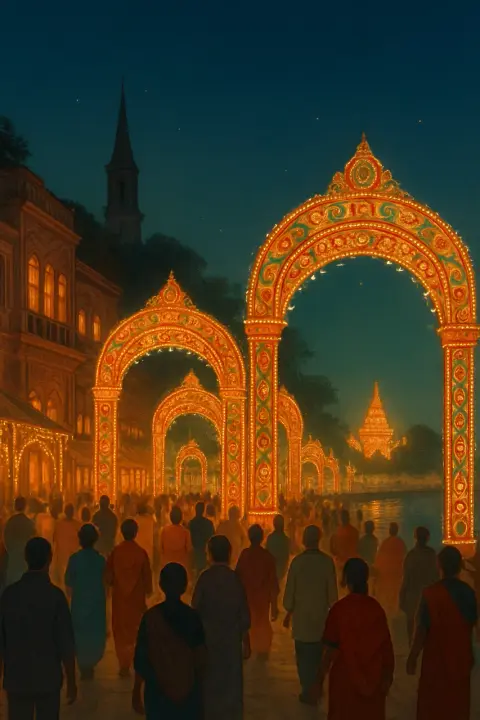
Towering goddesses carried to the river through streets of moving light
Jagaddhatri Puja is the autumn festival of the goddess Jagaddhatri, "she who upholds the world", and Chandannagar, a former French town on the Hooghly about an hour from Kolkata, holds its best-known celebration. Dates: 15–20 November 2026 (expected), with Navami, the main day, on 19 November 2026 (expected). It comes about a month after Durga Puja. The reasons to go are the tall neighbourhood images, the light installations made by the town's own workshops, and the immersion procession on the last night.
The Chandannagar Central Jagaddhatri Puja Committee announces the days and the procession route about a month ahead; the Hooghly district police publish the traffic plan in the week before.
The legend
Jagaddhatri, the goddess who upholds the world, rides a lion. She is seen as a combined form of Bhuvaneshwari and Durga, and her worship draws on Tantra.
Legend says Raja Krishnachandra of Krishnanagar missed Durga Puja while held by the Nawab, and the goddess appeared to him in a vision to console him.
She is worshipped in the bright half of Kartik, above all on Navami, about a month after Durga Puja. The puja itself is far older than Krishnachandra.
Customs
A town of lights
From Panchami to Dashami Chandannagar and neighbouring Bhadreswar glow with lights made by local craftsmen, whose work goes to festivals all over India.
Neighbourhood pandals
Neighbourhoods raise tall images of the goddess, and the older barowari pujas keep a distinct local form.
The procession night
On Dashami night the images are carried to the Hooghly under the town's lights; the procession runs from evening into the small hours.
Where to celebrate
Chandannagar
In the old French town on the Hooghly, neighbourhood pujas raise towering images of Jagaddhatri, and on Dashami night their immersion procession crosses the town under Chandannagar's own lights.
Who Jagaddhatri is
Jagaddhatri rides a lion and is seen as a combined form of Bhuvaneshwari and Durga; her worship draws on Tantra. In images she holds a discus, a bow, arrows and a conch. Her puja falls in the bright half of the month of Kartik, from Saptami or earlier, with the main worship on Navami, the ninth lunar day.
The best-known legend of her puja in Bengal is set at Krishnanagar: Maharaja Krishnachandra, jailed by the Nawab Alivardi Khan over late taxes, missed Durga Puja, and the goddess appeared to him in a vision, after which he began her worship. Local historians note that she was worshipped in Nadia even earlier. Krishnanagar still keeps a large Jagaddhatri Puja of its own, with more than 200 club and barowari (community) pujas; its Chasa Para "Burima" puja is said to date from 1772. Krishnanagar and Chandannagar are the best-known centres of the festival in West Bengal.
Why Chandannagar
Chandannagar was a French settlement from 1696 and part of French India until 1950, when India took de facto control; the formal transfer followed in 1952, and in 1954 the town became part of West Bengal. The festival plays out against this past: the Strand, a tree-shaded riverside promenade about 700 metres long, the clock tower of the old Fort d'Orleans buildings and the Sacred Heart Church, inaugurated in 1884.
The town's other claim is light. Chandannagar's lighting artisans, centred in the Bidyalanka area, pioneered the illuminated panels and moving light displays now seen across Bengal's pujas, and their work goes to festivals elsewhere in India and abroad. At Jagaddhatri Puja they light their own streets, often with topical themes; one recent edition took India's space missions as its subject.
What you see over the five days
The puja runs four to six days, from Shashthi to Dashami. At a recent edition the Central Jagaddhatri Puja Committee counted about 180 pujas, 133 in Chandannagar and 47 in neighbouring Bhadreswar. Many are tall neighbourhood images. By day you can walk between pandals; the light installations are the thing to see after dark, every evening of the puja.
The last night is the shobhajatra, the immersion procession. It sets out on Dashami night and runs until dawn towards the Hooghly, on a route fixed by the committee and the police; about 70 pujas took part at a recent edition, each with its own lit floats. By the committee's rule there are no firecrackers or DJ sound systems. Watching from the roadside along the route is free.
How to plan the trip
Chandannagar is easy as a long evening from Kolkata, but the procession night is better with a room in town.
- Pick your evenings
Come by Navami for the lights, and stay for Dashami night if you want the procession. Two nights cover both.
- Take the local train
Chandannagar station is on the Howrah–Bardhaman main line, about 33 km from Howrah; local trains take about 50–55 minutes, run frequently and need no booking. By road the town is about 37 km from Kolkata along the Grand Trunk Road.
- Book rooms early
Rooms in Chandannagar are few: book about six weeks ahead, or base yourself in Kolkata.
- Long-distance trains
If you are coming to Kolkata from elsewhere in India, book early: the puja falls in the same days as Chhath Puja, when trains in eastern India are packed.
- Check the route
The Central Jagaddhatri Puja Committee announces the days and the procession arrangements before the puja; check local news for the route and traffic restrictions.
Crowds and safety
Procession night brings very large crowds into narrow streets.
- Choose your spot early — Find a place along the route before the procession starts and keep to the side the police leave open.
- Mind the crowd — The UK Foreign Office notes that stampedes have occurred at large religious gatherings in India. Agree a meeting point with your group and keep away from the thickest crush.
- Emergency number — 112 works across India. More in emergency numbers in India.
Combine with other Bengal festivals
Jagaddhatri Puja closes Bengal's autumn festival run: Durga Puja in Kolkata comes about a month earlier and Kali Puja, on the night of Diwali, about ten days before. Krishnanagar holds its own Jagaddhatri Puja on the same days.
FAQ
When is Jagaddhatri Puja in Chandannagar?
Next: 15–20 November 2026 (expected), with Navami on 19 November 2026 (expected). The dates follow the lunar calendar; the Central Jagaddhatri Puja Committee confirms them before the puja.
What is the meaning of Jagaddhatri?
"She who upholds the world": a goddess riding a lion, seen as a combined form of Bhuvaneshwari and Durga.
Why is Chandannagar famous for Jagaddhatri Puja?
For its tall images, its all-night immersion procession and its lights: the town's artisans pioneered the illuminated displays now used at pujas across Bengal.
How do I get to Chandannagar from Kolkata?
By local train from Howrah on the Bardhaman main line, about 50–55 minutes, with frequent trains and no booking needed. By road it is about 37 km.
Is it the world's second largest procession?
The Chandannagar procession is often described that way, after the carnival in Rio de Janeiro, but there is no official count behind the claim. It runs through the night, from Dashami until dawn.
Is it worth going for one evening?
Yes. Any evening of the puja shows the pandals and the lights; stay overnight only if you want the Dashami procession.
Sources (6)
Facts checked: 21 October 2026. Prices and hours are approximate; check locally.