 India GO
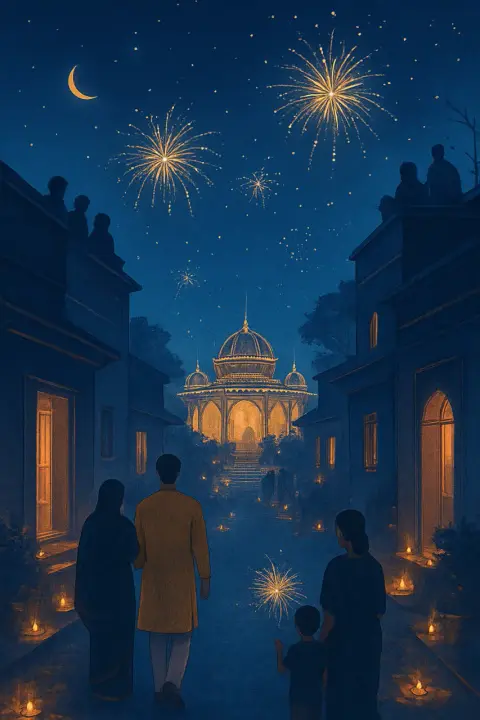
Kali Puja in Bengal: the night of the dark goddess
On the darkest night of autumn, Bengal prays to the dark goddess until dawn
Kali Puja, also called Shyama Puja, is Bengal's festival of the goddess Kali. It falls on the new-moon night of the month of Kartik, the same night the rest of India celebrates Diwali for Lakshmi, and the worship happens at night: devotees are meant to stay awake until dawn. Next: 8–9 November 2026. Kolkata's Kali temples are at their fullest; the largest pandal circuit is in Barasat, and Naihati is known for its giant Kali image, both a suburban train ride from Kolkata.
The night follows the Bengali almanacs (panjikas), on sale before the Bengali new year in April; the West Bengal holiday list, usually out in November or December of the previous year, confirms it.
The legend
In the Devi Mahatmya the goddess Durga fights the demon Raktabija: every drop of his blood that touches the ground becomes a new demon.
From Durga's rage comes Kali, black-skinned, tongue out. She catches every drop before it falls and so defeats the demon.
The goddess's fury calms only when Shiva lies down on the field. Stepping on her husband, Kali, in the best-known reading, bites her tongue in embarrassment.
In Bengal they tell how the 17th-century tantric Krishnananda Agamavagisha saw this form in a young woman by a wall and began to shape Kali in clay himself.

In the 18th century Raja Krishnachandra of Nadia takes up the puja, and ever since Bengal has prayed to Kali until dawn on the new moon of Kartik.
Meaning
Kalighat
At the Kalighat temple Kali is worshipped that night as Lakshmi, the goddess the rest of India prays to at Diwali.
Dakshineswar
The Kali temple on the Hooghly was built in 1855 by Rani Rashmoni. Ramakrishna served here, and his image appears even in the pandals.
Tangra
Tangra, Kolkata's Chinese quarter, has its own Kali temple, where the goddess is offered noodles, chop suey and rice with vegetables.
Customs
A night puja
Kali is worshipped at night, and the worshipper is meant to stay awake until dawn. Homes and pandals set up clay images of the goddess.
Red hibiscus
The goddess is offered red hibiscus flowers, sweets, rice, lentils and fruit.
Pandal hopping
Barasat, Naihati, Barrackpore and Siliguri build pandals with huge images and lights, and people go from one to the next all night.
Lights and fireworks
Homes are lit up and fireworks go off, and Kali Puja night is also a time for magic shows and theatre.
Songs to Shyama
Shyama sangeet, songs to Kali, fill the night; in the 20th century the brothers Pannalal and Dhananjay Bhattacharya made them famous.
Fourteen lamps
The evening before, on Bhoot Chaturdashi, fourteen lamps are lit: the belief is that fourteen generations of ancestors visit that night.
What people eat
Choddo shak
fourteen kinds of greens, eaten together on the eve of the festival
Words of the festival
শ্যামাপূজা
Shyama Puja
the festival's other name; Shyama, "the dark one", is a name of Kali
দীপান্বিতা অমাবস্যা
Dipannita Amavasya
the new moon of Kartik, the night of Kali Puja
শ্যামা সংগীত
Shyama sangeet
Bengali songs dedicated to Kali
ভূত চতুর্দশী
Bhoot Chaturdashi
"the fourteenth day of spirits", the eve of Kali Puja
True or myth
✅ True. While most of India prays to Lakshmi, Kalighat honours Kali in Lakshmi's form.
❌ Myth. In the 16th century a Nabadwip authority on ritual prescribed a Lakshmi puja for this new moon; Kali Puja spread widely only in the 18th century.
✅ True. The most widespread reading is that she bit her tongue on realising she had stepped on her husband, Shiva.
Where to celebrate
What happens on Kali Puja night
Kali is worshipped in homes and in pandals, temporary shrines built by neighbourhood committees, in the form of clay images made for the night. The puja takes place after dark, with mantras and offerings of red hibiscus, sweets, rice, lentils and fruit. Most homes and pandals follow the Brahmanical rite, in which no animals are sacrificed; in tantric rites animals are still ritually sacrificed and offered to the goddess.
At Kalighat, Kolkata's old Kali temple, the goddess is worshipped that night as Lakshmi, the deity the rest of India honours at Diwali. Pandals often add images of Shiva, Kali's consort, and of the Bengali Kali devotees Ramakrishna and Bamakhepa, along with scenes of the ten Mahavidyas, the tantric goddesses headed by Kali. People go from pandal to pandal all night. Kali Puja is also a night of lights, magic shows and theatre, and of Shyama sangeet, Bengali songs to Kali. Firecrackers are restricted: in West Bengal only certified green crackers are allowed, within a short evening window that the state Pollution Control Board announces each year.
After the puja the images are carried to the river for immersion. More about the goddess herself: Kali.
How Kali Puja became Bengal's festival
Kali grows in importance in Sanskrit texts of the late medieval period, and in the 17th century she appears in Bengali mangalkavya poetry, which describes her worship. The public festival is younger than it looks: Kali Puja spread widely only in the 18th century, when Raja Krishnachandra of Nadia took it up. In the 19th century it grew again, with the fame of Ramakrishna, the Kali devotee who served at the Dakshineswar temple, and with wealthy landowners sponsoring ever grander celebrations. Today it is one of the major festivals of West Bengal, and is also kept in Bihar (above all around Bhagalpur), Jharkhand, Odisha, Assam, Tripura and Bangladesh.
Where to see Kali Puja
All of it is free: the pandals stay open through the night, and the temples can be visited from the queue.
Kolkata
Kalighat and the riverside Dakshineswar temple are at their fullest, and neighbourhood pandals light up the city. Details: Kali Puja in Kolkata.
Barasat and Madhyamgram
The largest Kali Puja pandal circuit in West Bengal, built on the Durga Puja model, with huge images and lights. Reached by suburban train from Sealdah.
Naihati: Boro Maa
A Kali image about 22 feet tall, made anew every year in a tradition going back to 1923 and adorned with gold and silver ornaments donated over the decades; after the festival it is wheeled to the Ganga for immersion, and a permanent stone image stands in a temple opened for the puja's centenary. Reached by suburban train from Sealdah.
Elsewhere in Bengal and beyond
Barrackpore and Siliguri also build big pandals. In Bihar, Bhagalpur sets up hundreds of pandals, and after the puja some 80 to 90 images go in procession to the immersion ghat.
Etiquette and crowds
- Temples and pandals — Shoes come off at the Kali temples (at Kalighat they are left at stalls outside, so keep small change), and modest dress is expected. More: what to wear in India.
- Self-appointed guides — At Kalighat, pandas (self-appointed priests) offer to take you in for a fee. A firm, polite no is fine, or agree on a clear amount first.
- Crowds — The FCDO notes that stampedes have occurred at events with large crowds, including religious gatherings, and advises following the advice of local authorities.
- Valuables — The FCDO warns that pickpockets target tourist areas and crowds: keep phones and money in front pockets or a closed bag. Emergency number: 112, see emergency numbers.
Planning and booking
- Book transport as soon as sales open
Kali Puja falls in Diwali week, the busiest travel week of the year. Take long-distance trains (sales open 60 days ahead) and flights as early as you can.
- Book a room about six weeks ahead
Base yourself in Kolkata; Barasat and Naihati are best done as a night trip by suburban train from Sealdah, which needs no advance booking.
- Arrive by the afternoon of Amavasya
One night is the minimum, two are ideal.
- Combine it
Durga Puja in Kolkata comes earlier in the autumn, and Chandannagar's Jagaddhatri Puja follows Kali Puja.
FAQ
When is Kali Puja?
Next: 8–9 November 2026. It is held on the new-moon night (Amavasya) of Kartik, usually between mid-October and mid-November; the night is set by the Bengali almanacs and confirmed by the West Bengal holiday list.
Is Kali Puja the same day as Diwali?
Yes, it falls on the same new-moon night. In most of India that night belongs to Lakshmi; in Bengal it belongs to Kali, and at Kalighat Kali is worshipped as Lakshmi.
Why is Kali Puja celebrated at night?
Kali is worshipped at night by tradition, with tantric rites and mantras, and the worshipper is meant to meditate until dawn.
Why does Kali stick out her tongue?
In the best-known reading of the legend, she bit her tongue in embarrassment on realising she had stepped on her husband, Shiva, who had lain down to calm her fury.
Where is the biggest Kali Puja?
Barasat and Madhyamgram, north of Kolkata, have the largest pandal circuit in West Bengal. Naihati is known for Boro Maa, its 22-foot image.
What is the difference between Kali Puja and Durga Puja?
Durga Puja comes earlier in the autumn and lasts several days; Kali Puja is a single night, the new moon of Kartik. In the Devi Mahatmya, Kali springs from the goddess's fury on the battlefield and defeats the demon Raktabija by catching every drop of his blood.
Sources (5)
Facts checked: 21 October 2026. Prices and hours are approximate; check locally.