 India GO
Durga Puja in Kolkata: the pandals, the five days and the UNESCO listing
A whole city becomes a gallery for five nights, then gives its goddesses to the river
Durga Puja is the autumn worship of the goddess Durga, and in Kolkata it turns the whole city into a free, walkable exhibition: thousands of temporary pavilions (pandals) with clay images made for one year only. The five main days, Shashthi to Dashami, are 5–10 October 2027 (expected). Since 2021 “Durga Puja in Kolkata” has been on UNESCO’s Representative List of the Intangible Cultural Heritage of Humanity.
The days follow the Bengali almanacs (panjikas), on sale before the Bengali new year in April; the West Bengal holiday list, usually out in November or December of the previous year, confirms them.
The legend
In a Bengali tale, Uma, daughter of the mountain king Himalaya and Queen Menaka, marries Shiva against her father's wishes.
She leaves for her ascetic husband's poor home, and her mother cannot rest for missing her.
One autumn night Menaka dreams of her daughter and begs her husband to bring Uma home, even for a few days.

Uma agrees to stay with her parents for four days, then returns to her husband on Kailash.
So at Puja time married daughters go home to their parents, and Kolkata welcomes Durga as a daughter come home.
Meaning
Old families
In bonedi baris, the mansions of old families, the Puja goes back centuries: since 1610 with the Sabarna Roy Choudhurys at Barisha, since 1757 at Shobhabazar.
Neighbourhoods
Community pujas, barowari, are raised by each neighbourhood with pooled money: Kolkata had about 3,000 of them in 2022.
Artists
Theme pandals are built like installations, from scrap metal, nails, even turmeric. Since 1985 the best have won awards.
Customs
Mahalaya on air
On Mahalaya many get up at four in the morning to hear Mahishasuramardini on the radio, a broadcast dating back to 1931.
Painting the eyes
In the workshops of Kumortuli, the potters' quarter, the images get their eyes around Mahalaya, the moment the goddess is said to awaken.
Anjali
On Ashtami morning many fast until anjali, the offering of flowers with a mantra, and break the fast at the shared bhog lunch.
Kumari Puja
At Belur Math, after the Ashtami puja, a young girl is worshipped as the living goddess, a custom begun by Swami Vivekananda in 1901.
Puja annuals
For the festival magazines bring out special autumn issues, the pujabarshiki: Anandamela, Desh and others.
What people eat
Luchi and alur dom
puffed flatbreads with potato: the Mahalaya breakfast
Labra
the mixed-vegetable stew of the bhog, eaten with khichuri
Payesh
milk rice pudding, the sweet end of the bhog
Words of the festival
আগমনী
agomoni
songs of Uma's journey home; Ramprasad Sen was the first to write them
বোধন
bodhon
"awakening": on the evening of Shashthi the goddess is woken by a bel tree
সন্ধিপূজা
Sandhi Puja
a 48-minute rite where Ashtami meets Navami, lit by 108 lamps
প্রতিমা
protima
the clay image of the goddess, sculpted afresh each year
How to greet
শুভ শারদীয়া
Shubho Sharodiya!
"Happy autumn festival": the Puja greeting, since the festival is also called Sharodiya, "of autumn".
True or myth
✅ True. The film star Uttam Kumar replaced Birendra Krishna Bhadra's recording; audiences rejected it, and the old version came back.
❌ Myth. She is often called that, but she is the navapatrika: nine plants in a red-bordered sari, each seen as a form of Durga.
❌ Myth. The first community pujas in Kolkata were held in 1910; before that the festival belonged to wealthy families.
Where to celebrate
Kolkata
Worth the trip
Walk from one temporary pavilion to the next through the night, each one a commissioned installation built by artists and clubs, until the city itself reads as a single open-air exhibition.
What UNESCO inscribed
UNESCO’s Intergovernmental Committee added “Durga Puja in Kolkata” to the Representative List of the Intangible Cultural Heritage of Humanity at its 16th session, held online in December 2021 (decision 16.COM 8.b.15). The element is listed for India, and its name is the city’s own: the festival is kept across India and by Bengalis abroad, but UNESCO describes Kolkata as its geographical and cultural heart.
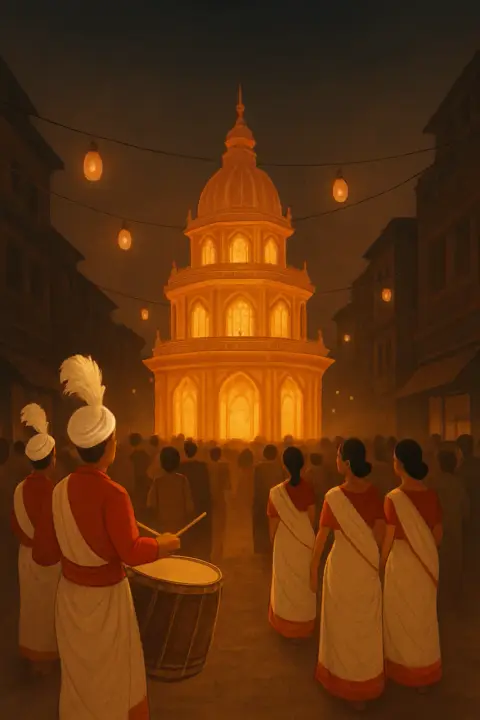
UNESCO’s description follows the year of an image. In the months before the festival, small artisanal workshops sculpt Durga and her family from unfired clay taken from the Ganga. On Mahalaya the eyes are painted on, which brings the goddess to life, and the worship lasts ten days. On the tenth day the images are immersed in the river the clay came from. In between, the city fills with large-scale installations and pavilions, traditional Bengali drumming and veneration of the goddess. UNESCO calls it the best instance of the public performance of religion and art, a thriving ground for collaborative artists and designers, and notes that the divisions of class, religion and ethnicity “collapse” as crowds walk from one installation to the next.
From Mahalaya to Dashami
The days follow the Bengali almanacs (panjikas) and are confirmed by the West Bengal holiday list. The five main days are 5–10 October 2027 (expected); Mahalaya comes about a week before them.
- Mahalaya
Devi Paksha, the fortnight of the goddess, begins. Many Bengalis get up before dawn for the radio recitation Mahishasuramardini, and offer tarpan, water for the ancestors, at the river. Arriving now buys several calmer days on the pandal circuit.
- Chaturthi and Panchami
The big pandals open to the public before the worship starts. The queues are shorter than they will be from Saptami on.
- Shashthi
The goddess is welcomed and woken (bodhon) in the evening. Be in the city by this day at the latest.
- Saptami
The navapatrika, nine plants dressed in a red-bordered sari, each a form of Durga, is bathed at dawn and set beside the image. Full worship begins.
- Ashtami
The peak of the worship: morning anjali, the flower offering, then Sandhi Puja at the junction of Ashtami and Navami. At Belur Math the Kumari Puja is held this day.
- Navami
Homa and bhog, the shared meal. Navami night is the busiest of the pandal-hopping nights.
- Dashami
Married women smear sindoor on the goddess and on each other (sindoor khela), and the images leave for the Hooghly in procession, to Babughat and the other ghats.
How to walk the pandals
Every pandal is free and open to the street. The pujas are raised by neighbourhood committees with pooled money (barowari pujas), and Kolkata had more than 3,000 of them in 2022, so nobody sees them all. People walk from evening into the small hours, and in recent years the metro has run extended hours on the main nights; check the Metro Railway’s announcements for the year. See the Kolkata metro.
Two kinds of puja are worth mixing. The art-led pandals take a new theme each year and are built like installations, sometimes from scrap metal, nails or turmeric; the best have competed for awards since 1985. The bonedi bari pujas are held in the mansions of old families, many of them in north Kolkata, such as Shobhabazar, with a quieter, older form of worship.
In the weeks before the festival, Kumartuli, the potters’ quarter in the north, is where the images take shape. It is a working neighbourhood: ask before you photograph a sculptor or a studio.
Etiquette and crowds
Everyone is welcome at the pandals. The UK Foreign Office (FCDO) advises avoiding large gatherings, including at religious sites, and notes that stampedes have occurred at events with large crowds, including religious gatherings. If you go, move with the flow of the crowd, not against it.
- At the image — Take shoes off where others do, do not touch the image, and do not turn your back to it for a selfie in the middle of a rite.
- Family pujas — Bonedi bari pujas are held in private homes. Follow the hosts’ lead and ask before photographing.
- Valuables — The FCDO warns that pickpockets work in tourist areas; the queues and the late-night crowds are where to keep a bag in front of you.
- A meeting point — In a dense crowd it is easy to lose each other. Agree where to meet before you set off.
- At the ghats — On Dashami stand well back from the water’s edge as the images are carried in.
FAQ
When is Durga Puja in Kolkata?
The five main days, Shashthi to Dashami, are 5–10 October 2027 (expected). They are the sixth to the tenth lunar days of the bright half of Ashvin, usually between late September and late October; Mahalaya is about a week earlier.
Is Durga Puja a UNESCO heritage?
Yes. “Durga Puja in Kolkata” was inscribed on UNESCO’s Representative List of the Intangible Cultural Heritage of Humanity in December 2021, at the Committee’s 16th session.
Where is Durga Puja celebrated in Kolkata?
Across the whole city, in thousands of neighbourhood pandals. Long-established pujas include Bagbazar, College Square, Santosh Mitra Square, Ekdalia Evergreen and Sreebhumi; the old family pujas cluster in north Kolkata.
What is done on Durga Puja?
Clay images of Durga are installed in pandals and homes, woken on Shashthi and worshipped through Ashtami and Navami with flowers, lamps, drums and shared meals, then immersed in the river on Dashami. In between, people walk from pandal to pandal.
Who stands with Durga in the pandal?
Lakshmi and Ganesha on one side, Saraswati and Kartikeya on the other, worshipped with her from Saptami to Navami. Durga herself is shown slaying the buffalo demon Mahishasura.
Do you need tickets for the pandals?
No. Every pandal is free and open to the street. Hotels fill months ahead, though, and room prices rise steeply in Puja week.
Sources (4)
Facts checked: 21 October 2026. Prices and hours are approximate; check locally.