 India GO
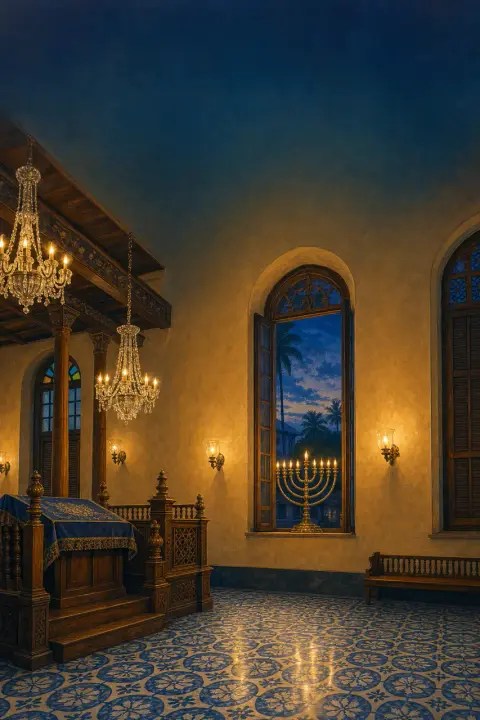
Hanukkah: the Jewish Festival of Lights, and where India keeps it
One more light every evening
Hanukkah is the Jewish Festival of Lights: eight nights from the 25th of Kislev in the Hebrew calendar, recalling the rededication of the Temple in Jerusalem in the 2nd century BCE. Each evening one more light is kindled on a nine-branched lamp. In India it is kept at home and in the synagogue by small, historic communities in Kochi, Mumbai and the Konkan, Pune, Kolkata and Ahmedabad. Dates: 4–12 December 2026 (expected), beginning at sundown.
The Jewish Festival of Lights: eight evenings of candles, kept by India's small and historic Jewish communities
Fixed years ahead by the Hebrew calendar: from sundown before 25 Kislev.
The legend
In the 2nd century BCE King Antiochus IV outlaws Judaism and sets up an altar to Zeus in the Temple in Jerusalem.

Rebels led by Judah Maccabee win back the Temple and dedicate it anew.
The Talmud says the only pure oil left for the Temple lamp was one jar under the High Priest's seal, enough for a single day.
Yet the flame burns for eight days, until new oil can be pressed and brought.
Meaning
Bene Israel
In the Konkan villages they were called Shanivar Teli, Saturday oil-pressers: they pressed oil and never worked on the Sabbath.
Kochi
The Paradesi Synagogue floor is laid with hundreds of hand-painted 18th-century Chinese tiles, no two of them alike.
Customs
Lights on show
The lamp is set by the door or in the window nearest the street, so the miracle is seen by all.
Dreidel
People play dreidel: the letter that lands face up says take all, take half, take nothing or put one in.
Fried in oil
Fried food comes to the table, and many add dairy dishes too.
Words of the festival
מעוז צור
Ma'oz Tzur
"Strong Rock", the hymn sung after the lights are kindled
מכבים
Maccabees
the rebels' byname: from Aramaic for "hammer", or from the initials of their battle cry
כסלו
Kislev
a month of the Hebrew calendar; Hanukkah begins on 25 Kislev
How to greet
חג שמח
Chag sameach!
"Happy holiday!", the greeting for Hanukkah as for other festivals.
True or myth
❌ Myth. The Hanukkah lights are only for looking at and remembering the miracle; the ninth candle, the shamash, is for practical use.
✅ True. Community tradition holds that their ancestors fled Judea under Antiochus Epiphanes and survived a shipwreck south of Mumbai.
✅ True. The four letters stand for "a great miracle happened there", and in Israel "there" becomes "here".
How Hanukkah is kept
Hanukkah, Hebrew for dedication, commemorates the revolt of the Maccabees against the Seleucid kingdom, which outlawed Judaism, and the recovery and rededication of the Second Temple around 164 BCE. Tradition tells that only one jar of pure oil was found, enough for a single day, yet the Temple lamp burned for eight.
So the lights are kindled for eight nights, usually at nightfall, and should burn for at least half an hour. The lamp, a hanukkiah, has nine branches: eight for the nights and a ninth, the shamash or helper, used to light the others. It is set in a window or by the door, so that passers-by see it. The Hanukkah lights are only for looking at, not for practical use. Food fried in oil comes to the table, and children play with the dreidel, a spinning top with four Hebrew letters.
In religious terms Hanukkah is a minor festival: people go to work as usual, and the lighting happens after work, at home or in the synagogue.
India's Jewish communities today
Jews in India have historically lived with relatively little antisemitism from their neighbours, and the communities are among the oldest in the diaspora. The Cochin Jews of Kerala are the oldest. The Bene Israel of the Konkan coast trace their ancestry to Jews who fled Judea under Antiochus, the very king of the Hanukkah story, and were shipwrecked near Navagaon, south of Mumbai; for centuries they pressed oil in Konkan villages and were known as Shanivar Teli, the Saturday oil-pressers, because they did not work on the Sabbath. Their mother tongue is Marathi. The Baghdadi Jews settled first in Surat and then in Bombay and Calcutta, where families such as the Sassoons built synagogues, docks and libraries. In the northeast, the Bnei Menashe of Mizoram and Manipur number more than 9,000.
By some estimates the Jewish population of India peaked at around 20,000 in the mid-1940s; after 1948 most families emigrated to Israel, and the latest census counted 4,429 Jews. A 2020 count put the Jews of Mumbai at about 3,500, almost all of them Bene Israel, and only 26 remain in Kerala.
Synagogues you can visit
Hanukkah itself is mostly kept at home and within the congregation. Visiting a synagogue that week is the way to see India's Jewish heritage; if a synagogue holds a lighting, ask in advance whether visitors may watch.
Paradesi Synagogue, Kochi
Completed in 1568 in Jew Town, Mattancherry, sharing a wall with the Mattancherry Palace temple; the oldest active synagogue in the Commonwealth. Its floor is laid with hand-painted 18th-century Chinese tiles, no two alike. The lanes of Jew Town lead to it past antique shops and spice warehouses. Mattancherry
Keneseth Eliyahoo, Mumbai
Completed in 1884 by Jacob Elias Sassoon in Kala Ghoda, in the Fort district. Keneseth Eliyahoo Synagogue
Magen David, Kolkata
Built in 1884; one of the city's active synagogues. Magen David Synagogue
Ohel David, Pune
In the Camp area; considered the largest synagogue in Asia outside Israel.
Magen Abraham, Ahmedabad
A Bene Israel synagogue and the only synagogue in Gujarat.
Visiting a synagogue
Synagogues are working houses of worship, not museums.
- Carry ID — Expect a security check at the entrance.
- Dress modestly — The Paradesi Synagogue keeps a strict dress code. See what to wear in India.
- Check visiting days — Many synagogues close to visitors on Saturdays and Jewish holidays, and the Paradesi Synagogue also on Fridays and Sundays.
- The greeting — Happy Hanukkah, or Chag Sameach, happy holiday.
Security
The UK Foreign Office notes that terrorist attacks in India could target places of worship and tourist attractions, and that security has been strengthened, including at major hotels and transport hubs. Security checks at synagogues are routine; follow the guards' instructions. More in our guide Is India safe.
FAQ
When is Hanukkah?
Next: 4–12 December 2026 (expected). It begins at sundown before the 25th of Kislev and lasts eight nights; the dates are fixed years ahead by the Hebrew calendar.
What is Hanukkah?
The Jewish Festival of Lights, recalling the rededication of the Temple in Jerusalem after the Maccabees won it back in the 2nd century BCE.
Why does the Hanukkah lamp have nine candles?
Eight are for the eight nights; the ninth, the shamash, is the helper used to light the others.
What is eaten at Hanukkah?
Food fried in oil, in memory of the oil that burned for eight days; many families add dairy dishes too.
Is Hanukkah celebrated in India?
Yes, by India's Jewish communities: the Cochin Jews of Kerala, the Bene Israel of Mumbai and the Konkan, and the Baghdadi Jews of Mumbai, Pune and Kolkata. It is kept mostly at home and in the synagogue.
Can visitors attend a Hanukkah lighting in India?
Sometimes. Synagogues are working houses of worship with security checks, so ask in advance whether visitors may watch, carry ID and dress modestly.
Sources (8)
Facts checked: 21 October 2026. Prices and hours are approximate; check locally.