 India GO
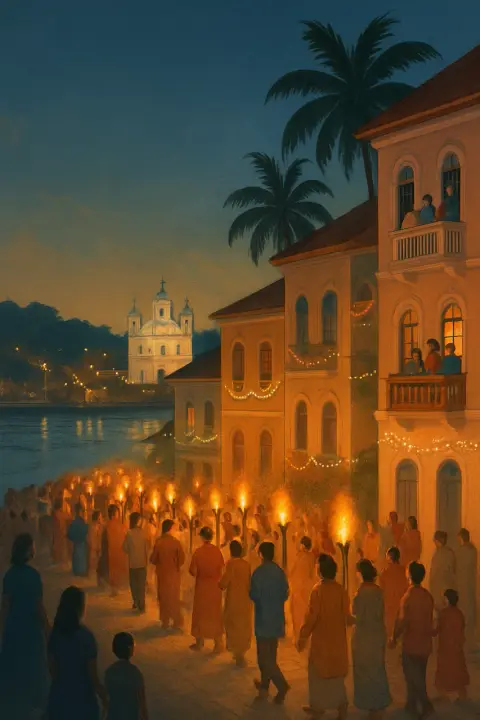
Goa Liberation Day: the end of Portuguese rule in 1961
A torch relay, a parade and the end of four and a half centuries of Portuguese rule
Goa Liberation Day marks the end of Portuguese rule in Goa on 19 December 1961, after 451 years, when Indian forces entered the territory in Operation Vijay and the Portuguese governor-general surrendered. It is a public holiday in Goa, observed every year on 19 December with flag hoisting, a parade and tributes to freedom fighters. Next: 19 December 2026.
Fixed by law; the Goa government announces the parade programme in December.
The legend
In 1510 Afonso de Albuquerque took Goa from the Sultan of Bijapur, and it became the capital of Portuguese India.
On 18 June 1946 Ram Manohar Lohia led a peaceful protest in Panaji; the day is now Goa Revolution Day.
India became independent in 1947, but Portugal kept Goa, calling it part of Portugal itself.
In December 1961, Operation Vijay ended 451 years of Portuguese rule in 36 hours.
Every 19 December since, Goa raises flags, holds a parade and honours its freedom fighters.
Customs
Flag hoisting
In the morning the Chief Minister raises the national flag, and ceremonies are held at every taluka headquarters too.
Parade at Campal
Panaji holds the Liberation Day parade at Campal.
Wreaths at memorial
Wreaths are laid at the Martyrs' Memorial and freedom fighters are honoured.
Words of the festival
गोवा मुक्ती दिन
Gova Mukti Din
"Goa Liberation Day" in Marathi
Operation Vijay
"Victory" in Sanskrit; the code name of the 1961 operation
satyagraha
non-violent resistance, one of the paths to freedom in Goa too
Estado da Índia
Portugal's Indian territories, with Goa as their capital
True or myth
❌ Myth. Portugal held Goa for 14 more years, until 19 December 1961.
✅ True. Until 30 May 1987 it was a union territory with Daman and Diu; then it became India's 25th state.
❌ Myth. In the opinion poll of 16 January 1967 Goans voted against the merger, and Goa stayed a separate territory.
What happened, in brief
In 1510 Afonso de Albuquerque took Goa from the Sultan of Bijapur, and it became the capital of the Estado da Índia, Portugal's territories in India. When British India became independent in 1947, Portugal kept Goa, Daman and Diu, holding that they were part of Portugal itself rather than colonies. India withdrew its diplomatic mission from Lisbon in 1953.
Inside Goa and from across the border, a movement against Portuguese rule grew. On 18 June 1946 Ram Manohar Lohia led a protest in Margao, remembered today as Goa Revolution Day. On 15 August 1955 several thousand unarmed activists tried to cross into Goa at six points; Portuguese police opened fire and between 21 and 30 people were killed, after which India closed its consulate in Goa.
On 17 December 1961 Indian army, navy and air force units entered Goa, Daman and Diu in Operation Vijay. The fighting lasted about 36 hours. Governor-General Manuel António Vassalo e Silva, disregarding orders from Lisbon to fight to the last man, surrendered on 19 December. Encyclopedias give the dead as 22 on the Indian side and 30 on the Portuguese side, with more than 4,600 Portuguese personnel taken prisoner.
The operation drew both support and criticism abroad. At the UN Security Council a resolution sponsored by France, Turkey, the United Kingdom and the United States calling for a ceasefire and Indian withdrawal was defeated by a Soviet veto. Portugal recognised Indian sovereignty over its former territories by a treaty signed on 31 December 1974. In India the events are called the liberation of Goa; English-language encyclopedias usually title them the Indian annexation of Goa.
After 1961: from territory to state
After the surrender Goa, Daman and Diu became a union territory administered by the central government, first under a military governor and from 1962 with a civilian administration. In an opinion poll on 16 January 1967 Goans voted against merging with Maharashtra, and Goa stayed a separate territory. On 30 May 1987 it became India's 25th state, while Daman and Diu remained a union territory.
How Goa marks the day
The day is official rather than festive. In the morning the Chief Minister hoists the national flag at the state-level ceremony, with a police guard of honour and band; in a recent year it was held at the Goa University ground in Taleigao, and earlier at Campal in Panaji. Ministers hoist the flag at the same time at the taluka headquarters, among them Margao, Ponda and Mapusa. Police, fire services, home guards and students march in a parade, and freedom fighters are honoured. The Goa government's information department publishes the programme and venues in December.
For travellers the main practical point is that it is a public holiday in Goa, so government offices are closed.
Where the history shows
Liberation Day falls in Goa's high season, between the Feast of St Francis Xavier in early December and Christmas. These places make the story of Portuguese Goa and its end easier to follow.
Old Goa
The former capital of the Estado da Índia, with its churches and convents. Old Goa
Panaji and Fontainhas
The state capital and its Latin quarter of painted houses. Panaji, Fontainhas
Fort Tiracol
A fort on the Terekhol estuary where in 1954 protesters against Portuguese rule raised the Indian flag for a day. Fort Tiracol
Naval Aviation Museum, near Vasco
Navy aircraft on outdoor display and a two-storey indoor gallery, at Bogmalo about 6 km from Vasco.
FAQ
On which date is Goa Liberation Day celebrated?
Every year on 19 December, the day the Portuguese surrendered in 1961. Next: 19 December 2026.
Is Goa Liberation Day a holiday?
Yes, it is a public holiday in Goa, listed in the state's official holiday list.
Why was Goa not part of India in 1947?
Goa was a Portuguese, not a British, possession. Portugal treated it as part of Portugal itself and did not hand it over when British India became independent.
What was Operation Vijay?
The code name of the Indian military operation of 17–19 December 1961 in Goa, Daman and Diu. Vijay means victory in Sanskrit.
How long did Portugal rule Goa?
451 years, from Albuquerque's conquest in 1510 to December 1961.
When did Goa become a state?
On 30 May 1987. Until then it was a union territory together with Daman and Diu.
Sources (9)
Facts checked: 21 October 2026. Prices and hours are approximate; check locally.