 India GO
Galdan Namchot and Ladakhi Losar: Ladakh's December new year
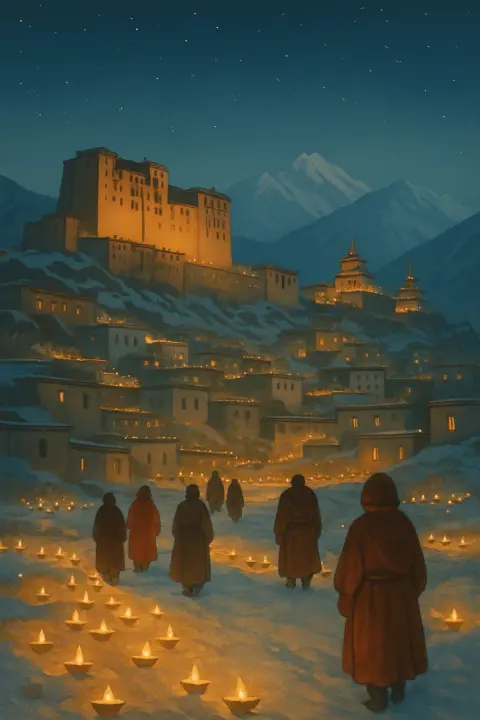
Butter lamps on every roof and window of old Leh on a December night
Ladakh celebrates its new year about two months before Tibet. The season opens with Galdan Namchot, on the 25th day of the tenth Tibetan month, when monasteries, homes and public buildings in Leh are lit with butter lamps in honour of the teacher Je Tsongkhapa. Ladakhi Losar, the new year itself, follows on the first day of the eleventh month, usually in December. From Galdan Namchot to Losar in Leh: 3–9 December 2026.
The Ladakh administration gazettes both holidays in its annual list, issued around December; in a year with a leap month the Ladakhi almanac decides.
The legend

Galdan Namchot honours Je Tsongkhapa (1357–1419), the teacher whose work gave rise to the Gelug school. It opens Ladakh's new-year season.
Tradition says that in the early 17th century King Jamyang Namgyal, planning a winter campaign against the Balti, had the new year kept two months early.
It became the custom: Ladakhi Losar falls in the eleventh month, two months ahead of the Tibetan new year.
Customs
Butter lamps
On Namchot night homes and monasteries glow: butter lamps line windowsills, roofs and altars, a sign that darkness is overcome.
Ibex on the walls
For Losar people make ibex figures for luck and dot the kitchen walls to bring a prosperous year.
Khatak
Visits come with a khatak, the white ceremonial scarf.
What you see: the lamp night and the new year
Galdan Namchot is the public, visible part. After dark, butter lamps are set out on windowsills, rooftops and altars, and monasteries, public buildings and houses are lit up; the light stands for darkness overcome. Galdan Namchot is also kept in Tibet, Nepal and Mongolia, and in India at Key Monastery in Spiti, on the same day.
Ladakhi Losar follows five or six days later and is mostly a household festival. Families make ibex figures for luck and dot the kitchen walls so that the year will be well fed. Visits between relatives and neighbours come with a khatak, the white ceremonial scarf, and with food such as thukpa (noodle soup), momos and butter tea. Losar is a public holiday in Ladakh, listed by the administration every year.
Besides Leh, the season is marked at Thiksey and Diskit monasteries and in Kargil.
Why Ladakh's new year comes early
Galdan Namchot commemorates Je Tsongkhapa (1357–1419), born in Tsongkha in Amdo, whose work led to the founding of the Gelug school of Tibetan Buddhism; the day marks his birth, his Buddhahood and his passing.
Why Losar comes early is a matter of tradition rather than written record. In the early 17th century King Jamyang Namgyal (r. 1595–1616) was preparing a winter campaign against the Balti of Skardu, and had the new year kept two months early so that it could be celebrated before the army left. The custom stayed, and Ladakhi Losar has fallen in the eleventh month ever since, while the Tibetan Losar is in February or March.
The season that begins with the lamps of Galdan Namchot ends in February with Dosmoche, when the year's misfortune is carried out of Leh and burned.
Altitude, cold and permits
Altitude. Leh is at about 3,500 m. Ladakh Tourism makes at least 48 hours of complete rest mandatory for every tourist arriving in Leh before travelling higher, and asks visitors to avoid alcohol and strenuous activity in the first two days. Land at least two days before Galdan Namchot if you want to be out on the lamp night. If you feel unwell, see a doctor; SNM Hospital in Leh provides emergency care. The UK FCDO advises travel insurance that covers altitudes over 2,400 m and mountain rescue.
Cold. Ladakh Tourism warns that winter temperatures can drop to -30°C and asks anyone travelling between October and March to carry proper cold-weather gear, thermal wear and emergency supplies.
Permits. The festival is mostly spent in Leh town. Permits are checked further out: the Ladakh administration names checkpoints at North Pullu on the road to Nubra (and Diskit) and at Upshi and Kharu towards Changthang. Foreign nationals need a Protected Area Permit for those areas. Permits and the tourist fees (environmental fee, Red Cross Fund and wildlife fee) are handled through the Leh district's official portal, lahdclehpermit.in, or a local travel agent. The rules for foreign tourists are under review, so check them before you book.
Getting in. In December most visitors fly into Leh.
Etiquette for a guest
This is a religious and family festival, not an event staged for visitors.
- Bring a khatak — If you are invited into a home for Losar, a white khatak scarf is the customary gift.
- Lamps are offerings — On Galdan Namchot night the lamps on altars and monastery walls are offerings. Look, photograph from a respectful distance, and do not touch or move them.
- Follow your hosts — Home rituals are private. In a homestay, ask what you may join and follow the family's lead.
Planning a December trip
Galdan Namchot and Losar are a week apart, so one winter trip to Leh covers both.
- Arrive before the lamps
Fly into Leh two or three days before Galdan Namchot to rest the mandatory 48 hours, then stay through Losar.
- Check the holiday list
The Ladakh administration publishes its holiday list around December; in a year with a leap month the Ladakhi almanac decides the days.
- Come back in February
The winter continues with Dosmoche in February and the Chadar trek season on the frozen Zanskar. Spiti keeps its own Losar, also earlier than the Tibetan one.
FAQ
When is Ladakhi Losar?
Galdan Namchot to Ladakhi Losar in Leh: 3–9 December 2026. Losar is the first day of the eleventh Tibetan month, usually in December, about two months before Tibetan Losar.
What is Galdan Namchot?
The festival of Je Tsongkhapa (1357–1419), whose work gave rise to the Gelug school. On the 25th day of the tenth Tibetan month homes and monasteries are lit with butter lamps, and it opens Ladakh's new-year season.
Why is Ladakhi Losar celebrated two months early?
By tradition, King Jamyang Namgyal moved the new year two months forward in the early 17th century so that his army could celebrate it before a winter campaign against the Balti. The custom stayed.
Where is the Losar festival celebrated in Ladakh?
Across Ladakh: in Leh, at monasteries such as Thiksey and Diskit, and in Kargil. Elsewhere in India Tibetan Losar is kept in February or March.
How do Ladakhis celebrate Losar?
At home: ibex figures for luck, dotted kitchen walls for a prosperous year, visits with a khatak scarf, and festive food such as thukpa, momos and butter tea.
Sources (9)
- Galdan Namchot
- Ladakh Tourism: Monastic Festival Calendar
- Ladakh Tourism: Advisories
- FCDO foreign travel advice: India
- Key Monastery, Spiti: events (Lama Tsongkhapa Day)
- Losar
- Administration of UT Ladakh: Chief Secretary reviews PAP and RAP framework
- Leh District Tourist Management System (permits and fees)
- FCDO: India, safety and security (altitude insurance)
Facts checked: 22 October 2026. Prices and hours are approximate; check locally.