 India GO
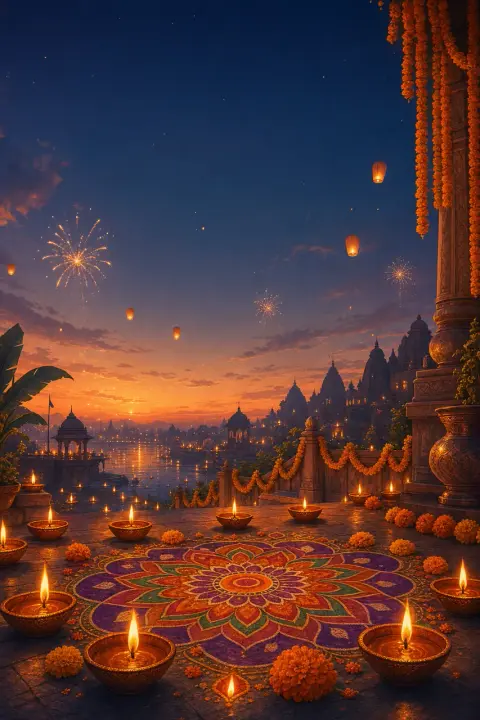
Diwali in Varanasi: what the city does on the night of lamps
The night darkness surrenders
On Diwali night (8 November 2026) Varanasi lights its aarti ghats and temple lanes, while most families keep Lakshmi Puja at home. The festival days are 6–11 November 2026. The river of lamps you may have seen in photos is a different festival: Dev Deepawali, on the Kartik full moon about fifteen days later (21–24 November 2026).
On Diwali night Varanasi lights its aarti ghats and temple lanes while families keep the puja at home; the river of lamps people picture is Dev Deepawali, fifteen days later.
Where to watch
Dashashwamedh Ghat: the Ganga Seva Nidhi evening aarti, lit on Diwali night 2024 with 5,100 diyas. Central riverfront, on foot through the old-city lanes.
Assi Ghat: the southern aarti, where visitors set out lamps on Diwali night (1,100 in 2024). South Varanasi, reachable by road closer than the central ghats.
Annapurna temple: the golden image of Annapurna on view from Dhanteras to Annakut, with coins and puffed rice given out as khazana, the goddess's treasure. Next to Kashi Vishwanath, in Vishwanath Gali; queues are long.
Kashi Vishwanath Dham: decorated with lamps, with Lakshmi and Ganesha worshipped on the main night. Through the Vishwanath corridor; security screening and queues on festival days.
Panchganga Ghat: akashdeep, lamps raised in baskets on tall bamboo poles through the month of Kartik in memory of ancestors. North along the ghat line, on foot or by boat.
Free viewing
- Dashashwamedh Ghat at the evening aarti, from the steps or from a boat
- Assi Ghat, where lamps are set on the water after the aarti
- Godowlia and the lanes towards Vishwanath Gali on Dhanteras evening, at their brightest and fullest
- Panchganga Ghat after dark, for the akashdeep baskets on their bamboo poles
Diwali or Dev Deepawali: two different evenings
Diwali falls on the new moon (amavasya) of the month of Kartik. In Varanasi, as across North India, it is first of all a family night: the house is cleaned, rangoli is laid at the door, clay lamps go up on ledges and rooftops, and Lakshmi, goddess of prosperity, is worshipped at dusk. Fireworks follow and go on late into the night. For a visitor the public side is the river and the temples: the evening aarti ghats are lit with lamps, and the Kashi Vishwanath temple is decorated, with Lakshmi and Ganesha worshipped on the main night.
Dev Deepawali comes fifteen days later, on the Kartik full moon. That is the night the ghats carry over a million diyas and boats of light move on the dark Ganga. If you picture Diwali in Varanasi as lamps from one end of the riverfront to the other, that picture belongs to Dev Deepawali. The two can be one long trip: the whole month of Kartik is a season of lamps here, and at Panchganga Ghat akashdeep, lamps raised in baskets on tall bamboo poles in memory of ancestors, go up every evening through the month. More on the month: Kartik.
The five days in Varanasi
Diwali runs 6–11 November 2026. What each day means for a visitor in the old city:
- Day 1, Dhanteras: bazaars and the golden Annapurna
The shopping day, and the best evening for the lit lanes: Godowlia and the lanes towards Vishwanath Gali are at their brightest and fullest. Around these days the Annapurna temple, about 15 m from Kashi Vishwanath, shows its golden image of the goddess, which is not on view the rest of the year, and gives out khazana, the goddess’s treasure of coins and puffed rice. Queues are long.
- Day 2: the day before
Buy sweets from the halwais (sweet shops) now: on Diwali itself the lines are very long. A box is the right gift if you are invited to a home.
- Day 3, 8 November 2026: the main night
Lakshmi Puja at home at dusk. On the river, the evening aarti at Dashashwamedh is lit with diyas, and at Assi visitors set lamps on the water after the aarti. Firecrackers start at sunset and can go on until 3 or 4 in the morning.
- Day 4: Annakut
The day the deities are offered a mountain of cooked food. At the Annapurna temple it closes the days of the golden image. Elsewhere in North India this is Govardhan Puja: see Govardhan Puja.
- Day 5: Bhai Dooj, then two weeks of Kartik
A family day for brothers and sisters. After it, the lamps at Panchganga continue every evening until Dev Deepawali on the full moon.
Moving around on festival evenings
The old city is walk-only. Cars are stopped 1–1.5 km from the ghats, and the lanes from Assi to Manikarnika take no vehicles at all, so on Diwali evenings you will walk in any case. E-rickshaws (about ₹10–30 for a shared seat) and Uber, Ola or Rapido drop you on the outer streets; on festival evenings the traffic into the old city crawls, so leave early or stay inside it.
The river is the one continuous street along the old city. A shared boat costs about ₹100–200 per person, a shared seat for the evening aarti about ₹150–300, a private rowing boat about ₹800–1,500 an hour. Agree the price before you get in. More: getting around Varanasi and boat rides.
Practical tips for Diwali week
The UK Foreign Office (FCDO) asks travellers to take particular care during periods of religious significance such as Diwali, and notes that stampedes have occurred at events with large crowds, including religious gatherings.
- Earplugs — Firecrackers start at sunset and can continue until 3–4 am, also in the lanes around the ghats.
- Air — Air quality drops sharply around Diwali. If you have asthma or other lung problems, bring masks.
- Temple queues — Kashi Vishwanath has security screening and long queues on festival days; dress as for any major temple: temple dress code.
- In the crowd — At the aarti ghats keep to the edges of the crowd, agree a meeting point and keep valuables in a front pocket.
- People at work — Keep a box of sweets or a small gift for those who work through the night: guards, drivers, hotel night staff.
FAQ
When is Diwali in Varanasi?
The five days are 6–11 November 2026, with Lakshmi Puja on the main night, 8 November 2026. Dev Deepawali, the night of lamps on the ghats, follows about fifteen days later: 21–24 November 2026.
What is the difference between Diwali and Dev Deepawali?
Diwali is the Kartik new moon, kept mostly at home with Lakshmi Puja and fireworks. Dev Deepawali is the Kartik full moon fifteen days later, when Varanasi lights its ghats with over a million diyas.
Where is Dev Diwali celebrated in Varanasi?
Along the whole line of ghats on the Ganga, best seen from the steps or from a boat. On Diwali night itself the lit places are the aarti ghats, Dashashwamedh and Assi, and the temples around Kashi Vishwanath.
Is Varanasi crowded in Diwali?
Yes, on a city scale: the old-city lanes are full on Dhanteras evening and around the aarti, and the Diwali and Chhath weeks are the busiest of the rail year into Uttar Pradesh and Bihar. Book trains the day sales open, 60 days ahead.
When can you see the golden Annapurna in Varanasi?
Only around Diwali, from about Dhanteras to Annakut; the temple sets the exact days each year. The rest of the year a brass image is worshipped.
What festivals are celebrated in Varanasi?
Besides Diwali and Dev Deepawali, Holi, Mahashivaratri, the Ramnagar Ramlila, Navratri and Chhath are among the big ones. See festivals in Varanasi.
Sources (4)
Facts checked: 21 October 2026. Prices and hours are approximate; check locally.