23 April 2027

Dhinga Gavar: the night old Jodhpur belongs to its women

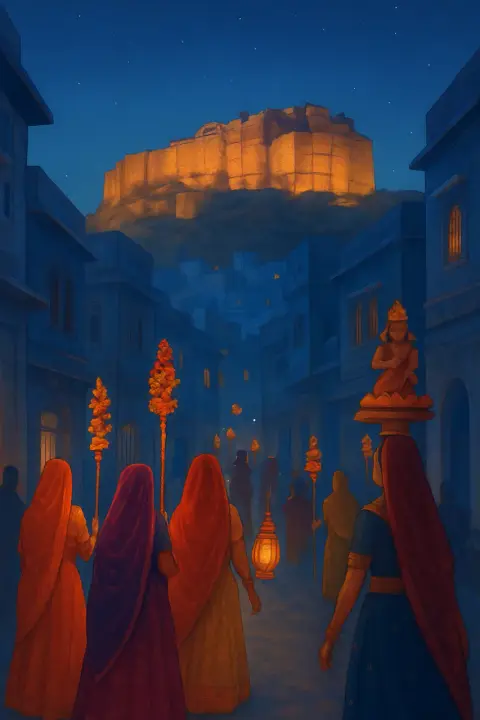
Women in costume, sticks in hand, guard the goddess through the old city's night

Dhinga Gavar is a one-night festival kept only in Jodhpur, at the close of the Gangaur season. After sunset, images of Gavar (Gangaur, the consort of Shiva) dressed in kilos of gold are set up in the lanes of the walled city, and women in costume, sticks in hand, guard them until dawn. It falls on the third lunar night after the Chaitra full moon, about two weeks after Gangaur, in April or early May; next: 23 April 2027 (expected). In recent years entry to the mela lanes has been restricted, so check before you plan around it.

Countdown23 April 2027
When23 April 2027

The night follows the lunar calendar; there is no separate announcement beyond the programme of the organisers in Jodhpur's old city.

The legend

🎭

Dhinga means fun by deception, and Gavar is Gangaur, Shiva's consort. Dhinga Gavar is her playful side, honoured in Jodhpur alone.

👞

Legend says Shiva once teased Parvati by dressing as a cobbler, and she paid him back by appearing as a Bhil woman.

👭

The festival belongs to all women, married, unmarried and widowed, and widows take part on equal terms.

Customs

Images in the lanes

After sunset images of Dhinga Gavar, dressed and decked in gold, are set on platforms in the lanes of old Jodhpur.

The night watch

Women dressed as gods, saints, police and bandits patrol the streets all night with sticks in hand, guarding the images.

The lucky tap

It is believed an unmarried man touched by a stick will soon marry; a stick is a baint, so the night is also called Baintmar Teej.

Where to celebrate

Jodhpur

For one night in April, women in costume carrying sticks rule the lanes of Jodhpur's walled city, keeping vigil until dawn over images of the goddess dressed in kilos of gold.

How the night unfolds

Gangaur in Rajasthan is a women's festival: for about sixteen days after Holi, women and girls worship clay or wooden images of Isar (Shiva) and Gavar (Parvati) for a happy marriage, and in Jodhpur they hold the puja in groups across the neighbourhoods. The season ends on Gangaur day, and Jodhpur alone adds one more night, for Gavar in her playful form. Dhinga means fun by deception.

On the eve, women go to Padam Sagar to fetch water for the goddess. On the day, the dressing of the images begins at the auspicious midday hour (Abhijit muhurat) and goes on until after 9 pm. The jewellery is pooled by the residents of each neighbourhood, who sit up with their Gavar all night and return the gold the next day. The richest image is usually the one in Sunaron ki Ghati, the goldsmiths' lane, with about 15 kg of gold ornaments in recent years; at Ada Bazaar, near Kumhariyon ka Kuan, one image has worn 21 kg. More than a dozen images are set up in the walled city, from Jalori Gate to Chand Baori, including at Hatdiyon ka Chowk, Kabutaron ka Chowk, Navchokiya and Jalap Mohalla.

Once the images are ready, the women take the streets. Dressed as gods and goddesses, saints, police officers, bandits and tribal women, carrying sticks, they walk between the images through the night. Many of them, called teejania, are fasting. It is believed that an unmarried man struck by one of their sticks will soon marry, so young men hang about hoping for a tap; a stick is a baint, and the night is also called Baintmar Teej.

The story and the women's festival

Dhinga Gavar is a folk deity, the humorous side of Gangaur. The story told in Jodhpur is a game between husband and wife: Shiva once teased Parvati by disguising himself as a cobbler, and she paid him back by appearing before him as a Bhil tribal woman. The disguises of the night, and the sticks, carry on that joke.

What sets Dhinga Gavar apart is who may take part. Gangaur is kept by brides, married women and girls praying for a good marriage. Dhinga Gavar is described as belonging to all women, and widows take part on equal terms. Most of the women in costume are from Pushkarna Brahmin families of the old city.

Check the entry rules first

In recent years, at the request of the mela committee, police have limited who could enter the mela lanes. Press reports describe people from other parts of the inner city being turned away, and women from outside not being allowed to carry sticks. Before building a trip around the night, ask your hotel inside the walls whether guests are being let through, and follow police instructions on the night. Police deploy extra personnel across the inner city for the night.

How to behave on the night

This is a women's religious night, and the lanes are theirs. A few rules make it easy.

  • Keep to the side — Let the women pass and do not provoke a blow from the sticks; the tap is part of their rite, not a game for visitors.
  • Ask before photographing — Many of the women are fasting and keeping a vow. Ask first, and photograph the images of Gavar respectfully.
  • Come after 9 pm — The images are on view once the dressing is finished, after 9 pm, and the night goes on until first light.

Where to stay and when to book

Everything happens on foot inside the old city walls, so where you sleep decides what you can see.

  1. Stay inside the walls

    Book a room in the walled city near the Clock Tower, about three weeks ahead. One night is the minimum; two let you see the eve at Padam Sagar or sleep after the vigil.

  2. Arrive that afternoon

    Trains and flights to Jodhpur need no more than a month's notice. Be inside the walled city by the afternoon of the festival.

  3. Combine with Gangaur

    Gangaur itself falls about two weeks earlier. See Gangaur in Jaipur; Jodhpur's Marwar Festival comes in autumn.

FAQ

When is Dhinga Gavar?

Next: 23 April 2027 (expected). It is the third lunar night after the Chaitra full moon (Vaishakha Krishna Tritiya), about two weeks after Gangaur, and lasts one night.

What is Dhinga Gavar?

A Jodhpur festival of Gavar (Gangaur) in her playful form: gold-dressed images are set up in the old city's lanes and guarded all night by women in costume carrying sticks.

Are Teej and Gangaur the same?

No, though both honour Parvati and are women's festivals. Gangaur ends on the third day of the bright half of Chaitra; Dhinga Gavar, also called Baintmar Teej, follows about two weeks later in Jodhpur.

Can tourists attend Dhinga Gavar?

The images are in the public lanes, but in recent years police limited entry to the mela area at the committee's request. Ask your hotel inside the walled city before you plan.

Sources (4)
  1. Dhinga Gavar
  2. Gangaur
  3. ETV Bharat: Dhinga Gavar mela in Jodhpur
  4. Dhinga Gavar fair in Jodhpur, ETV Bharat

Facts checked: 21 October 2026. Prices and hours are approximate; check locally.

India GO: your pocket guide to India

35 cities, one map with every place, the festival calendar, the 90/180 visa calculator and offline mode.

Point your phone's camera here