 India GO
Dhammachakra Pravartan Din: the day of Ambedkar's turn to Buddhism
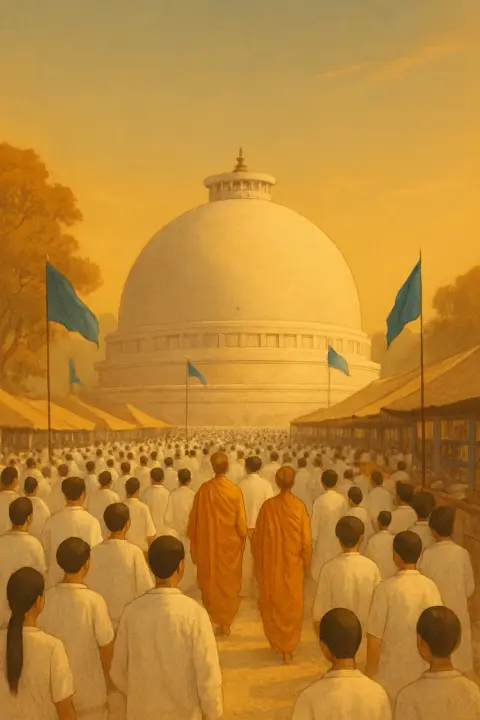
A white-clad crowd reciting twenty-two vows under a white stupa
Dhammachakra Pravartan Din marks the day in 1956 when B. R. Ambedkar, who chaired the committee that drafted India's Constitution, embraced Buddhism at Nagpur together with hundreds of thousands of his followers. It is kept on Ashoka Vijayadashami, the Dussehra day of the lunar calendar, and the next one falls on 9 October 2027. Its centre is Deekshabhoomi in Nagpur, where the white stupa stands on the site of the 1956 ceremony and where one of the largest Buddhist gatherings in India takes place.
The day follows Dussehra in the central and Maharashtra holiday lists; the Dr Babasaheb Ambedkar Smarak Samiti announces the programme in September.
The legend
After the bloody war in Kalinga, Emperor Ashoka repented of violence and turned to the Buddha's teaching.

Buddhists remember the day of his conversion as Ashoka Vijayadashami. In 1935 B. R. Ambedkar declared he was born a Hindu but would not die one.
On 14 October 1956 in Nagpur, Ambedkar and his wife took Buddhist vows from a Burmese monk, then he gave the vows to hundreds of thousands of followers.
He chose Nagpur deliberately: in his words, it was the home of the Nag people, who embraced Buddhism and spread it across India.
Now every year, on Ashoka Vijayadashami and on 14 October, hundreds of thousands, many in white, come to the white stupa of Deekshabhoomi.
Meaning
Chandrapur
Ambedkar held a second conversion here on 16 October 1956, so Chandrapur has its own Deekshabhoomi, which draws hundreds of thousands on the day.
Solapur
Since 1975 processions carry images of the Buddha and Ambedkar through the city, with around a hundred mandals performing lezim and martial games.
Customs
Twenty-two vows
On the morning of the main day the crowd recites in unison the 22 vows Ambedkar gave in 1956. They are carved in marble at the approach to the stupa.
Diksha
Thousands embrace Buddhism on the day: in 2019, 67,543 people took the vows at Deekshabhoomi.
Book fair
Book stalls fill the grounds: books in many languages sell in large numbers in a single day, and songs of the Buddha and Ambedkar play.
Feeding pilgrims
Many organisations set up stalls around Deekshabhoomi to serve food to those who come.
Calls of the day
The flag goes up in the morning, monks chant the Mahaparitran, and the crowd answers with "Namo Buddhaya" and "Jai Bhim".
Words of the festival
धम्मचक्र प्रवर्तन
Dhammachakra pravartan
"turning the wheel of the Dhamma", the name of the Buddha's first sermon at Sarnath
दीक्षाभूमी
Deekshabhoomi
"ground of ordination": the site of the 1956 conversion and its white stupa
बावीस प्रतिज्ञा
bavis pratidnya
the twenty-two vows Ambedkar gave to new Buddhists
बाबासाहेब
Babasaheb
"respected father", the honorific his followers use for Ambedkar
How to greet
जय भीम
Jai Bhim!
"Victory to Bhim": the greeting of Ambedkar's followers, used for hello and goodbye.
True or myth
❌ Myth. The main gathering falls on Ashoka Vijayadashami, the lunar Dussehra day, while the date itself, 14 October, is marked separately.
✅ True. Its design follows the stupa at Sanchi, but unlike Sanchi it holds a great hall inside: the largest hollow stupa in the world.
✅ True. The monk Anand Kausalyayan brought three branches of the sacred tree at Anuradhapura.
Where to celebrate
Nagpur
Hundreds of thousands of Ambedkarite Buddhists, many in white, gather on Ashoka Vijayadashami at Deekshabhoomi, where Ambedkar took the Buddhist vows in 1956, and book stalls fill the grounds.
What the day marks
Ambedkar was born into the Mahar caste, a Dalit community treated as untouchable, and for him the question of religion was tied to equality. At a conference at Yeola in October 1935 he announced that he would leave Hinduism: in the words his followers often quote, he had been born a Hindu but would not die one. Twenty-one years later, on 14 October 1956, he and his wife took the Three Refuges and Five Precepts from a Buddhist monk at Nagpur, and he then gave the vows to the crowd of followers gathered around him. Their number is given variously: Ambedkar himself spoke of about 400,000, and the Wikipedia articles on the event give from about 365,000 to some 500,000, one adding 220,000 more on the next day.
Ambedkar added twenty-two vows of his own for the new Buddhists, recited after the refuges and precepts. They are carved in marble at the approach to the Deekshabhoomi stupa and are recited again every year. He explained the choice of Nagpur himself: it was, in his words, the home of the Nag people, who had embraced Buddhism and spread it across India. Two days later he held a second ceremony at Chandrapur. He died on 6 December 1956, less than two months after the conversion.
The name of the day means "turning the wheel of the Dhamma", the traditional name of the Buddha's first sermon at Sarnath.
When it is kept
The 1956 ceremony fell on Vijayadashami, the Dussehra day, and Ambedkarite Buddhists call it Ashoka Vijayadashami, after Emperor Ashoka, who in Buddhist tradition turned to the Buddha's teaching after the bloody war in Kalinga. The main gathering therefore follows the lunar calendar and moves each year between late September and late October: the next one is on 9 October 2027. The calendar date of the ceremony, 14 October, is also marked at Deekshabhoomi as a second, smaller day.
Dussehra is a public holiday in the central and Maharashtra lists, so the day is a holiday in Nagpur in any case. The Dr Babasaheb Ambedkar Smarak Samiti, which manages Deekshabhoomi, announces the programme in September. Dhammachakra Pravartan Din is a different festival from Buddha Purnima, the full moon that marks the Buddha's birth, awakening and passing.
The day at Deekshabhoomi
Deekshabhoomi, "the ground of ordination", is in central Nagpur, on South Ambazari Road. Its stupa follows the design of the great stupa at Sanchi but is hollow: inside is a large hall with a Buddha image. The stupa was inaugurated in 2001. Beside it grows a Bodhi tree raised from three branches of the sacred tree at Anuradhapura in Sri Lanka, brought by the monk Bhadant Anand Kausalyayan.
The programme runs over several days. In a recent year the flag was raised and a Dhamma Parishad held on the eve; on the main day the twenty-two vows and a mass Buddha Vandana were recited at 09:00, and the main function began at 18:00. Through the day monks chant, the crowd answers with "Namo Buddhaya" and "Jai Bhim", and many people, a large share of them dressed in white, walk in from all over Maharashtra and beyond. Thousands take the vows themselves: 67,543 people did so in 2019.
The grounds and the roads around turn into a fair of books: stalls sell works on the Buddha and on Ambedkar in many languages, and songs about both play from loudspeakers. Organisations run free food stalls and medical camps.
Visiting respectfully and practically
Dhammachakra Pravartan Din is first of all a religious and civic day for Ambedkarite Buddhists; visitors are welcome, and everything at Deekshabhoomi is free: the stupa, the morning vows, the evening function and the book stalls.
- Shoes off at the stupa — Leave footwear before entering the stupa and its hall; dress modestly; many people come in white.
- Greet as people greet you — "Jai Bhim", "victory to Bhim", is the greeting of the day, used for hello and goodbye.
- Ask before photographing — People come to take vows and to pray; ask before photographing individuals, and do not stand in front of those reciting.
- Expect to walk — The roads around Deekshabhoomi close to vehicles for about three days around the main day, so the last stretch is on foot.
- Book early — Arrive the day before and book a room about two months ahead; regular trains sell out on the day the 60-day booking window opens, and Central Railway has added unreserved specials from Mumbai, Pune, Solapur and Nashik.
- Follow the crowd plan — The UK Foreign Office advises following local authorities' advice at large religious gatherings. Keep to the marked routes; the emergency number is 112.
FAQ
What is the date of Dhammachakra Pravartan Din?
The main gathering is on Ashoka Vijayadashami, the Dussehra day: next on 9 October 2027. The anniversary of the 1956 ceremony, 14 October, is also marked.
Why is Dhammachakra Pravartan Din important?
It marks B. R. Ambedkar's embrace of Buddhism at Nagpur on 14 October 1956 with hundreds of thousands of followers, the start of the modern Buddhist movement in India.
How do people greet each other on Dhammachakra Pravartan Din?
With "Jai Bhim", "victory to Bhim", and "Namo Buddhaya", "homage to the Buddha".
Is Dhammachakra Pravartan Din the same as Buddha Jayanti?
No. Buddha Jayanti is the Vaishakha full moon in spring; Dhammachakra Pravartan Din falls on Dussehra in autumn and recalls the 1956 conversion at Nagpur.
Where is Dhammachakra Pravartan Din celebrated?
Above all at Deekshabhoomi in Nagpur. Chandrapur, where Ambedkar held a second ceremony, has its own Deekshabhoomi, and Solapur holds processions.
Is entry to Deekshabhoomi free?
Yes, the stupa, the vows, the evening function and the book stalls are all free.
Sources (8)
Facts checked: 21 October 2026. Prices and hours are approximate; check locally.