 India GO
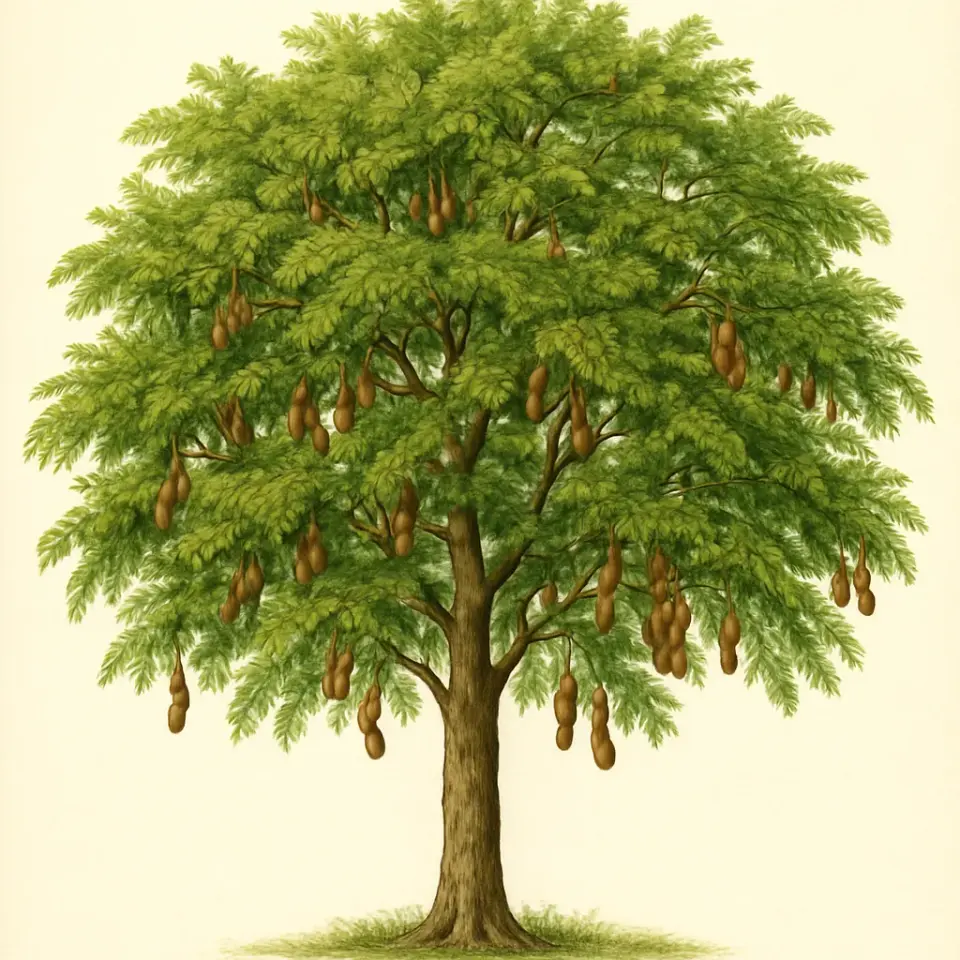
Tamarind (imli): the tree behind India's sour
इमली (imli)
Tamarind (Tamarindus indica), imli in Hindi and puli in Tamil, is the massive, feathery-leaved tree whose curved brown pods give South Indian cooking its sourness. Its Latin and Arabic names call it the “Indian date”, yet it is not Indian at all: it came from the savannas of tropical Africa and has been grown here for so many centuries that it is often mistaken for a native.
A very long-lived tree with fine feathery foliage and curved brown pods full of sticky sour pulp.
How to recognise it
Small paired leaflets that fold at night, a short massive trunk, and pods hanging in the crown most of the year.
Where to see it
Hampi
Tamarind fruit is a major food of sloth bears in this landscape as well as the acid in the local cooking, so the same groves feed the people and the bears.
 Pampa Sarovar · Sanapur Lake · Daroji Sloth Bear Sanctuary (often)
Hyderabad
Hyderabad's most famous tamarind stands at Osmania General Hospital: about 150 people survived the Musi flood of September 1908 by clinging to it, and a memorial is held beneath it every year. Osman Sagar was built after the same flood to protect the city.
KBR National Park · Osman Sagar (Gandipet Lake) · Ananthagiri Hills
Mysore
Sour tamarind pulp is the acid base of most South Indian cooking, and roadside tamarind avenues were deliberately planted as shade for bullock carts long before motor traffic.
Kukkarahalli Lake · Bandipur Tiger Reserve
Pune
Tamarind pulp is the sourness in sambar, rasam and chutney across India. Old tamarinds are common village landmarks and are seldom cut.
Saras Baug · Parvati Hill · Empress Botanical Garden
The tree, the leaf and the pod
A grown tamarind is long-lived and heavy-set: up to 25–30 m tall, with a dense crown up to 12 m across and a trunk that can reach 7.5 m around. The timber is hard, with a dark red heartwood. The leaves stay on all year, divided into many small bright-green leaflets that fold together at night.
The flowers are easy to miss: small, about 2.5 cm, five-petalled, yellow streaked with orange or red. The pods are the giveaway, 12–15 cm long, curved, with a hard brown shell. Asian trees bear longer pods with six to twelve seeds set in sticky brown pulp, and a mature tree can yield up to 225 kg of fruit a year.
An African tree with an Indian name
The English word goes back to Arabic tamr hindi, “Indian date”, and Marco Polo wrote it as tamarandi. Botanists, however, place the tree's home and domestication in the dry savannas of the Sudanian belt of Africa, where it still grows wild. It reached South Asia through people, probably several thousand years ago, and spread so thoroughly that it is sometimes reported as native. In the 16th century Spanish and Portuguese colonists took it on to Mexico and Central America.
In the Indian kitchen
The pulp is sweet and sour. It gives the sour base of sambar, rasam and chutney, and the sweet tamarind chutney served with samosas and other snacks in India and Pakistan; in India tamarind pulp is also made into a juice used to preserve fish. Young leaves are used in Indian cooking too.
The seeds are not edible raw; they have to be soaked and boiled first.
Avenues, landmarks and bears
In India tamarind is mostly met as a planted tree, single or in lines. Many roadside avenues were planted on purpose, long before motor traffic, to shade bullock carts, and old village tamarinds serve as landmarks that people are slow to cut.
Around Mysore look along the walking circuit of Kukkarahalli Lake and the highway through Bandipur, where langurs and macaques feed in the crowns; the rest of the city's trees are on the Mysore trees page. Around Hampi the same groves feed people and sloth bears: tamarind fruit is a major bear food at Daroji. In Hyderabad, an old tamarind at Osmania General Hospital is remembered for the roughly 150 people who survived the Musi flood of 1908 by clinging to it; a memorial is held beneath it every year. In Pune the database lists Saras Baug, Parvati Hill and Empress Botanical Garden.
The IUCN lists tamarind as Least Concern.
FAQ
Is tamarind native to India?
No. It is native to tropical Africa and was brought to South Asia by people, probably thousands of years ago. Its long history here is why it carries the name “Indian date”.
What is tamarind called in Hindi and other Indian languages?
Imli (इमली) in Hindi, puli in Tamil, valanpuli in Malayalam, hunase in Kannada and chinta in Telugu.
What is tamarind used for in Indian cooking?
Its sour pulp is the base of sambar, rasam and chutney, including the sweet tamarind chutney served with samosas, and a tamarind juice is used to preserve fish.
How big does a tamarind tree get?
Up to 25–30 m tall, with a crown up to 12 m wide and a trunk up to 7.5 m around. It lives a very long time, which is why old trees become village landmarks.
Sources (3)
Facts checked: 8 October 2026. Prices and hours are approximate; check locally.