 India GO
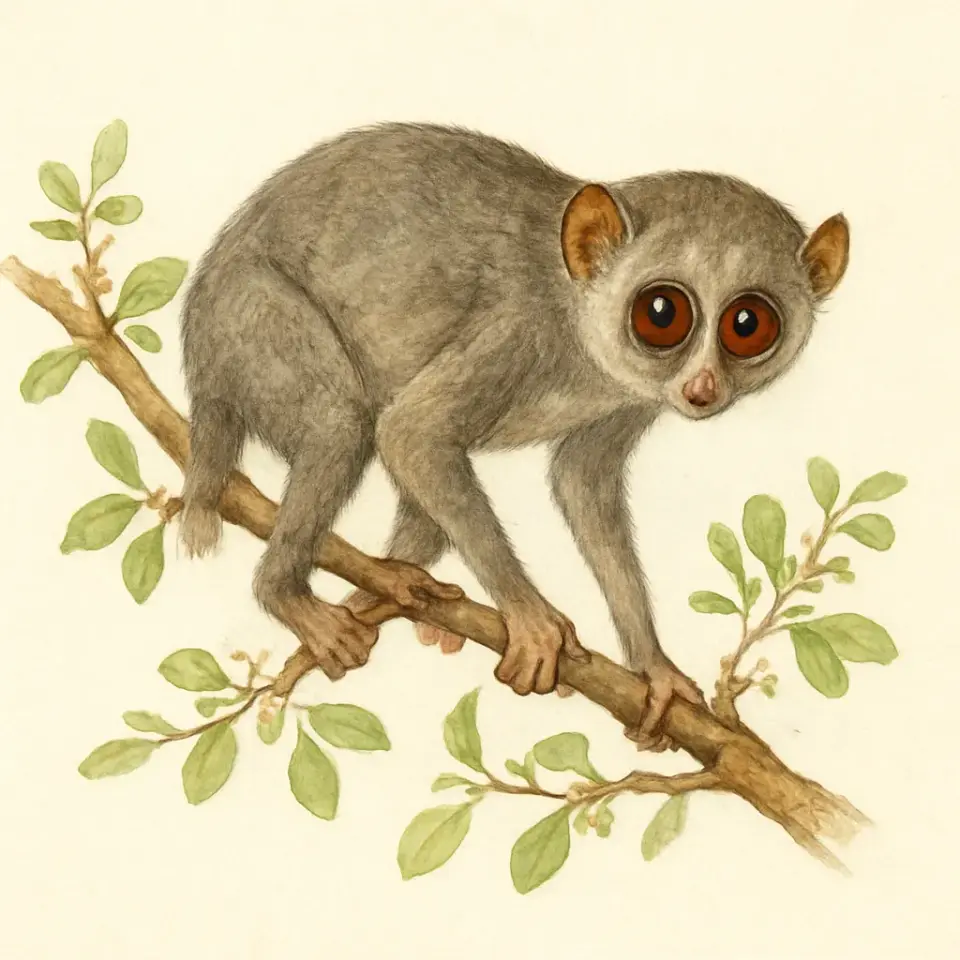
Grey slender loris: India's palm-sized night primate
The grey slender loris is a palm-sized nocturnal primate with enormous forward-facing eyes, found only in South India and Sri Lanka. It climbs slowly hand over hand, never jumps, and needs branches that touch, so it vanishes wherever a canopy is cut. It is listed as Near Threatened and has the highest level of protection in India, Schedule I of the Wildlife (Protection) Act. You will only see one after dark, on a guided night walk, as a red eyeshine in a torch beam.
A palm-sized nocturnal primate with enormous forward-facing eyes, which climbs hand over hand and never jumps.
How to recognise it
Only after dark, and only with a guided walk: a red eyeshine at torchlight, high in a continuous canopy. It needs branches that touch, so it disappears wherever a canopy is cut.
Protection
Schedule I, Wildlife (Protection) Act 1972 - the highest level of protection in India
Where to see it
Bengaluru
In Kannada it is kaadu paapa, 'forest baby'. A citizen-science project run out of the Indian Institute of Science has been mapping the city's lorises since the 2010s; some Bengaluru residents still treat the animal as an ill omen, which is itself a conservation problem. The lorises still live in the city's older tree patches.
 Turahalli Forest · Bannerghatta Biological Park
Tirumala
A 2025 Andhra Pradesh Forest Department survey counted 419 slender lorises in the Seshachalam forests of the Sri Venkateswara sanctuary, where a decade earlier the count had been in double digits.
Talakona Waterfall
What a slender loris looks like
Everything about it is built for slow, careful climbing at night. The limbs are extremely thin, the body small enough to sit in a palm, and the huge round eyes sit closer together than in any other primate, ringed with dark fur and separated by a pale stripe down the nose. The coat is short, grey or reddish on the back and white or buff underneath.
It moves hand over hand along branches and never leaps, so a continuous canopy is everything: a gap between two trees can be the end of its range. By day it sleeps curled in a hollow or dense foliage and comes out at dusk.
Its food is mainly insects, with some fruit, flowers and the occasional gecko or mouse. That diet makes it a welcome neighbour on farms: in South India it is often found in acacia and tamarind scrub next to fields, where cattle dung breeds plenty of insects.
Where it lives and where you might see it
India has two subspecies: the Malabar slender loris in the wet forests of the Western Ghats in Kerala, Karnataka and Tamil Nadu, and the Mysore slender loris in the dry forests of the southern Deccan and Eastern Ghats in Karnataka, Tamil Nadu and Andhra Pradesh. It is active all year, but only at night, and sightings are always a matter of luck.
Bengaluru
The city's lorises still live in its older tree patches. Turahalli Forest is one, though roads and construction have split it; around Bannerghatta Biological Park look to the surrounding national park forest, not the display enclosures. A citizen-science project run from the Indian Institute of Science has been mapping Bengaluru's lorises since the 2010s.
Seshachalam forests, Tirupati
A recent Andhra Pradesh Forest Department survey counted 419 slender lorises in the Seshachalam forests of the Sri Venkateswara sanctuary, where a decade earlier the count was in double digits. Guided night walks run in the Sri Venkateswara National Park forest near Talakona Waterfall; the dry months are easiest.
Threats, superstition and the law
The IUCN lists the grey slender loris as Near Threatened (2020 assessment), and in India it is in Schedule I of the Wildlife (Protection) Act, 1972, the highest level of protection: catching, keeping or selling one is an offence. The pressures are old and new at once. Lorises are still caught for love potions and folk remedies for leprosy and eye ailments, kept as pets (most die quickly in captivity) and used by street astrologers to pick cards. Meanwhile road building and tree felling cut the canopy it cannot cross.
It also breeds slowly, with one of the lowest reproductive rates of any small primate: a pregnancy of about 170 days, often twins, but a female breeds only once a year.
In Kannada it is kaadu paapa, the forest baby; in Tamil devangu, in Telugu devanga pilli. Some people still treat it as an ill omen, which is itself a conservation problem.
FAQ
Where is the slender loris found in India?
Only in the south: the Western Ghats of Kerala, Karnataka and Tamil Nadu, and the dry forests of the southern Deccan and Eastern Ghats, including around Bengaluru and Tirupati.
Is the slender loris endangered?
The IUCN lists the grey slender loris as Near Threatened (2020), and India protects it under Schedule I of the Wildlife (Protection) Act, 1972.
Can I keep a slender loris as a pet?
No. It is a Schedule I species, so keeping one is illegal, and lorises rarely survive long in captivity.
What does the slender loris eat?
Mostly insects, plus some fruit, flowers and occasionally small animals such as geckos.
What is the slender loris called in Kannada?
Kaadu paapa, meaning "forest baby".
Sources (2)
Facts checked: 8 October 2026. Prices and hours are approximate; check locally.