 India GO
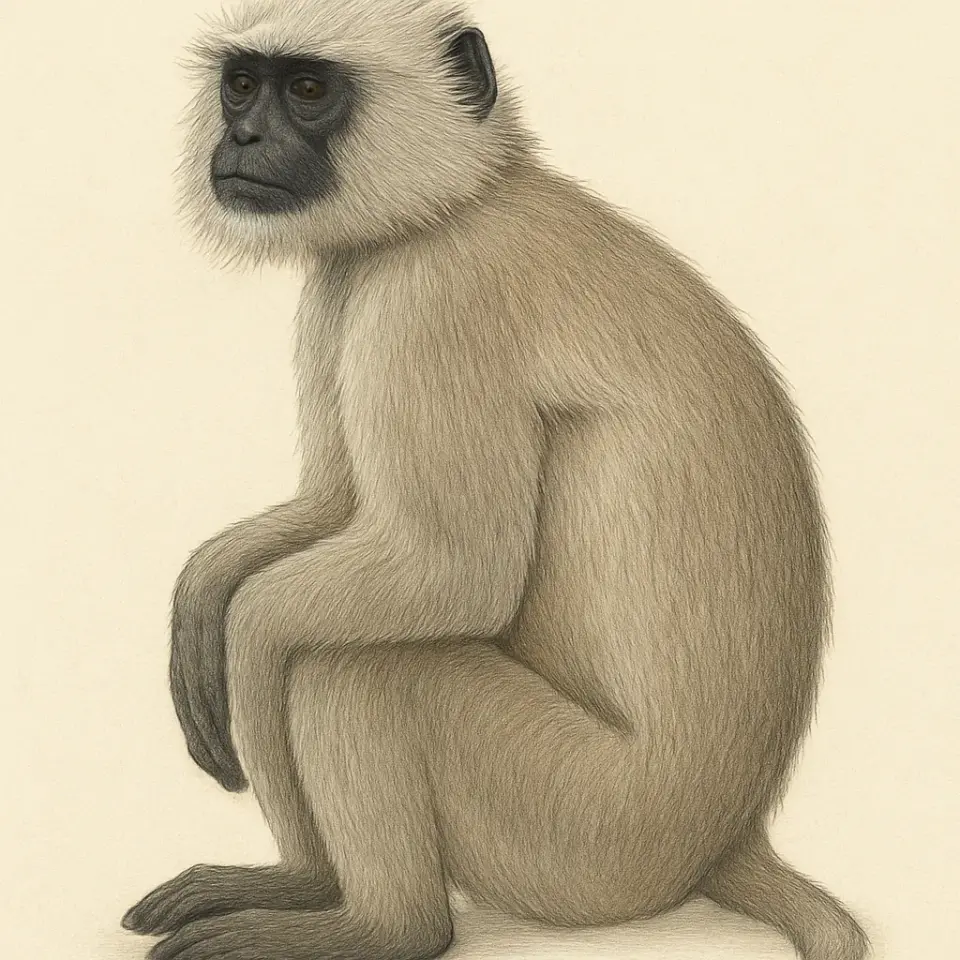
Northern plains grey langur: Hanuman's monkey
हनुमान लंगूर (Hanuman langur)
The northern plains grey langur, also called the Hanuman or sacred langur, is the tall silver-grey monkey with a black face and a tail longer than its body. It lives across north and central India south of the Himalaya, year-round, and because it is identified with Hanuman it is left alone even in towns. It eats leaves, fruit and flowers, and it is a different animal from the bag-snatching rhesus macaque.
A tall, slender, silver-grey monkey with a black face, black hands and a tail far longer than its body. It is quieter than the rhesus macaque: it eats leaves and flowers and does not raid bags.
How to recognise it
Silver-grey body, black face and hands, and that enormous tail carried in a loop over the back. Langurs move through the canopy in long leaps; macaques stay on walls and wires.
Protection
Protected under the Wild Life (Protection) Act, 1972.
Where to see it
Ajmer
The langur is identified with Hanuman throughout northern India, which is why it is left alone even where it raids gardens. Rajasthan has both this species and the rhesus macaque, and they share the same hills without interbreeding.
 Maharana Pratap Smarak & Nag Pahar Ridge (often) · Daulat Bagh (Subhash Udyan)
Delhi
Named for Hanuman and rarely harmed anywhere in north India, which is the main reason it survives inside towns at all.
Sanjay Van · Asola Bhatti Wildlife Sanctuary (Neeli Jheel) · Aravalli Biodiversity Park (often)
Mathura
The grey langur is Hanuman's monkey, which is why it is fed at shrines and never driven off, and why troops sit on temple roofs with no one minding. Around Mahavan and Gokul they share the groves with the macaques but keep to the treetops.
Brahmand Ghat, Mahavan (often) · Raman Reti, Gokul (often)
Pushkar
The Hindi name ties the species to Hanuman, and the black face and hands are explained in the Ramayana story as burns taken when he set Lanka alight. Rajasthan has both this langur and the rhesus macaque, and they use the same hills without mixing.
Naga Pahar (Snake Mountain) (often) · Pushkar Lake
Rishikesh
Named for Hanuman and rarely harmed anywhere in north India, which is the main reason it survives inside towns at all.
Neelkanth Mahadev Temple · Phool Chatti Waterfall (often) · Garud Chatti Waterfall (often)
Ujjain
Named for Hanuman and rarely harmed anywhere in north India, which is the main reason it survives inside towns at all.
Dewas Tekri (Mata Tekri) · Naulakhi Eco Tourism Park (often)
Langur or macaque
Most visitors meet two monkeys in north India and mix them up. The langur is the bigger, leaner one: head and body 45–78 cm, a tail of 80–112 cm, adult males about 17–19.5 kg. The fur is pale silver-grey, darker on the back and limbs, and the face, ears, hands and feet are black. Infants are brown.
The rhesus macaque is much smaller (males about 7.7 kg), brown or grey, with a bare pink face and a tail of only about 21–23 cm. It is the one that steals food and raids bags. A langur moves through the canopy in long leaps and sits on temple roofs and in big trees; macaques stay on walls and wires. More about the macaque is on the rhesus macaque page.
How a langur troop lives
Langurs are active by day and as much at home on the ground as in the trees. Their natural habitat is dry tropical forest and scrub, and the range covers much of India south of the Himalaya, down to the Tapti and Krishna rivers. The key to their success is the stomach: they can live on mature leaves, which lets them get through the dry season when fruit is scarce. They also eat fruit, flowers, buds, seeds, bark and insects, and around temples many troops get a large share of their food from people.
The usual group is one adult male with several females and young; males that have no group live in all-male bands, and some troops pass a hundred animals. Young males leave home, females stay. In forests langurs keep company with chital deer, and the two answer each other's alarm calls: the monkeys see from the treetops, the deer smell and hear better. Rufous treepies follow them through the canopy too, picking up what they shake loose.
Hanuman's monkey
In Hindi the animal is simply the Hanuman langur. Hanuman, the monkey devotee of Rama, is worshipped across north India, and the langur is treated as his kin: fed at shrines, never driven off, allowed to sit on temple roofs. A story from the Ramayana tradition explains the black face and hands as burns Hanuman took when he set Lanka alight.
That reverence has practical weight. It is the main reason a large monkey survives inside Indian towns at all, and why the species is still common across its range.
Where to see langurs
Langurs are resident, so there is no season: what matters is finding big trees or rocky wooded hills.
Delhi: Sanjay Van, the Aravalli Biodiversity Park and Asola Bhatti. See also animals of Delhi.
Mathura and Braj: the old groves above Brahmand Ghat at Mahavan and around Raman Reti in Gokul. Look up into the trees rather than along the walls.
Rishikesh: troops along the forest road to Neelkanth Mahadev and near the waterfalls of Phool Chatti and Garud Chatti.
Rajasthan and Ujjain: the wooded ridges of Naga Pahar between Pushkar and Ajmer, and Dewas Tekri and Naulakhi park near Ujjain.
The city cards above give the likelihood for each spot.
Keep your distance
Langurs are calmer than macaques and do not raid bags, but they are large wild animals. Don't feed them by hand, don't get between a mother and her infant, and keep children back. In India the species is protected under Schedule II of the Wild Life (Protection) Act as amended in 2022; catching or keeping one is an offence. The IUCN lists it as Least Concern, though road traffic, dogs and loss of forest take a toll.
FAQ
What is the difference between a langur and a monkey?
A langur is a monkey: a leaf-eating one. In India the contrast people mean is with the rhesus macaque, which is much smaller, brown or grey, pink-faced and short-tailed; the langur is silver-grey with a black face and a very long tail.
Why is it called the Hanuman langur?
Because it is identified with Hanuman. A Ramayana story explains its black face and hands as burns from the setting alight of Lanka.
Are grey langurs dangerous?
They are generally calmer than macaques and do not snatch bags, but they are wild animals. Keep a few metres away, don't feed them and don't approach infants. If someone is bitten, call 112.
What do grey langurs eat?
Mostly leaves and fruit, plus flowers, buds, seeds, bark and insects. Being able to live on mature leaves carries them through the dry season.
Is the grey langur protected in India?
Yes. It is listed in Schedule II of the Wild Life (Protection) Act as amended in 2022.
Sources (4)
Facts checked: 8 October 2026. Prices and hours are approximate; check locally.