 India GO
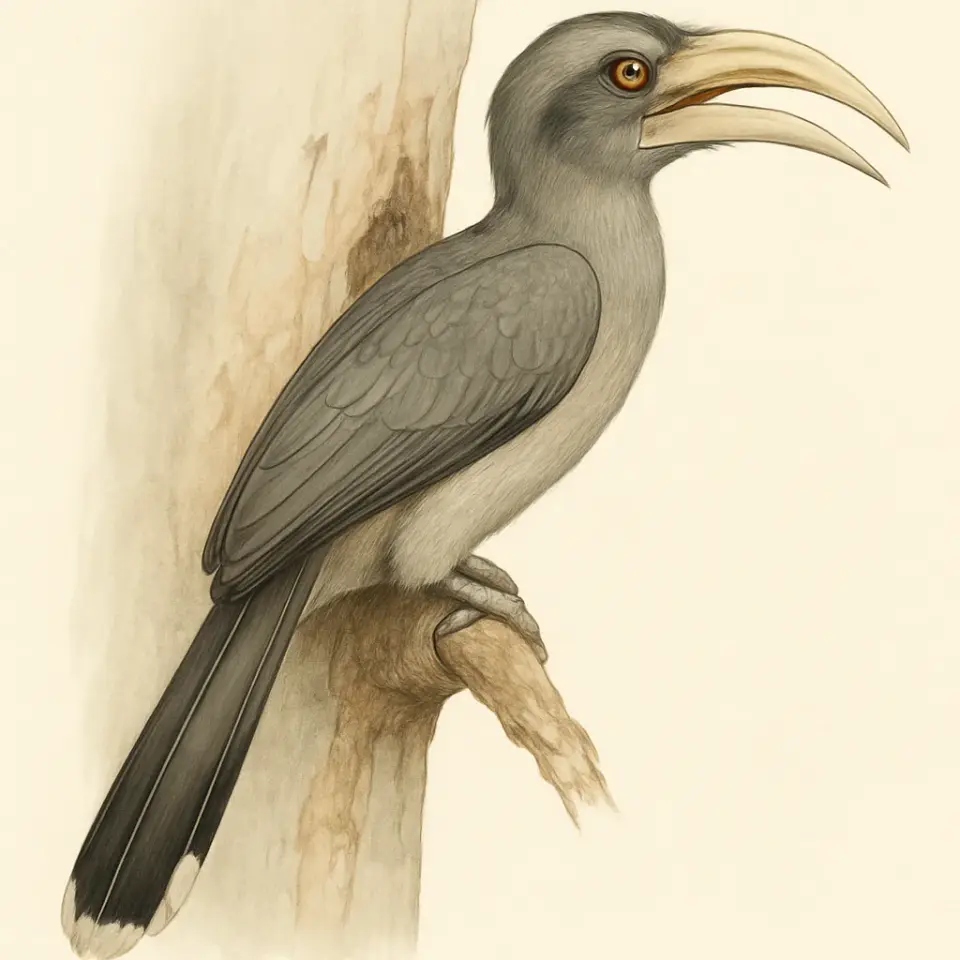
Indian grey hornbill (dhanesh): the big bird of old city trees
धनेश (dhanesh)
The Indian grey hornbill is a grey, long-tailed bird about 61 cm long with a heavy down-curved bill, and one of the few large birds that still lives inside Indian cities. It needs one thing above all: big old trees with hollows. Where those survive, in Delhi's tomb gardens, the groves of Vrindavan or Chandigarh's avenues, you can hear its squealing call from the canopy. In Hindi it is धनेश (dhanesh).
A grey, long-tailed hornbill with a down-curved bill and a small ridge running along the top of it. It lives in the big old trees of towns and groves.
How to recognise it
The flight gives it away — a few flaps, then a long glide on closed wings, with a heavy head in front and a very long tail behind. The call is a loud squealing cackle from inside the canopy.
Where to see it
Chandigarh
The state bird of Chandigarh, adopted with the city's other three symbols in 2010. It needs old trees with natural hollows to nest in, which the city's mature avenue planting now provides.
 Leisure Valley (often) · Sukhna Wildlife Sanctuary (often) · Pinjore Gardens (often)
Delhi
One of the few large birds that has kept a foothold inside central Delhi, because the old tomb gardens still hold hollow trees for it to nest in.
Lodhi Garden (often) · Sanjay Van (often) · Sunder Nursery (often)
Govardhan
The female walls herself into a tree hollow with mud, leaving a slit through which the male feeds her and the chick for weeks. A pair therefore depends on the old trees along the circuit and around the tanks, the same trees that give pilgrims their shade.
Govardhan Hill & Parikrama Marg (often) · Mansi Ganga (often)
Pune
The female seals herself into a tree hole with mud while nesting and is fed by the male through a slit, which makes old hollow trees non-negotiable for the species.
Empress Botanical Garden (often) · Vetal Tekdi (often) · P.L. Deshpande Garden (Okayama Friendship Garden) (in season)
Vrindavan
The female shuts herself into a tree hollow, sealing the entrance with mud until only a narrow slit is left, and the male feeds her and the chick through it for weeks. A pair therefore needs a big hollow tree, which is why hornbills vanish from a town as soon as its old trees do. The hornbill is one of the few large birds that stays inside the built-up parts of Vrindavan.
Gahvar Van (often) · Bhandirvan (Bhandir Vat) (often) · Vrindavan Parikrama Marg (often)
Male, female and voice
The bill gives the sexes away. Males carry a larger casque, the ridge along the top of the bill, and a darker bill; females have a more yellowish bill with black marks and a smaller casque. Pairs stay close, so you often get to compare the two in one tree.
The call is a loud squeal, close enough to a black kite's that it is easy to look for the wrong bird. Hornbills are mostly in the canopy and come down little; in a quiet garden, listen for the squeal, then wait for the glide between crowns.
The sealed-in nest
Hornbill nesting is unusual. Between April and June the female climbs into a tree hollow and seals the entrance with her droppings and mud pellets brought by the male until only a slit is left. She lays one to five white eggs and stays inside, while the male flies in with food and passes it through the gap; he also brings pieces of bark that help keep the chamber clean.
That is why the species vanishes from a town as soon as its old trees do. A neat young avenue offers shade but no hollows.
What it eats
Mostly fruit, including figs: in Delhi's Lodhi Garden it feeds in the fig trees around the tombs, so fruiting peepals and banyans are worth checking. It also takes other fruit such as carissa, and more animal food than its gentle look suggests: snails, scorpions, insects, lizards and even small birds. Birds sometimes grapple bills or joust in the air; this is social behaviour.
Where to see it
In Delhi the old gardens are the reliable places: Lodhi Garden, where the birds feed in the fig trees around the tombs, Sunder Nursery and Sanjay Van; more of the city's birds are on the Delhi birds page. In Braj, try Gahvar Van and Bhandirvan near Vrindavan, or the big trees around Mansi Ganga in Govardhan, where pairs often cross the parikrama road calling.
Chandigarh adopted the grey hornbill as its state bird in 2010, along with three other city symbols; the India GO list there is Leisure Valley, Sukhna Wildlife Sanctuary and Pinjore Gardens.
FAQ
What is the Indian grey hornbill called in Hindi?
धनेश (dhanesh). Around Vrindavan and Govardhan people also say धनचिड़ी (dhanchiri).
Which state's bird is the Indian grey hornbill?
It is the state bird of Chandigarh, adopted in 2010.
When does the Indian grey hornbill nest?
April to June. The female seals herself into a tree hollow and the male feeds her through a slit.
Is the Indian grey hornbill protected?
Yes. It is listed in Schedule II of the Wild Life (Protection) Act as amended in 2022; IUCN lists it as Least Concern.
How do I tell a male from a female?
The male has a larger casque and a darker bill; the female's bill is more yellowish with black marks.
Sources (3)
Facts checked: 8 October 2026. Prices and hours are approximate; check locally.