 India GO
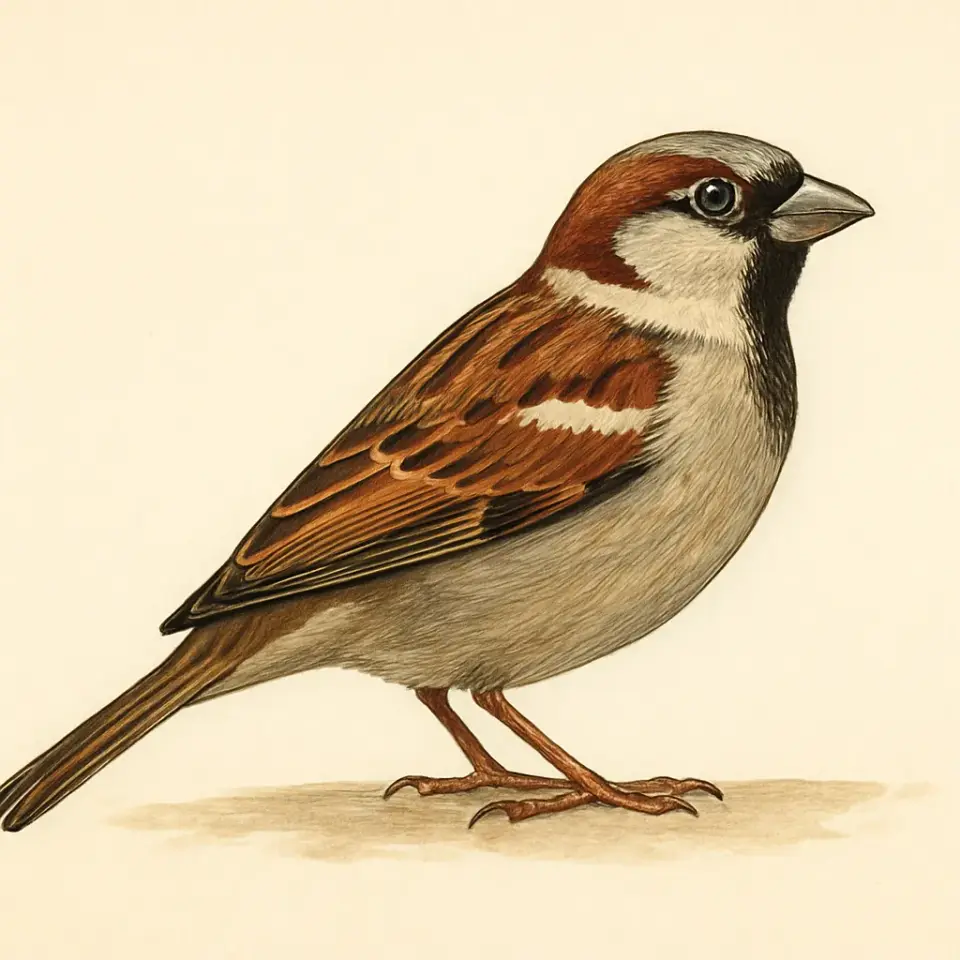
House sparrow: the gauraiya, Delhi's state bird
गौरैया (gauraiya)
The house sparrow, gauraiya in Hindi, is the small brown bird of courtyards, shop awnings and old markets. In the 2000s it disappeared from many Indian cities, and that decline turned it into a symbol: Delhi declared it the state bird in 2012 to draw attention to it, and World Sparrow Day on 20 March began as an Indian initiative.
The small brown bird of courtyards and shopfronts. Numbers fell sharply in Indian cities in the 2000s, and it has become the emblem of urban nature campaigns.
How to recognise it
The male has a grey cap and a black bib, the female is plain buff with a pale stripe behind the eye. Look in old markets and under shop awnings rather than in new glass districts.
Where to see it
Delhi
Declared the state bird of Delhi in 2012 specifically to draw attention to its decline in the city. World Sparrow Day, on 20 March, was started in India.
 Sunder Nursery (often) · Lodhi Garden (often) · Shantivan & Parks Beyond Red Fort
Male, female and look-alikes
A house sparrow is about 16 cm long and weighs 24–40 g, with a full chest, a round head and a short, thick, conical bill made for cracking seeds.
The male has a grey cap, a black bib on the throat and bolder black, white and brown markings than the female. The female is plain buff and grey-brown, with a pale stripe behind the eye and no bib. Young birds look like females.
The sparrows of the Indian subcontinent belong to their own subspecies, Passer domesticus indicus, which was first described from Bangalore. In north India in winter another subspecies arrives from Central Asia; it keeps to open country rather than towns.
Where to see sparrows in Delhi
Sparrows follow old buildings, not new ones. Look in old markets and under shop awnings, where there are gaps in walls and eaves to nest in, rather than in districts of glass and concrete. Old Delhi's markets and courtyards hold far more of them than the newer parts of the city.
Among the parks in the guide, house sparrows are frequent at Sunder Nursery and Lodhi Garden, and common at Shantivan by the Yamuna. Listen before you look: a loose chorus of cheeps from a hedge or a roofline usually means a small flock.
The birds nest mostly in the eaves and crevices of houses, and the chicks are raised on insects, which is why gardens and hedges near old buildings suit them.
Why sparrows disappeared from Indian cities
Worldwide the house sparrow is still the most widely distributed wild bird, rated Least Concern by the IUCN. But its numbers have fallen in many places close to its original range, and in South Asia it has largely vanished from many major cities.
There is no single proven cause. The causes discussed in the encyclopedia include fewer nesting holes in modern buildings, loss of the bushes sparrows hide in, predators, disease, and above all a shortage of insects to feed the chicks, linked to pesticides, monoculture and the replacement of native plants in cities with introduced plants and parking areas. Radiation from mobile phones is often blamed; it is among the proposed causes, not the established ones.
Because the shortage of nesting sites is probably one factor, conservation groups encourage special nest boxes for sparrows.
State bird of Delhi and Bihar, and World Sparrow Day
Delhi declared the house sparrow its state bird in 2012, specifically to draw attention to its decline in the city. Bihar has also adopted the house sparrow as its state bird.
World Sparrow Day, 20 March, was started by the Nature Forever Society of India, founded by the conservationist Mohammed Dilawar, who began his sparrow work in Nashik. The first World Sparrow Day was held in 2010, together with partners in France and elsewhere, and it now promotes common urban birds in general.
In law the house sparrow is in Schedule II of the Wild Life (Protection) Act as amended in 2022, so hunting or capturing wild sparrows is prohibited.
FAQ
What is the house sparrow called in Hindi?
Gauraiya (गौरैया).
Which is the state bird of Delhi?
The house sparrow, declared in 2012 to draw attention to its decline in the city.
How can I tell a male sparrow from a female?
The male has a grey cap and a black bib; the female is plain buff-brown with a pale stripe behind the eye and no bib.
Is the house sparrow endangered in India?
Not globally: the IUCN rates it Least Concern. It has declined sharply in many Indian cities, and in India it is protected under Schedule II of the Wild Life (Protection) Act.
When is World Sparrow Day?
On 20 March. It was started by India's Nature Forever Society and first held in 2010.
Where can I see house sparrows in Delhi?
In Old Delhi's markets and courtyards, and in parks such as Sunder Nursery and Lodhi Garden, where they are frequent.
Sources (5)
Facts checked: 8 October 2026. Prices and hours are approximate; check locally.