 India GO
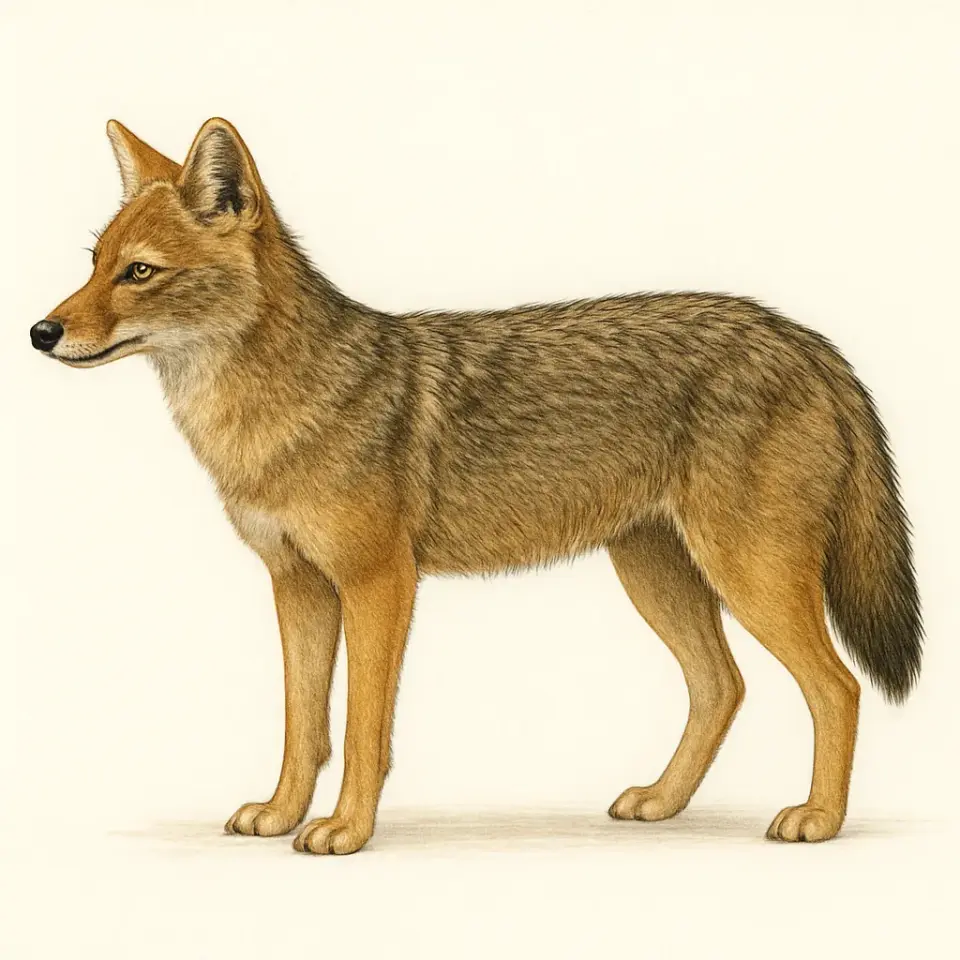
Golden jackal (siyar): the voice of the Indian dusk
सियार (siyar)
The golden jackal is India's everyday wild dog: a medium-sized, dog-like animal, sandy-grey with a black-tipped tail, living in scrub and along rivers right up to the edges of Delhi and other cities. In Hindi it is सियार (siyar). Most people hear it long before they see it, as a rising chorus of howls at dusk.
A medium dog-like animal, sandy-grey with a black-tipped tail, living in scrub and along riverbanks on the edge of Indian cities.
How to recognise it
Most often heard: a rising chorus of howls at dusk, taken up by several animals at once. Seen best at first light on open ground.
Where to see it
Auroville
The jackal's return is one of the clearest measures of the restoration here: a predator only settles where there is enough prey and enough cover, which on this plateau did not exist before the planting began.
 Pitchandikulam Forest
Delhi
Camera traps set across Asola Bhatti in 2021–2022 by the BNHS and the Delhi forest department caught jackals scavenging nilgai carcasses, and never more than two of them in one frame.
Asola Bhatti Wildlife Sanctuary (Neeli Jheel) (often) · Aravalli Biodiversity Park (often) · Sanjay Van (in season)
Size and habits
Males are 71–85 cm long without the tail and weigh 6–14 kg, females a little less. The coat shifts with the seasons, pale cream in summer and darker tawny in winter, and the build is lighter than a wolf's, with shorter legs and a narrow, pointed muzzle.
Jackals are monogamous: the pair stays together until one dies, sometimes with the year's young around them. They eat almost anything: rodents, birds, insects, fruit and carrion. In Delhi's Asola Bhatti sanctuary, camera traps caught them at the carcasses of nilgai.
The howl
The call is the jackal's signature. A howl starts with two or three low calls that rise to a high wail, and a single howl can draw replies from several jackals nearby. Jackals typically howl at dawn and in the evening. Howling is most frequent from December to April, when pairs form and breed, which suggests it helps mark territory. In Delhi the India GO notes say they are heard at dusk more often than seen.
Is it dangerous?
Jackals usually keep away from people, but attacks are recorded in India: in one forest division of Chhattisgarh 220 non-fatal attacks were reported in 1998–2005, mostly in villages where jackals were regularly chased off; females with pups attacked more often. Jackals can also carry rabies. Do not feed them or try to approach, keep children and dogs close at dusk, and if anyone is bitten, call 112 for help.
The Panchatantra trickster
In Indian folklore, the Jatakas and the Panchatantra the jackal is the clever, scheming one. The first book of the Panchatantra is built around two jackals, Damanaka and Karataka, ministers at a lion's court who set out to break up the king's friendships, and the same book has the Blue Jackal, who falls into a tub of indigo dye and passes himself off as the protector of the forest.
Where to look
Open ground at first light gives the best chance of seeing one; dusk gives the best chance of hearing them. In Delhi, the restored grassland of Aravalli Biodiversity Park, the ridge forest of Asola Bhatti and Sanjay Van all hold jackals; the rest of the city's mammals are on the Delhi animals page. At Auroville, where it has been documented on camera traps at Pitchandikulam Forest, the jackal's return to the replanted plateau is counted as one of the measures of the restoration.
FAQ
Is the golden jackal found in India?
Yes, across most of the country, in scrub, farmland and river margins, often close to towns.
Is the golden jackal dangerous to humans?
Rarely. It usually avoids people, though non-fatal attacks are recorded in India, and it can carry rabies: never feed or approach one, and call 112 if someone is bitten.
Is the golden jackal protected in India?
Yes. Under the Wild Life (Protection) Act as amended in 2022 the jackal (Canis aureus) is in Schedule I, Part A (mammals), the highest category.
What is a jackal called in Hindi?
सियार (siyar). In Tamil and Kannada it is nari.
What does a golden jackal eat?
Almost anything: rodents, birds, insects, fruit and carrion.
Is the golden jackal the same as the African golden wolf?
No. A 2015 genetic study showed that African «golden jackals» are a separate species, the African golden wolf; the jackal of India is Canis aureus.
Sources (4)
Facts checked: 8 October 2026. Prices and hours are approximate; check locally.