 India GO
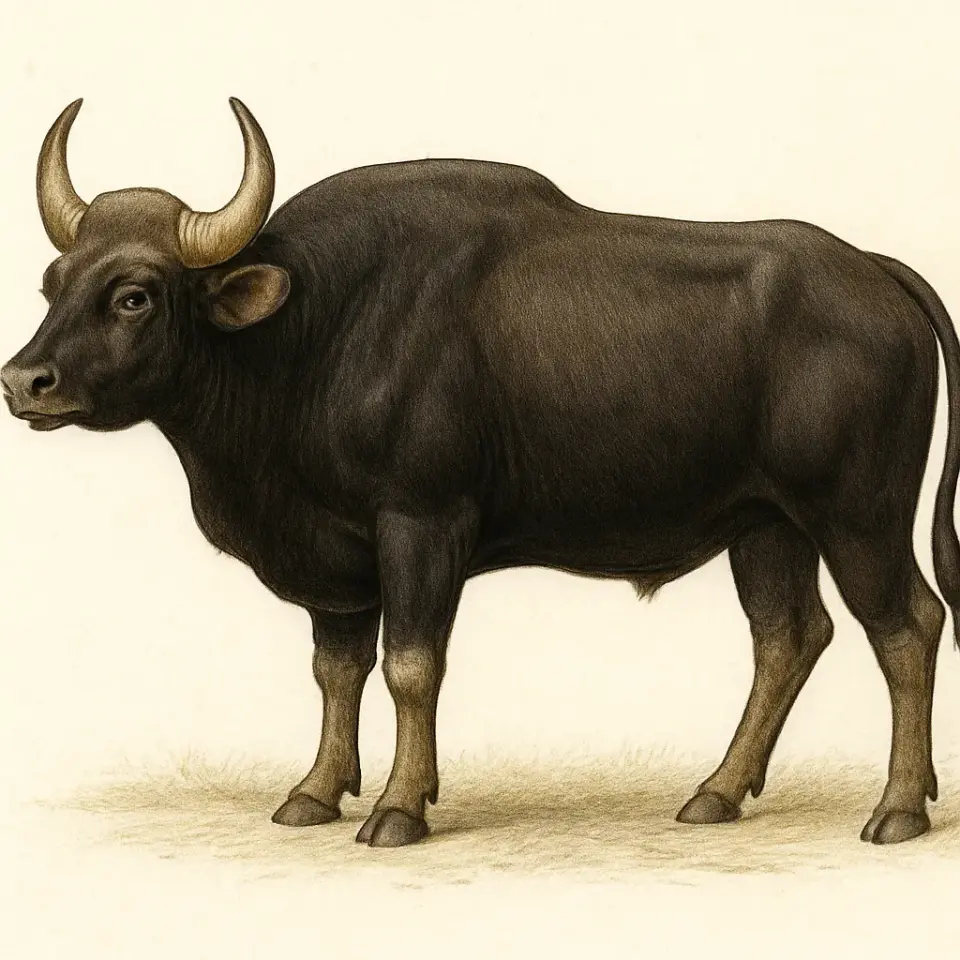
Gaur, the Indian bison: the largest wild cattle in the world
गौर (gaur)
The gaur (Bos gaurus), often called the Indian bison, is the largest wild cattle species in the world: a big bull stands close to two metres at the shoulder and can weigh around a tonne and a half. The gaur is Goa's state animal, is listed as Vulnerable by the IUCN, and is in Schedule I of India's wildlife law.
The largest wild cattle in the world: a black bull with white stockings, a high ridge along the shoulders and a bulging pale forehead.
How to recognise it
Size alone identifies it — a big bull stands nearly two metres at the shoulder. Herds feed at forest edges at dawn and dusk.
Protection
Schedule I of the Wildlife (Protection) Act, 1972.
Where to see it
Goa
The state animal of Goa. Gaur come down to plantation and village edges in the Ghat interior, and are the largest wild cattle in the world.
 Chorla Ghat (in season) · Budbudyanchi Tali (Bubbling Lake), Netravali
Isha Yoga Center
Gaur, elephant, leopard and Nilgiri langur are all recorded in the Siruvani forest, which forms part of the Nilgiri Biosphere Reserve: India's first, constituted in September 1986 and covering 5,520 sq km across three states.
Kovai Kutralam (Siruvani Falls) (in season) · Velliangiri Hills (in season) · Nilgiri Biosphere Nature Park, Anaikatti
Mysore
A year-long 2023 study in Bandipur found only about 43% of the reserve still suitable for gaur, with invasive lantana among the main reasons, and its authors call for restoring the grasslands.
Bandipur Tiger Reserve (often)
Ooty & Coonoor
Estate workers here have lived alongside gaur for generations and work near them without alarm. The animals usually ignore people who keep their distance: this is a coexistence situation, not a danger zone.
Sim's Park Coonoor (in season) · Wenlock Downs (often) · Lamb's Rock (in season)
How big a gaur is and how to recognise it
The gaur is the largest living member of the cattle family: 2.5 to 3.3 metres from nose to rump, 1.42 to 2.2 metres at the shoulder, about 1.68 metres on average in cows and 1.88 metres in bulls. Bulls in India weigh around 1,500 kg on average; cows are lighter, roughly 700 kg.
The details to look for:
- Colour. Adult bulls are dark brown, close to black in old animals. Cows and young bulls are paler, sometimes reddish.
- Legs. The lower legs are white or tan, like stockings.
- Back. A distinct ridge runs from the shoulders to the middle of the back, so the shoulders stand higher than the rump.
- Head. A high, rounded ridge between the horns and a pale grey forehead. Both sexes have horns that curve upward and inward, pale green or yellow with black tips.
How gaur live
Gaur keep to evergreen, semi-evergreen and moist deciduous forest, preferably hilly, with water nearby. Herds are led by an old cow; in January and February they are small, eight to eleven animals with one bull, and in the breeding season more bulls join them.
Where they are left alone, gaur are active by day, but where people disturb the forest they shift towards the night. A study in Goa's Bhagwan Mahaveer Sanctuary and Mollem National Park recorded 32 food plants and found feeding peaks between 6:30 and 8:30 in the morning and between 17:30 and 18:45 in the evening, with the hottest hours spent resting in the shade. That is why sightings cluster at forest edges early and late.
Is the gaur dangerous?
In undisturbed forest gaur are timid and crash away into cover when alarmed. Where they are used to people, as in parts of South India, they can be bold; bulls may charge without provocation, especially in summer heat. Estate workers in the Nilgiris live and work near gaur without alarm, and the animals usually ignore people who keep their distance. So keep your distance: watch from a safari vehicle or from well back on a road, do not walk towards a herd or get between a cow and her calf, and never approach on foot for a photo. In an emergency in India, call 112.
Where to see gaur in India
The Western Ghats and the hills around them are one of the gaur's main strongholds, especially the forest block that joins Wayanad, Nagarhole, Mudumalai and Bandipur; Nagarhole and Bandipur have each been reported to hold around 2,000 animals. The places the India GO database records:
- Mysuru, for Bandipur. Herds graze the open grass patches of Bandipur Tiger Reserve and are often seen from the safari track. A 2023 study there found only about 43% of the reserve still suitable for gaur, with invasive lantana a main cause.
- Goa. The gaur comes to forest and plantation edges in the Ghat interior: at Chorla Ghat, around Netravali, and on guided walks arranged through the forest office at Valpoi. Details are on the gaur in Goa page.
- Ooty and Coonoor. Herds on the open downs at Wenlock Downs, and at dusk around Sim's Park in Coonoor and on the estate road to Lamb's Rock.
- Isha Yoga Centre, near Coimbatore. On the lower forested slopes of the Velliangiri Hills and around the Siruvani falls, part of the Nilgiri Biosphere Reserve.
Sightings are never guaranteed, and the database marks most of these places as seasonal or a matter of luck.
Protection status
The gaur has been listed as Vulnerable on the IUCN Red List since 1986. The global population was estimated in 2016 at no more than 21,000 mature animals, most of them in India; in Indochina and Malaysia numbers fell by more than 70% over three generations, and the species is gone from Sri Lanka. In India it is in Schedule I of the Wild Life (Protection) Act, the highest level of protection, and it is also on CITES Appendix I, which bans international commercial trade.
FAQ
Is the gaur the same as the Indian bison?
Yes, Indian bison is a common name for the gaur, but the animal is not a true bison. It belongs to the genus Bos with domestic cattle; its closest wild relatives are the banteng and the kouprey of Southeast Asia.
What is the state animal of Goa?
The gaur. In Goa it lives in the forested Ghat interior, for example around Chorla Ghat and Netravali.
What is gaur called in Hindi?
Gaur (गौर). In Tamil it is kaattu erumai, in Malayalam kaattupothu and in Kannada kaadukona.
Sources (4)
Facts checked: 8 October 2026. Prices and hours are approximate; check locally.