 India GO
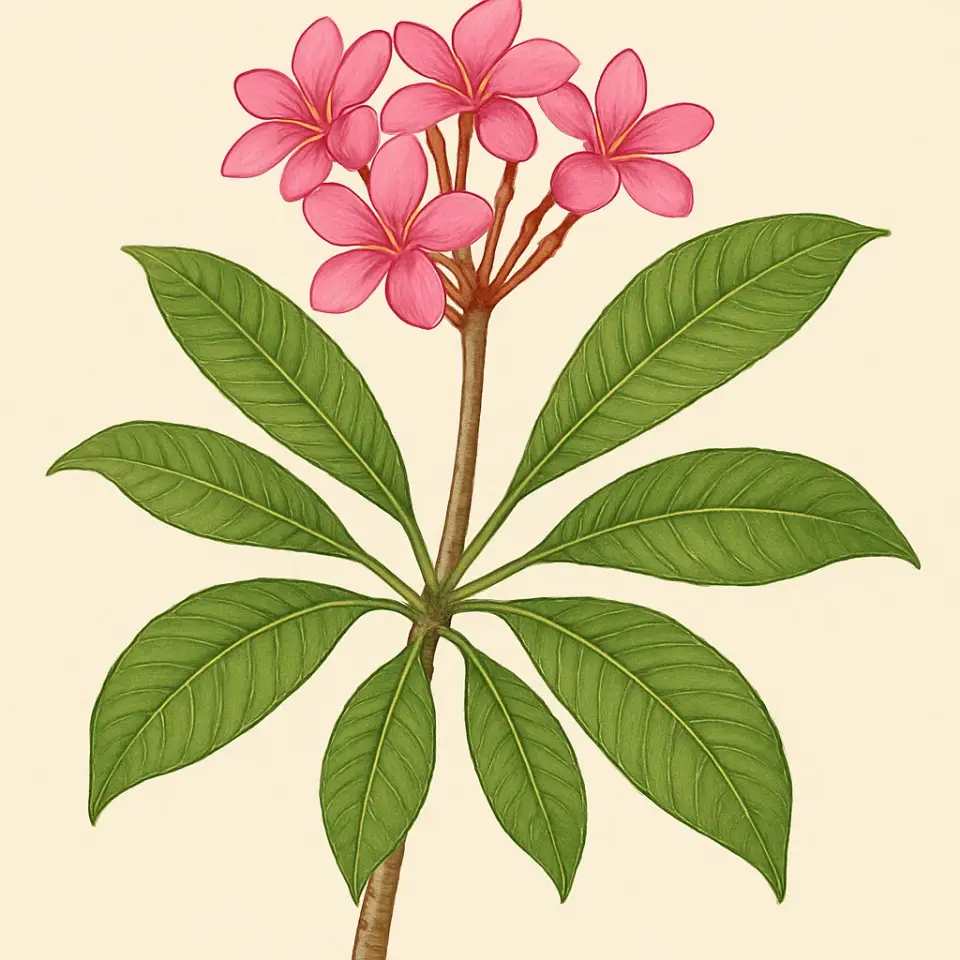
Frangipani: the temple-and-chapel tree of Goa and Mumbai
चंपा (champa)
Frangipani (Plumeria) is a small tree with thick, almost bare grey branches and clusters of waxy five-petalled flowers, white with a yellow centre or deep pink, most fragrant at night. In Hindi it is champa. It is not native to India: the genus comes from Mexico, Central America, the Caribbean and northwestern South America, and the Portuguese brought it to the Indian coast. In Goa it now grows by churches and temples alike.
A small bare-branched tree carrying thick five-petalled flowers, white with a yellow throat or deep pink, scented most strongly at night.
How to recognise it
Thick, blunt grey branches that look almost leafless, with flowers clustered at the tips. Breaking a twig releases white latex.
Where to see it
Goa
Brought from tropical America by the Portuguese, frangipani is planted around Goan churches and chapels and in temple courtyards alike, one of the few plants that reads as belonging to both.
 Garcia de Orta Garden (Panjim Municipal Garden) · Campal Gardens & the Riverfront · Sahakari Spice Farm (often)
Mumbai
Frangipani is not native to India: the Portuguese brought it from tropical America.
Hanging Gardens & Kamala Nehru Park · Rani Baug · Elephanta Caves (often)
How to recognise a frangipani
Look at the shape before the flowers. The branches are thick, blunt and succulent, grey, forking again and again, with leaves gathered only at the tips. In the dry season the tree can stand almost leafless.
The flowers grow in clusters at the ends of the branches. Each is a tube 5–10 cm long opening into five rounded, overlapping, waxy petals. The ones you see most in India are white with a yellow throat or deep pink; the database lists both Plumeria rubra and Plumeria alba.
Break a twig or a leaf and white milky sap appears. That is the most reliable test, and also the main caution: see the section below.
Why it smells strongest at night
Frangipani flowers are fragrant all day but strongest after dark, and the scent is a trick. The flowers produce no nectar. Their perfume draws sphinx moths (hawk moths), which fly from flower to flower looking for a reward that is not there and carry pollen as they go.
In the guide's notes for Goa and Mumbai it flowers from March to October. The scent has been compared to jasmine, citrus, gardenia, coconut and peach.
The name frangipani is often explained with a story about a sailor of that name on Columbus's ship who smelled the flowers from sea. The encyclopedia records that the story was invented in the 19th century by a perfumer to sell his products.
The milky sap irritates skin and eyes
Like other plants of the oleander family, frangipani has a milky latex with poisonous compounds that irritate the eyes and skin. Avoid breaking branches, keep the sap away from your eyes and wash your hands if it gets on them.
Where to see frangipani in Goa and Mumbai
Frangipani is grown as an ornamental across the tropics; in the guide it is marked on the west coast, in Goa and Mumbai, where the Portuguese brought it. In Goa it is planted around churches and chapels and in temple courtyards. For a close look, the guide marks it in the Panjim public gardens, including the Garcia de Orta garden, and as frequent at Sahakari Spice Farm. The Konkani name is khair chafo.
In Mumbai the guide lists it in the Hanging Gardens, at the Rani Baug zoo and, often, on Elephanta Island around the caves.
Champa, khair chafo and other names
In Hindi frangipani is champa (चंपा), in Konkani champe (चाम्पॅ) and in Marathi chafa (चाफा). The word travels: in Laos, where Plumeria rubra is the national flower, it is dok champa. Elsewhere in Asia the tree goes by names such as pagoda tree, kemboja and chempaka. Nicaragua has the same species as its national flower under the name sacuanjoche.
FAQ
What is frangipani called in Hindi?
Champa (चंपा). In Konkani it is champe, in Marathi chafa.
Is frangipani native to India?
No. Plumeria comes from Mexico, Central America, the Caribbean and northwestern South America; the Portuguese brought it to India.
Is frangipani poisonous?
Its milky sap contains compounds that irritate the skin and eyes. Do not break branches, and keep the sap off your skin and out of your eyes.
When does frangipani flower?
In Goa and Mumbai the guide notes flowering from March to October; the scent is strongest at night.
Where can I see frangipani in Goa?
Around churches, chapels and temples across Goa, in the Panjim public gardens and at Sahakari Spice Farm, where it is frequent.
Sources (3)
Facts checked: 8 October 2026. Prices and hours are approximate; check locally.