 India GO
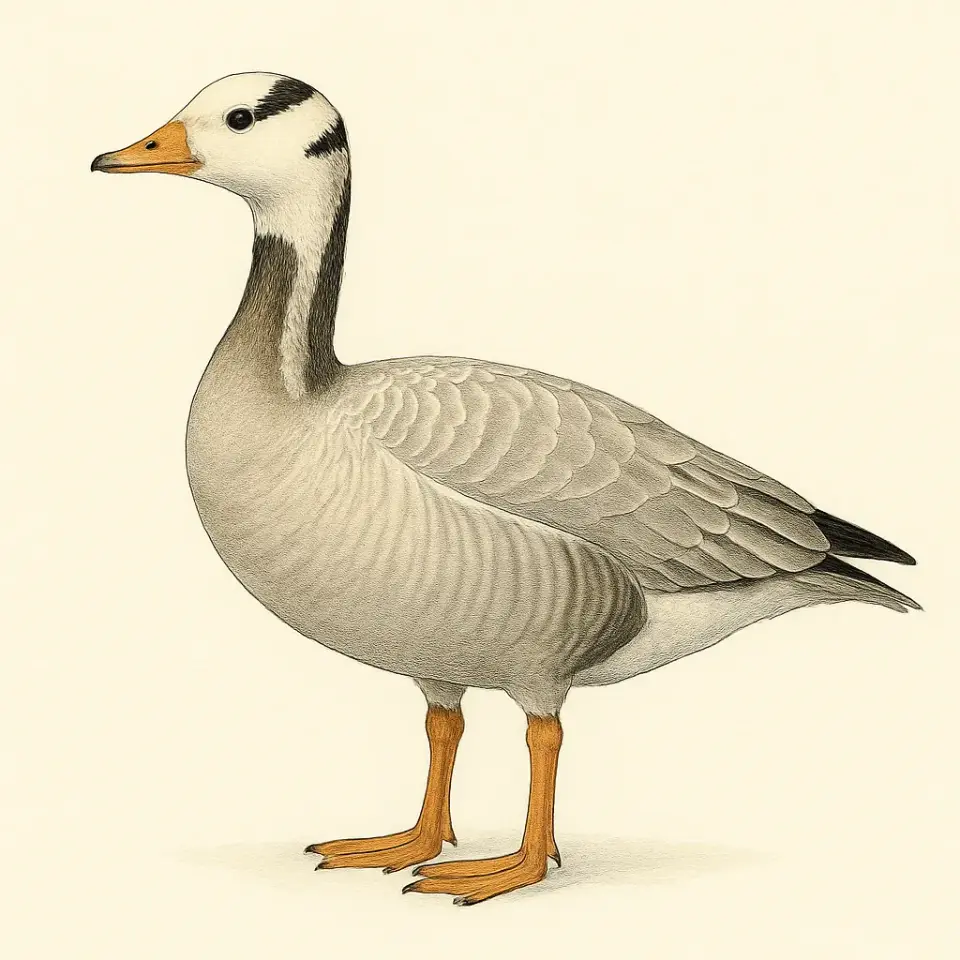
Bar-headed goose: the goose that crosses the Himalaya
राजहंस (rajhans)
The bar-headed goose is a pale grey goose with two black bars on a white head, and it is a winter guest: it breeds on high Central Asian lakes and spends roughly November to February on the wetlands, rivers and wet fields of north India. To reach them it crosses the Himalaya twice a year, one of the highest regular migrations of any bird.
A pale grey goose with two black bars across a white head. It breeds on the Tibetan plateau and crosses the Himalaya twice a year to winter in India.
How to recognise it
Two clean black bars on the back of the head, and an orange bill and legs. Flocks graze on sandbanks and wet fields and fly in ragged lines.
Where to see it
Agra
At Keoladeo the geese are grazers: a study in the park found that 97 per cent of what they ate was Paspalum distichum, the dominant grass of its wetlands, and that they fed in quiet spots away from roads and the park boundary.
 Keoladeo Ghana National Park (Bharatpur) (in season) · Sur Sarovar Bird Sanctuary (Keetham Lake) (in season)
Chandigarh
The rajhans of Sanskrit poetry, the swan-like bird said to separate milk from water, was identified by the Indologist J. Ph. Vogel with this goose or a close relative, not a European swan.
Sukhna Lake (in season) · Siswan Dam and Community Reserve (in season)
Dehradun
At Asan the January 2026 waterbird census counted 5,806 birds of 126 species and named the bar-headed goose among the key ones, alongside the greylag goose and common pochard.
Asan Conservation Reserve (Asan Barrage) (in season)
Delhi
The rajhans of Sanskrit poetry, the swan-like bird said to separate milk from water, was identified by the Indologist J. Ph. Vogel with this goose or a close relative, not a European swan.
Okhla Bird Sanctuary (in season) · Asola Bhatti Wildlife Sanctuary (Neeli Jheel)
Jaipur
This is the goose that flies over the Himalaya twice a year, one of the highest migrations known in birds; the flocks that settle on a Rajasthan farm pond have just crossed the highest mountains on earth.
Chandlai Lake (in season) · Sambhar Salt Lake
Vrindavan
Bar-headed geese cross the Himalaya twice a year, among the highest sustained flights recorded for any bird. The winter flocks on the Braj wetlands are the far end of that journey, and they are the clearest sign that the cold season has properly set in.
Jodhpur Jhal Wetland (in season)
Telling it from other geese
It is a mid-sized goose, 71–76 cm long and weighing about 1.9–3.2 kg, and much paler than any other grey goose. The head settles it: white, with two black bars across the back, a pattern no other grey goose shares. Bill and legs are orange.
In north Indian winters it shares the wetlands with the greylag goose, the other grey goose of the region, so a mixed flock is common. Scan for the white heads. In flight the call is ordinary goose honking.
How high it really flies
Popular accounts put bar-headed geese over the summit of Everest. The tracking data tell a more modest and more interesting story. In a 2012 study of 91 tagged geese, the birds spent 95 per cent of their time below about 5,800 m and chose longer routes through valleys and passes; only one went above 6,500 m, reaching 7,290 m. The researchers consider the 8,000 m stories apocryphal.
What the geese do is still extreme. Heading north in spring, they can climb from the Indian plains across the Himalaya non-stop in as little as seven hours, mostly at night, when the air is colder and denser. Their blood haemoglobin binds oxygen more readily than that of lowland geese, and they breathe more deeply in thin air. The flocks that winter on a farm pond in Rajasthan or on the Yamuna in Delhi have crossed the same mountains on their way south.
Where and when to look in India
Across Delhi, Agra, Jaipur, Chandigarh and Dehradun the geese are present from about November to February; on the Braj wetlands near Vrindavan numbers build through December and thin out in March. Outside that window the geese are away on their breeding grounds.
The birds feed on grass and on winter crops (barley, rice and wheat in the wintering range), so look on open water, sandbanks and the wet fields around them. In Delhi the reliable site is the Yamuna barrage at Okhla Bird Sanctuary. Near Mathura the flocks gather at Jodhpur Jhal, described on the Vrindavan page. Further sites by city, from Keoladeo to Sukhna Lake, are listed above with how likely a sighting is.
None of this is a guarantee: the flocks move between waters and fields during the day, and a sighting depends on where they have settled that winter.
Rajhans and the hamsa
In Hindi the bird is often called rajhans, the "royal swan". The hamsa of Sanskrit texts, the mount of Saraswati and in tradition the bird that can separate milk from water, was identified with this goose by the Dutch Indologist J. Ph. Vogel, who noted that swans are rare in India while bar-headed geese are common. Scholars do not all agree: other readings keep hamsa for the swan and take the bar-headed goose to be the kadamba of Sanskrit literature.
Status and protection
Globally the species is listed as Least Concern by the IUCN; its range covers more than 2.5 million km², which makes trends hard to measure. In India it is listed in Schedule II of the Wild Life (Protection) Act as amended in 2022, so hunting or trapping one is an offence. On the water, keep your distance and do not flush resting flocks.
FAQ
What is the bar-headed goose called in Hindi?
Usually rajhans (राजहंस), the "royal swan". The name links it to the hamsa of Sanskrit poetry.
When can I see bar-headed geese in India?
In winter, roughly November to February in Delhi, Agra, Jaipur, Chandigarh and Dehradun; on the Braj wetlands near Vrindavan into March. In summer they are on their breeding lakes in Central Asia.
Does the bar-headed goose really fly over Mount Everest?
There is no verified record of that. Tracked geese mostly stayed below about 5,800 m and used passes; the highest recorded flight in a 2012 study reached 7,290 m.
Where is the best place to see bar-headed geese near Delhi?
The Yamuna barrage at Okhla Bird Sanctuary is the reliable Delhi site in winter. Other wintering sites in the region include Keoladeo in Bharatpur and Jodhpur Jhal near Vrindavan.
Is the bar-headed goose endangered?
No. The IUCN lists it as Least Concern. In India it is protected under Schedule II of the Wild Life (Protection) Act.
Sources (4)
Facts checked: 8 October 2026. Prices and hours are approximate; check locally.