 India GO
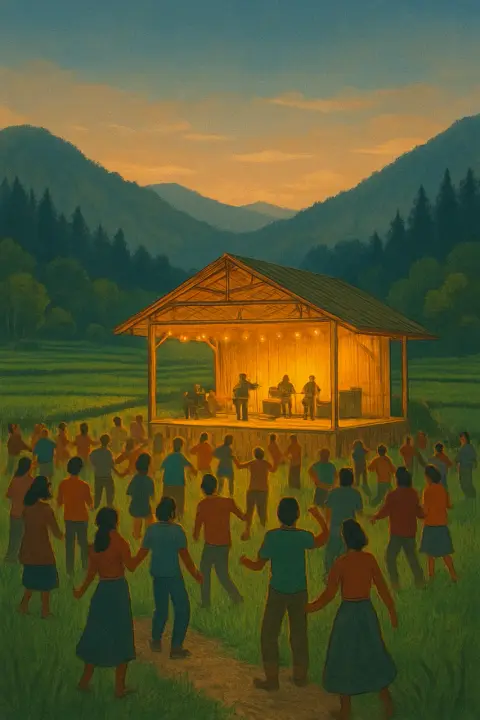
Ziro Festival of Music: four days on bamboo stages in the rice fields
Bamboo stages in the rice fields of a pine-ringed Himalayan valley
The Ziro Festival of Music is an outdoor festival of independent music held over four days, Thursday to Sunday, in late September in the Ziro valley of Arunachal Pradesh, on bamboo stages among the rice fields of the Apatani people. It was founded in 2012 by Bobby Hano and Anup Kutty. The organisers announce the dates and line-up each year, usually in August. Two things decide the trip: a permit to enter the state and a bed in a valley with few hotels.
The organisers announce the dates and the line-up each year, usually in August, on the festival's own site.
The legend
For centuries the Apatani have farmed the Ziro valley, and their wet rice fields are known for remarkably high yields.

The valley has been put forward for UNESCO's World Heritage list as a living cultural landscape where people and nature live in balance.
In 2012 the first music festival is held on Apatani land, with bamboo stages standing right among the rice fields.
The festival favours new musicians from the Northeast, who play alongside long-established bands.
Meaning
Myoko
In March the Apatani hold Myoko, a festival of friendship between villages handed down from the ancestors, with the host village feeding its guests.
Dree
In July, at Dree, people pray for a rich harvest and the wellbeing of all, and dance the Piree.
Customs
Bamboo stages
The stages are built of bamboo on Apatani land, among rice fields and pine-covered hills.
Camping
For four days the audience camps beside the stages.
Apatani crafts
The Apatani are known for intricately patterned weaving and cane and bamboo craft.
Words of the festival
bulyañ
the Apatani's traditional village councils
Hao-Polyang
the Apatani name for Hapoli, the business part of Ziro
Tani
a family of languages and peoples of Arunachal, the Apatani among them
True or myth
❌ Myth. The Apatani farm without draught animals and without machines.
✅ True. It is spoken in the Ziro valley villages of Hong, Hari, Biilla, Dutta, Hija, Mudang-Tage and Bamin Michi.
Where to celebrate
Ziro
Worth the trip
Four days of music on bamboo stages in the Apatani paddy fields at Biiri; settle the permit and a bed long before late September.
What the festival is
The festival ground is at Biiri, in the paddy fields of the Ziro valley, on land of the Apatani, who host the festival. The stages are built of bamboo; in recent editions there were three of them, plus a workshop space. The programme favours new musicians from the Northeast alongside long-established bands, and much of the audience camps beside the stages for all four days. Days two and three are usually the fullest.
The valley itself is part of the reason to come. The Apatani have farmed it for centuries without draught animals or machines, and their wet rice fields are known for remarkably high yields; the valley has been proposed for UNESCO's World Heritage list as a living cultural landscape. Their villages are outside the festival and not part of the pass. Visit them separately, and ask before entering a house or photographing anyone, especially the older women with facial tattoos.
Permits for Arunachal Pradesh
Arunachal Pradesh is a protected state: everyone from outside it needs a permit, and it must be in hand before you reach the entry check gate.
- Indian citizens: Inner Line Permit (eILP) — Apply online on the Government of Arunachal Pradesh eILP portal. The tourist eILP covers a stay of up to 14 days; for longer stays there is a provisional ILP. The portal lists a revised tourist eILP fee of approximately ₹300 for up to three days and ₹500 for up to 14 days; fees once paid are not refunded. Children under 14 do not need their own eILP but must travel with an adult. Tourist ILP facilitation centres also work at Naharlagun and Gumto railway stations, at Guwahati airport and Asom Paryatan Bhawan in Guwahati, and at Donyi Polo Airport, Itanagar.
- Foreign nationals and NRIs: Protected Area Permit (ePAP) — Foreign nationals and NRIs need a Protected Area Permit, applied for on the same state portal. It is issued to groups of two or more, with up to five people per application, and is valid for up to 30 days. Required documents: photo, passport, tourist visa and air ticket. Citizens of Afghanistan, China and Pakistan, and foreign nationals of Pakistani origin, need prior approval from the Ministry of Home Affairs.
- Apply early — The FCDO advises applying for access permits three months before arrival and notes that permit rules can change at any time. Check the state portal before you book anything non-refundable.
Getting to Ziro
Ziro sits at about 1,500 m in the Lower Subansiri district. The last stretch is always by road.
- By train
The overnight Donyi Polo Express runs from Guwahati to Naharlagun, where the station has an ILP facilitation centre. From Naharlagun shared taxis go to Ziro in about three hours. Train tickets go on sale 60 days ahead.
- By air
Hollongi (Donyi Polo Airport, Itanagar) is about 100 km away, three to four hours by road; Lilabari in Assam is about three and a half hours; Dibrugarh about five and Guwahati about nine. Flights into Hollongi and Lilabari are few, so book them together with the bed.
- Allow for rain
Landslides are common during the rains, and the FCDO warns that monsoon flooding and landslides can happen with limited warning. Arrive the day before the festival opens.
Tickets, stay and what to pack
- Tickets — Entry is by festival pass; day passes are sold online and at the gate. Tickets are non-refundable and non-transferable, even if the line-up changes. Children under 12 enter free with an adult. Every stage is inside the ticketed ground, so there is no free vantage point.
- Where to stay — The festival does not provide accommodation, but lists camping packages run by travel partners. Camping near the ground and homestays in the Apatani villages are the usual options, and both go early: book about three months ahead. Hapoli, the valley's main town, has most of the hotels and shops.
- Pack for rain and cold — The organisers say it has always rained at the festival. Bring a light winter jacket, raincoat, umbrella, gumboots, insect repellent, a power bank, a headlamp and a dry bag.
- Cash and cameras — Carry cash: the nearest ATM is a few kilometres from the ground. DSLRs, professional audio recorders and drones are not allowed. Parking is limited, so come by taxi or on foot from the camps.
Other festivals of the Apatani
The Apatani year has festivals of its own. Dree, in July (5 July 2027), is a prayer for a rich harvest and the wellbeing of all, with the Piree dance. Myoko, in March, is a festival of friendship between villages, when the host village feeds its guests.
FAQ
When is the Ziro Festival of Music?
Four days, Thursday to Sunday, in late September. The organisers announce the exact dates and line-up each year, usually in August, on the festival's own site.
When did Ziro Festival start?
In 2012, founded by Bobby Hano and Anup Kutty and hosted by the Apatani in the Ziro valley.
Do I need a permit for Ziro?
Yes. Indian citizens need an Inner Line Permit (tourist eILP for up to 14 days, approximately ₹300–500 depending on the length of stay), and foreign nationals and NRIs a Protected Area Permit, issued to groups of two or more for up to 30 days. Both are applied for on the Arunachal Pradesh government portal.
Is September a good time to visit Ziro Valley?
It is festival time, but late September is wet: the organisers say it has always rained at the festival, nights are chilly, and landslides are common on the roads during the rains.
Can I buy a ticket for one day?
Yes, day passes are sold online and at the gate. Tickets are non-refundable and non-transferable.
How do I get to Ziro?
By the overnight train from Guwahati to Naharlagun and then about three hours by shared taxi, or by air to Hollongi (about 100 km, three to four hours by road) or Lilabari.
Sources (9)
- Ziro Festival: FAQs
- Ziro Festival: Getting there
- Ziro Festival of Music
- Government of Arunachal Pradesh: eILP information
- Government of Arunachal Pradesh: ePAP information
- Arunachal Tourism: ILP and arrival formalities
- FCDO: India, entry requirements (access permits)
- FCDO: India, safety and security
- Ziro Festival: camping packages
Facts checked: 21 October 2026. Prices and hours are approximate; check locally.