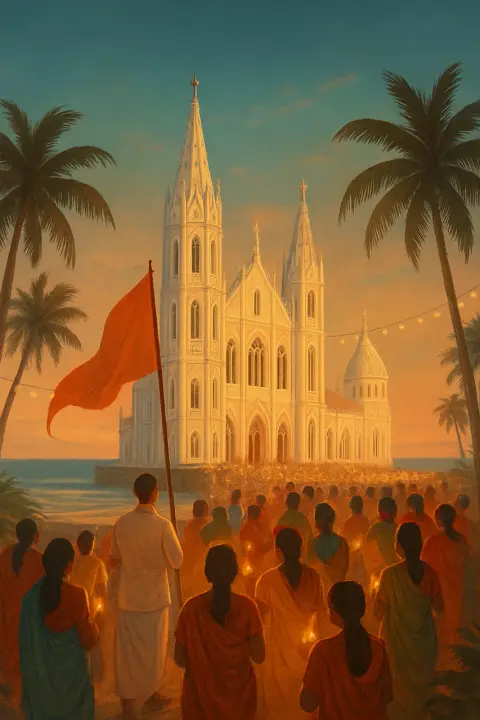
The Velankanni Feast is the annual festival of the Shrine Basilica of Our Lady of Health (Arokia Matha) on the Tamil Nadu coast. It runs eleven days on fixed dates, 29 August – 8 September 2027 (expected), from the hoisting of a flag bearing Mary's image to the feast of her Nativity, 8 September 2027 (expected), when the flag comes down. The shrine says the festival draws nearly 3 million pilgrims each year, and that Hindus, Muslims and Christians worship there together.
The dates are fixed; the shrine publishes the novena and Mass programme in August, and the Nagapattinam district administration issues the crowd and transport arrangements in the last week of August.
🥛
Tradition says that in 1570 a shepherd boy gave some milk to a woman with a child, and later found his jug still full.
In 1597, the story goes, a woman with a child appeared to a lame boy selling buttermilk, and he was healed.
⛵
In the late 17th century a Portuguese ship was saved from a storm here on 8 September, the feast of Mary's Nativity. In thanks the sailors rebuilt the shrine.
Mary's flag
On the evening of 29 August a flag bearing Mary's image is carried in procession from the basilica and raised, opening the novena.
Many languages
For nine days Masses run from morning to night in Tamil, Malayalam, Telugu, Kannada, Hindi and English.
Car and feast
On the evening of 7 September Mary's statue rides a decorated car through the streets, and on the 8th, the feast of her Nativity, the flag is lowered.
How the eleven days run
The flag. On the first evening a flag bearing Mary's image is carried in procession from the basilica along Beach Road, blessed by the bishop and hoisted, opening the festival.
The novena. The days that follow are a novena, a cycle of prayer leading to the feast. Masses run from morning to night in Tamil, Malayalam, Konkani, Telugu, Kannada, Hindi and English.
The car procession. On the eve of the feast the statue of Our Lady rides through the streets around the basilica on the last and most decorated of a line of cars (ther). Only women pull the first car. It starts in the evening; the time is in the shrine's programme.
The feast. On the Nativity of Mary many priests say the festival Mass together, and the flag is lowered to close the festival.
The three events behind the shrine
The basilica traces its origin to three events, in its own telling.
The milk. In the mid-16th century, the story goes, a Hindu shepherd boy carrying milk to Nagapattinam gave some to a Lady with a child by a pond. At his master's house the pot overflowed, and when they returned to the pond Our Lady appeared again. The place became Matha Kulam, Our Lady's Tank.
The buttermilk. A few years later a Lady with a child asked a lame buttermilk seller at Nadu Thittu for a drink and sent him to ask a Catholic gentleman in Nagapattinam for a chapel. The boy found he could walk. A thatched chapel was built, and the Lady was called Arokia Matha, Mother of Good Health.
The ship. In the 17th century, the shrine relates, Portuguese sailors caught in a storm in the Bay of Bengal prayed to Mary as Star of the Sea and came ashore at Velankanni on the feast of her Nativity. In thanks they rebuilt the chapel in stone; the porcelain plates they later gave still surround the statue above the main altar.
The chapel grew into today's white Gothic-style church. Pope John XXIII made it a basilica on 3 November 1962, and it is popularly known as the Lourdes of the East.
Facts checked: 21 October 2026. Prices and hours are approximate; check locally.
 India GO