 India GO
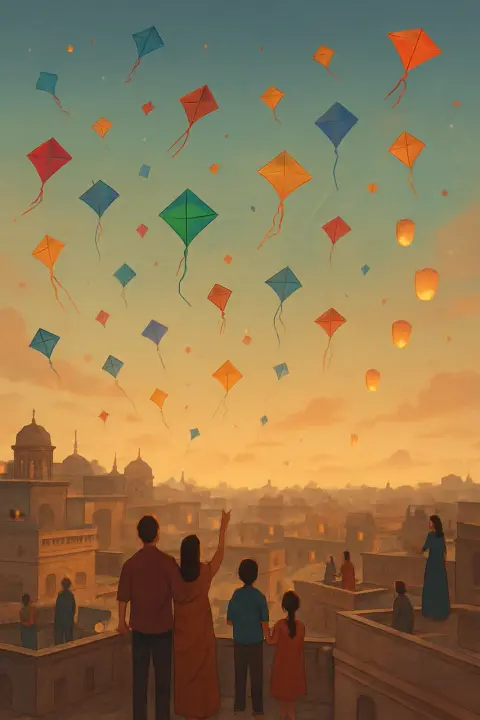
Uttarayan: two days when Gujarat flies kites from its rooftops
A whole city on its rooftops from dawn to dusk, kite against kite
Uttarayan is Gujarat's name for Makar Sankranti, and the state marks it in the sky. On 14 January, Uttarayan, and 15 January, Vasi Uttarayan, Ahmedabad goes up onto its roofs at sunrise and stays there until dark, cutting each other's kites, while Gujarat Tourism's International Kite Festival fills the Sabarmati Riverfront in the week around them. Next dates in Ahmedabad: 14–15 January 2027.
The Gujarat holiday list, issued in November or December of the previous year, fixes Uttarayan; Gujarat Tourism announces the kite festival programme in December.
The legend

Tradition holds that the half-year of the sun's northward journey is the daytime of the gods, and Uttarayan greets its start.

Gujarat greets it in the sky: from sunrise to dark, all of Ahmedabad is up on its roofs.
The kites fight with their strings: whoever cuts the other's line wins.
Meaning
The pols
Old Ahmedabad is divided into pols, gated quarters once locked at night; at Uttarayan their roofs fill with kite flyers from dawn.
Kite museum
The Sanskar Kendra city museum, designed by Le Corbusier, has a kite museum of its own.
Customs
Lanterns, now banned
Paper lanterns once climbed the kite strings after dark; Ahmedabad now bans them because of the fire risk.
Karuna Abhiyan
In these days the state opens more than a thousand care points for birds hurt by kite strings, staffed by vets and thousands of volunteers.
Kite festival
For the week around the festival, Gujarat Tourism runs the International Kite Festival.
What people eat
Undhiyu
Gujarat's spiced mix of winter vegetables
Chikki
brittle bars of sesame or peanuts set in jaggery
Jalebi
fried batter spirals soaked in syrup
Words of the festival
ઉત્તરાયણ
Uttarayan
"the northward journey": uttara is north, ayana movement
પોળ
pol
a gated quarter of old Ahmedabad; the word itself means gate or street
kai po che
"I have cut!", the cry of whoever cuts another's kite
True or myth
❌ Myth. Gujarat keeps 14 January, as it did in 2024, and the 15th is a day of its own, Vasi Uttarayan.
✅ True. In nine years of Karuna Abhiyan, 112,951 birds and animals were rescued, and 103,874 of them were nursed back to health.
Where to celebrate
Ahmedabad
Worth the trip
On 14 January Ahmedabad moves onto its roofs: the old-city pols trade kite duels all day, while the state's International Kite Festival fills the Sabarmati Riverfront.
What the two days look like
Old Ahmedabad is divided into pols, gated quarters whose terraces join into one long rooftop. In Khadia, Raipur, Dariapur, Sarangpur, Manek Chowk and Astodia the roofs fill with families from dawn on the 14th, and the kites fight with their strings: whoever cuts the other's line wins, with a shout of kai po che, "I have cut". The 15th, Vasi Uttarayan, is a second full day of the same. After dark on the 14th the riverfront and its bridges are where people watch the fireworks over the city.
The International Kite Festival is the organised side of the holiday. Gujarat Tourism runs it on the Vallabh Sadan stretch of the Sabarmati Riverfront, with flyers from some 50 countries and from across India, craft and food stalls, and cultural programmes in the evening. Entry is free; the flying area itself is closed to the public.
In the evenings before Uttarayan the old kite markets are busiest and stay open latest: Raipur Darwaja is the largest, with more stalls at Tankshal, Delhi Darwaja and Jamalpur. Paper lanterns that once climbed the strings after dark are now banned (see below).
Why Uttarayan is celebrated
Uttarayan means "the northward journey": uttara is north, ayana movement. It greets the start of the half-year of the sun's northward course, which tradition holds to be the daytime of the gods. Across India the same day is Makar Sankranti, the sun's entry into Capricorn; in Gujarat it is a two-day public holiday. Gujarat keeps 14 January even in years when the sun crosses after midnight and almanacs print Sankranti on the 15th, and the 15th is a holiday of its own.
The food of the days is undhiyu, a spiced mix of winter vegetables, chikki, bars of sesame or peanuts in jaggery, and jalebi, often eaten up on the roof.
Kite string: what is banned and why
The National Green Tribunal, ruling in 2017, described synthetic, glass-coated and "Chinese" manja as injurious to people, birds and animals: invisible once it is high in the sky, able to cut skin, and conductive enough to cause accidents on high-tension lines. It recorded deaths of people whose throats were cut by kite string, imposed a total ban on kite string made of nylon or other synthetic material or coated with non-biodegradable synthetic substances, and ordered states to stop its manufacture, sale, storage, purchase and use.
Gujarat goes further. A Gujarat government resolution bans making and selling Chinese lanterns, nylon and plastic string, and any thread coated with glass or another harmful substance. When kite traders asked the Gujarat High Court to exclude glass-coated cotton thread, the court refused: the ban makes no difference between synthetic and cotton thread. The court has also recorded police raids on makers and sellers in the days before the festival and pressed the state to find the manufacturers.
Birds and Karuna Abhiyan
Kite string is deadliest for birds. For the days around the festival Gujarat runs Karuna Abhiyan, a statewide bird-rescue drive with more than a thousand care and collection points, staffed by vets and thousands of volunteers. In its first nine years it rescued 112,951 birds and animals and nursed 103,874 of them back to health.
- If you find an injured bird — Each year the state publishes a WhatsApp number that sends the list of nearest care points, and a forest-department helpline. Ask your host for the current ones, or search for Karuna Abhiyan.
Where to stay and when to arrive
The festival happens on the roofs, so where you sleep decides what you see.
- Stay in or beside the walled city
Khadia, Raipur, Dariapur, Sarangpur, Manek Chowk and Astodia are the neighbourhoods of the day. Some heritage hotels in the old city bundle terrace access with the room, and residents rent out places on their terraces, with food, for both days: approximately ₹3,000–4,000 a person, or ₹20,000–25,000 for a whole terrace for 24 hours. A hotel west of the river is calmer, but leaves you watching from the street or the riverfront.
- Book room and roof together
One to two months ahead: the pol terraces sell out before the festival.
- Arrive two days early
The kite markets are at their fullest in the last two evenings, and that is the time to buy kites and string and to settle the roof.
FAQ
When is Uttarayan?
Uttarayan is on 14 January and Vasi Uttarayan on 15 January; next dates in Ahmedabad: 14–15 January 2027. The International Kite Festival on the riverfront runs in the week around them, and Gujarat Tourism announces its programme in December.
Is Makar Sankranti the same as Uttarayan?
Yes: Uttarayan is Gujarat's name for Makar Sankranti, the sun's entry into Capricorn. Gujarat adds a second day, Vasi Uttarayan, and celebrates both with kites.
Is Makar Sankranti on the 14th or 15th in Gujarat?
Gujarat keeps Uttarayan on 14 January, even in years when almanacs place Sankranti on the 15th; the 15th is Vasi Uttarayan, a holiday of its own.
Why do we celebrate Uttarayan?
It greets the start of the sun's northward journey, the half-year that tradition calls the daytime of the gods, and the turn from winter towards the harvest.
Where is the International Kite Festival held?
On the Sabarmati Riverfront in Ahmedabad, on the Vallabh Sadan stretch. Entry is free; the flying area is closed to the public.
Is Chinese manja banned in Gujarat?
Yes. The state bans making and selling nylon and plastic string, any thread coated with glass or another harmful substance, including cotton, and Chinese lanterns; the Gujarat High Court has refused to exclude glass-coated cotton thread from the ban.
Sources (4)
- International Kite Festival in Gujarat – Uttarayan
- National Green Tribunal, OA 384 of 2016 (Khalid Ashraf v. Union of India), judgment of 11.07.2017 (copy on Puducherry DSTE site)
- Gujarat High Court, WP(PIL) 253 of 2016, order of 10.01.2025 (court order text)
- Over 1.18 lakh injured birds rescued in Gujarat since launch of Karuna Abhiyan (IANS)
Facts checked: 21 October 2026. Prices and hours are approximate; check locally.