 India GO
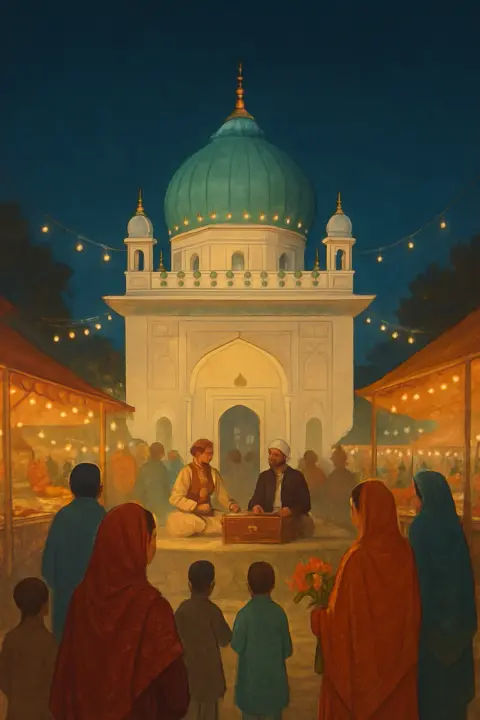
The Urs of Sabir Pak at Piran Kaliyar
Qawwali rising over a sea of lamps around a Sufi saint's tomb
The Urs of Sabir Pak is the yearly death anniversary of the 13th-century Sufi saint Hazrat Alauddin Ali Ahmed Sabir Kaliyari, held at his dargah in Piran Kaliyar on the outskirts of Roorkee, Haridwar district, Uttarakhand. It lasts about two weeks in Rabi al-Awwal, the third month of the Islamic calendar, around the anniversary on the 13th. Expected: 3–16 August 2027 (expected); the start is fixed only when the new crescent is sighted. The dargah is revered by Muslims and Hindus alike, and pilgrims of every faith come for the Urs.
Urs marks a Sufi saint's death anniversary, understood as the union of the soul with the divine, and is kept as a celebration rather than a mourning. At Kaliyar it runs for about a fortnight in Rabi al-Awwal, around the anniversary of Sabir Pak's death on the 13th of the month, with qawwali, chadars laid on the tomb and pilgrims of every faith.
The Urs begins on the night the crescent is sighted, so the start is confirmed only that evening; the dargah and the Haridwar administration then follow the fixed lunar days.
The legend

Alauddin was born in 1196. His uncle, the Sufi Baba Farid, took the boy as a disciple and put him in charge of the communal kitchen.

He never ate from that kitchen himself: he had been told to serve, not to eat. The youth fasted and lived on leaves and wild food.
On learning why, Baba Farid embraced him and called him sabir, "the patient one". That is how the saint got his name.
In 1253 Farid sends him to Kaliyar. Sabir lives here until his death on 13 Rabi al-Awwal 690 AH, in 1291.
The tomb over him was built by the Delhi sultan Ibrahim Lodi, and every Rabi al-Awwal the urs is held here for about two weeks.
Meaning
Sabiriya
Sabir founded a branch of the Chishti Sufi order named after him, the Sabiriya.
For every faith
The dargah is revered by Muslims and Hindus alike, and people of every faith and caste come for the urs.
Customs
Qawwali and mushairas
After the opening rites the urs turns festive, with qawwali and mushairas, evenings of poetry.
A chadar for the tomb
Pilgrims lay a chadar, a cloth cover, on the tomb and pray for their families and country.
The gular tree
A gular fig tree grows in the dargah: the saint is said to have meditated in its shade, and its fruit is taken home as a blessing.
Langar for guests
Pilgrims are fed free of charge. In 2010 even Sikh volunteers from Punjab ran a langar for urs guests.
Words of the festival
عرس
urs
"wedding": a saint's death anniversary, his union with God
صابر
sabir
"patient": the title Baba Farid gave the saint
درگاہ
dargah
a Sufi shrine built over a saint's tomb
قوالی
qawwali
Sufi devotional singing
چادر
chadar
a cloth cover laid on the saint's tomb
تبرک
tabarruk
a blessed gift, something taken from a saint's shrine as a blessing
True or myth
❌ Myth. Hindus and followers of other faiths revere the dargah equally and come together for the urs.
✅ True. Groups of pilgrims from Pakistan come under a 1974 agreement on visits to religious shrines.
✅ True. On 22 December 1851 an engine hauled soil between Roorkee and Piran Kaliyar for the Ganges canal aqueduct.
What the Urs is
Urs literally means 'wedding'. In the Sufi tradition a saint's death anniversary is understood as the union of the soul with God, so it is kept as a celebration rather than as mourning.
Sabir Pak was a nephew and successor of Baba Farid (Fariduddin Ganjshakar) and the founder of the Sabiri branch of the Chishti order. According to the shrine's tradition, Baba Farid sent him to Kaliyar in 1253, and he lived there until his death on 13 Rabi al-Awwal 690 AH, in 1291. The tomb over his grave was built under Ibrahim Lodi, sultan of Delhi. The story behind his title, 'sabir', the patient one, is told on the page about Sabir Kaliyari.
The Haridwar district administration describes the dargah as a living example of unity between the Hindu and Muslim faiths, visited by devotees of all religions from India and abroad.
The rites of the Urs, in order
The sequence below follows the dargah's custom as reported in the local press. The exact days depend on the moon, and the sajjada nashin, the hereditary custodian of the shrine, leads the main rites.
- Jhanda kushai: the flag
Before the month begins, a flag brought each year by a group of devotees from Bareilly Sharif is hoisted on the Buland Darwaza, the high gate of the dargah. This is the first rite of the Urs.
- Mehndi dori: the opening
On the night the crescent of Rabi al-Awwal is sighted, the Urs formally opens with the mehndi dori rite. From then on the lanes around the shrine fill with lamps and stalls.
- Days of qawwali and poetry
After the opening rites the Urs turns festive, with qawwali, Sufi devotional singing, and mushairas, evenings of poetry. Pilgrims lay a chadar, a cloth cover, and flowers on the tomb and pray for their families and country.
- Badi Roshni: the great night of lights
On 12 Rabi al-Awwal, which is also Eid Milad-un-Nabi, the dargah is lit up. The Khatm Sharif, a completion of Quran recitation, is held in the Mehfil Khana, followed by a mehfil-e-sama, a gathering for qawwali, and prayers for peace and brotherhood in the country.
- Qul Sharif: the anniversary
The next day, on the anniversary itself, the sajjada nashin performs the Qul Sharif rite.
Visiting the dargah during the Urs
Visitors of any faith are welcome. The Urs is worship first: move with the pilgrims, follow the khadims (shrine attendants) and the police.
- Dress modestly — Men and women alike. Keep a scarf or cap to hand in case the khadims ask you to cover your head.
- Expect queues and a one-way route — On Badi Roshni the press reported long queues from the morning; for security, pilgrims entered by one gate and left by another and were not allowed to stay inside the complex.
- The gular tree — A gular fig tree grows in the dargah complex. The saint is said to have meditated in its shade, and pilgrims take its fruit home as tabarruk, a blessing.
- Other shrines nearby — Many pilgrims also pay respects at the smaller dargahs of Kaliyar, such as Imam Sahab and Kilkili Sahab.
Getting there
Piran Kaliyar is in Haridwar district, on the outskirts of Roorkee. The district administration gives the nearest airport as Jolly Grant (Dehradun), about 72 km from Haridwar, and the nearest railway station as Haridwar. Haridwar makes a convenient base; see how to get to Haridwar and where to stay in Haridwar. Because the dates follow the Islamic lunar calendar, the Urs moves about eleven days earlier each year and falls in a different season over time.
FAQ
When is the Kaliyar Urs?
Expected: 3–16 August 2027 (expected). The Urs follows Rabi al-Awwal in the Islamic calendar: it opens on the night the crescent is sighted and peaks around the 12th and 13th, so the dates are confirmed only when the moon is seen.
What is Kaliyar Sharif famous for?
It is the dargah of Sabir Pak, the 13th-century founder of the Sabiri branch of the Chishti order, one of the most revered Sufi shrines in India, honoured by Muslims and Hindus alike.
Where is the Kaliyar dargah?
In the town of Piran Kaliyar on the outskirts of Roorkee, in Haridwar district, Uttarakhand. Haridwar is the nearest railway station named by the district administration.
Who was Sabir Kaliyari?
Alauddin Ali Ahmed Sabir, nephew and successor of Baba Farid, who came to Kaliyar in 1253 and died there in 1291. His title 'sabir' means 'the patient one'.
Can non-Muslims attend the Urs?
Yes. Hindus and followers of other faiths revere the dargah and come for the Urs. Dress modestly and follow the khadims.
Sources (6)
Facts checked: 22 October 2026. Prices and hours are approximate; check locally.