 India GO
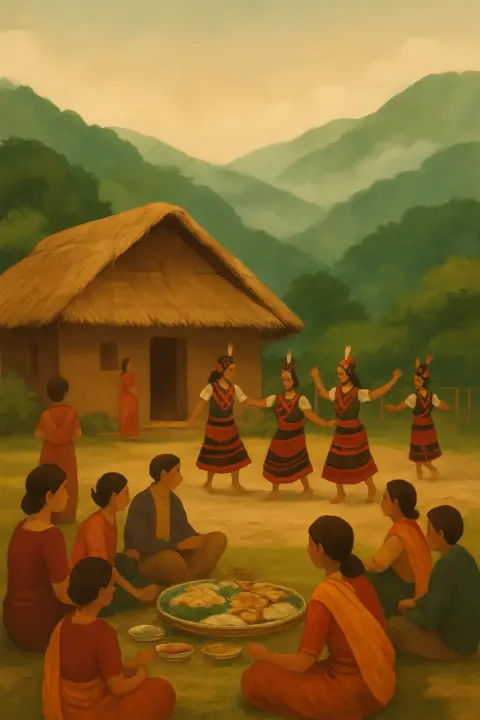
Tuluni: the Sümi Naga feast of plenty and reconciliation
Rice beer in bamboo cups, and old quarrels settled over a monsoon feast
Tuluni is the main mid-year festival of the Sümi (Sumi) Nagas of Nagaland, held every year on 8 July, with programmes on 7 and 8 July. Nagaland Tourism describes it as a feast in the bountiful season of the year, also called Anni, "the season of plentiful crops", and as a time for peace-making between families. Next date: 8 July 2027. Its centre is Zunheboto, the Sümi district town, and every visitor from outside Nagaland needs an Inner Line Permit.
The date is fixed; the Sümi community bodies and the Zunheboto district publish the programme in early July.
The legend
Tuluni is the main midyear festival of the Sümi Nagas. It is also called Anni, the name for the season of plentiful crops.
Tuluni rites once guarded the crops, beans above all, from pests. Each area kept it its own way until a common date was set in 1966.
The first unified Tuluni was held in Zunheboto on 7–8 July 1972. Today it is a festival of peace, friendship and family ties.
Customs
Gifts of the betrothed
The families of betrothed couples exchange gifts and host each other to meals; it is also the customary time to arrange betrothals.
Making peace
Tuluni is a time for making up: families who fell out during the year mend their ties.
Songs and contests
In Zunheboto and the villages there are Sümi folk songs such as the lejole, festive meals and contests.
What Tuluni is about
Nagaland Tourism's account of the Sümi festivals says Tuluni was observed to protect the crops, with prayers to Litsaba, the deity considered the giver of fruitfulness. It falls in the middle of the monsoon, when people who have worked the fields all year rest and feast.
The heart of Tuluni is in the home, not on a stage. Betrothed couples and their families exchange gifts and host each other to meals, and the festival is the customary time to arrange betrothals. It is also a time of reconciliation: households that fell out during the year make up. At a recent town programme in Zunheboto the chairman of the Sumi Literature Board said that Tuluni strengthens the bonds that unite families, relatives, neighbours and the wider community. Today almost all Sümi are Christian (Baptist missions arrived in the 20th century), and the public programme opens with an invocation by a pastor and closes with a benediction.
What a visitor can see
Most of Tuluni happens in family homes, so a visitor sees its public side. Nagaland Tourism lists cultural performances and indigenous games, an exhibition and sale of handloom and handicrafts, and a display and sale of local plants, fruit and produce. In Zunheboto the town's village elders (gaon buras) hold a programme with speeches and folk songs such as the lejole, and the India GO base also records festive meals and contests in the villages. Sümi communities in Dimapur hold their own celebrations.
The Sümi community bodies and the Zunheboto district publish the programme in early July, so check it before you travel.
Inner Line Permit: who needs it
Under the Bengal Eastern Frontier Regulation of 1873, anyone who is not an indigenous inhabitant of Nagaland, Indian or foreign, needs an Inner Line Permit (ILP) to enter the state. The FCDO adds that permit rules can change at any time.
- Apply online — Choose the tourist category on ilp.nagaland.gov.in and verify by phone OTP. Tourists do not need a guarantor but must give a local contact. You can also apply at Nagaland House offices or the Deputy Commissioner's office of a district.
- Fee and validity — A tourist ILP costs approximately ₹200 for Indian citizens and approximately ₹500 for foreigners, valid for 30 days, plus a payment-gateway charge.
- Allow time — An online tourist ILP applied for during working hours may be approved within about four hours; outside working hours, early on the next working day.
- Respect local guidelines — The FCDO asks foreign visitors to keep to security and administrative guidelines in tribal areas.
Being a good guest
Tuluni is a family and community festival, open to visitors with etiquette.
- Household feasts are by invitation — The family meals and betrothal exchanges are private. Join one only if a host invites you, and follow the host's lead.
- Ask before photographing — Ask before you photograph people, especially at prayers and in homes.
- Join the public programme — Performances, games and the craft and produce stalls are the parts meant for everyone.
Other Naga festivals
For a larger, multi-tribe event, the Hornbill Festival is held in December, and Sekrenyi comes in late February.
FAQ
When is Tuluni?
Every year on 8 July, with programmes on 7 and 8 July; the next date is 8 July 2027. The date was fixed for all Sümi villages in 1966.
Which state is the Tuluni festival associated with?
Nagaland. Tuluni is the festival of the Sümi (Sumi) Nagas, centred on Zunheboto district.
What is Tuluni also called?
Anni, the name for the season of plentiful crops.
Do I need a permit to visit Nagaland for Tuluni?
Yes. Indian citizens from outside Nagaland and foreigners need an Inner Line Permit, which tourists can get online at ilp.nagaland.gov.in; it costs approximately ₹200 for Indians and ₹500 for foreigners and is valid for 30 days.
What happens during Tuluni?
Families of betrothed couples exchange gifts and host meals, households reconcile, and towns hold programmes with folk songs, games and craft stalls.
Sources (6)
Facts checked: 21 October 2026. Prices and hours are approximate; check locally.