 India GO
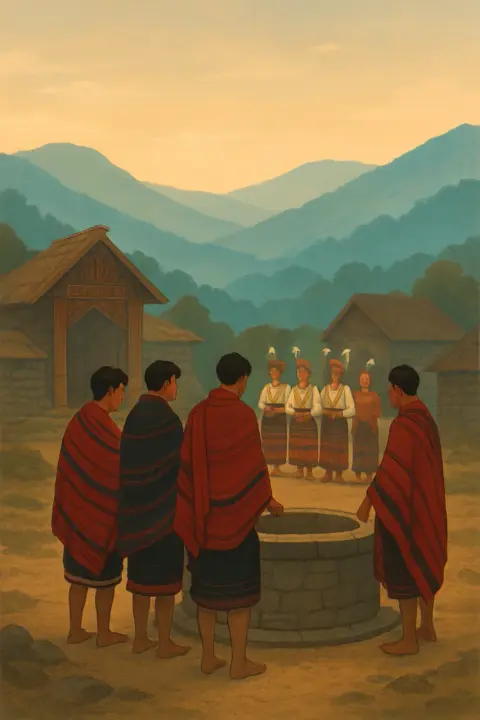
Sekrenyi: the Angami purification festival around Kohima
A village washes the old year away at its well before dawn
Sekrenyi, also called Phousanyi, is the biggest festival of the Angami Naga: ten days of purification that begin on the 25th day of the Angami month of Kezei, fixed in Nagaland as 25 February. Next dates: 25 February – 6 March 2027. The village form is best seen at Khonoma and Kigwema near Kohima, and a permit is needed to enter Nagaland.
The date is fixed in the Nagaland calendar; village programmes are announced locally.
The legend

Sekrenyi is the purification festival of the Angami Naga. The name joins sekre, sanctification, and nyi, festival; it cleanses a village in body and soul.

It also marks the coming of age of the young and is held to be a mark of Angami identity. Its fourth day is the Angami new year.
For ten days field work stops, a pause called penyü. After the festival, farming, house building and weddings can begin again.
Customs
Water at the well
On the first day the lady of the house fixes leaves holding drops of rice water to the house pillars, and the men go to bathe at the village well.
Thekra Hie
From the fourth day, for three days, young people in traditional dress sit together in their age groups singing old songs all day.
Gate and visits
The key rite falls on the eighth day: the old gate is pulled down and replaced, and then villages exchange visits and greetings.
Where to celebrate
Kohima
Ten days from 25 February when Angami villages around Kohima wash away the old year: rites at the well, three days of age-group singing and the gate-pulling on day 8.
The ten days at a glance
The festival starts on the 25th day of the Angami month of Kezei, which Nagaland fixes at 25 February. The Kohima district describes the order of the days like this; villages vary in detail.
| Day 1 (Kezie) | Rice-water drops on leaves fixed to the house pillars; the men bathe at the village well. |
| Day 2 | Young men return to the well, put on two new shawls and sprinkle the water on themselves; a cock is offered on their return. |
| Days 4 to 6 | The Angami new year opens three days of feasting and Thekra Hie, the age-group singing. |
| Day 7 | The young men go hunting. |
| Day 8 | The gate-pulling, which the district calls the most important ceremony, followed by visits between villages. |
| To the close | Field work stays paused until the festival ends; then farming, house building and weddings can begin again. |
Village rites and the public programme
Two different things go by the name Sekrenyi, and it helps to know which one you are looking at. The rites at the well, the sacrifice and the gate belong to villagers who keep the old Angami religion. Many Angami are Christian; in their villages the festival is shorter, often five days, and kept as a cultural celebration without the rituals. Southern Angami villages hold theirs in December.
Alongside the village observance, the Angami Public Organisation and the state hold a public 'Sekrenyi cum Mini Hornbill' with Angami troupes, indigenous games and a feast, open to anyone. Its venue changes: it has been held at the State Stadium in Dimapur and at Sovima village. Nagaland Tourism lists Sekrenyi as part of the Mini Hornbill programme in February, a smaller cousin of the Hornbill Festival in December.
Where to see it
The village observance is near Kohima; the public programme moves.
Khonoma
About 20 km from Kohima, an Angami village that keeps the village form and has community homestays.
Kigwema
Another village near Kohima where the observance is kept.
Kohima village
The wells and khels (wards) of Kohima village, for the first two days and the singing.
The state-level gathering
The public programme with performances and games, free to attend; check the venue locally.
Permits for Nagaland
Nagaland requires an Inner Line Permit, applied for online at ilp.nagaland.gov.in. The official fee is about ₹200 for 30 days for Indian visitors and about ₹500 for 30 days for foreign nationals.
Foreign nationals: according to press reports, the central government has reintroduced the Protected Area Permit for foreigners visiting Nagaland, with registration after arrival. There is no official notice to confirm this, so check the current rules with the Nagaland government or the FRRO before you book. For protected areas in general, the UK Foreign Office advises applying about three months before arrival, through an Indian mission or, in India, the state liaison office or the FRRO, and notes that permit rules can change at any time.
Nagaland is also a dry state: the Foreign Office notes that drinking, possessing or transporting alcohol there is illegal and that you could be arrested and held without bail.
Being a guest
In the villages Sekrenyi is a family and community observance, not a show.
- Stand back at the well — The purification rites are private acts. Watch from a distance and do not follow people to the well unless invited.
- Wait to be asked — Sit with a singing group only when someone invites you; ask before photographing anyone.
- Ask which villages are open — Which villages welcome visitors changes from year to year. Ask the Directorate of Tourism in Kohima.
Where to stay and when to arrive
Rooms near the villages are few.
- Book about six weeks ahead
Kohima has most of the rooms; Khonoma's community homestays are few and go first.
- Fly or take the train to Dimapur
Dimapur, about 74 km from Kohima, has the nearest airport and railway station.
- Arrive the day before it starts
Be in Kohima by the evening before the first day; for the gate-pulling, stay at least the nights before and after day 8.
FAQ
Why is Sekrenyi celebrated?
It is the Angami Naga festival of purification: the village is washed clean of the past year in body and soul, and the young are marked as coming of age. Its fourth day is the Angami new year.
What is another name for Sekrenyi?
Phousanyi. It is also spelled Sokre-n.
In which state is Sekrenyi celebrated?
Nagaland, by the Angami Naga, mostly in the villages around Kohima.
When is Sekrenyi and how many days does it last?
Ten days from 25 February. Next: 25 February – 6 March 2027. Christian Angami villages often keep a shorter version.
Do I need a permit to attend Sekrenyi?
Yes, an Inner Line Permit for Nagaland, issued online. Press reports say foreign nationals again need a Protected Area Permit as well; check the current rules before you travel.
Sources (8)
- Sekrenyi Festival, Nagaland Tourism
- Culture and heritage, Kohima district administration
- Sekrenyi, Wikipedia
- Nagaland Inner Line Permit: fees
- FCDO: India, entry requirements (access permits)
- FCDO: India, safety and security (alcohol laws)
- Sekrenyi celebration at Sovima, DIPR Nagaland
- Eastern Mirror: ILP and PAP for Nagaland
Facts checked: 21 October 2026. Prices and hours are approximate; check locally.