 India GO
Chandanotsavam at Simhachalam: the one day the sandal comes off
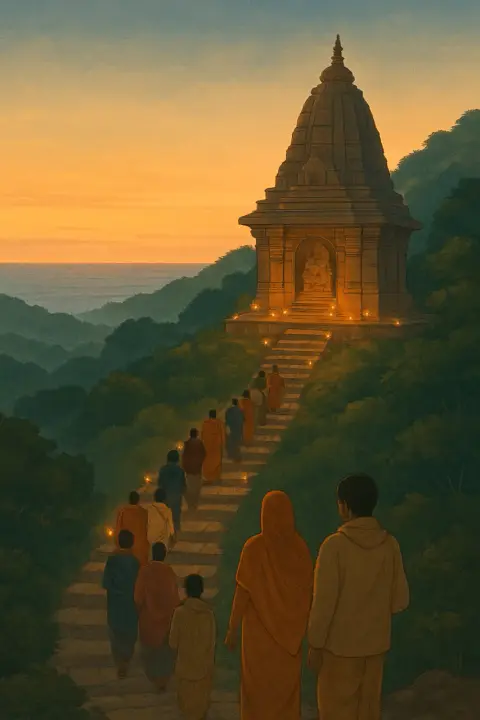
A night queue up a hillside to see a face hidden under sandal all year
Chandanotsavam is the one day of the year when the sandalwood paste is taken off Varaha Lakshmi Narasimha, the deity of the Simhachalam hill temple on the edge of Visakhapatnam, and pilgrims can see the image in its true form, the nijarupa darshan. It falls on Akshaya Tritiya, the third lunar day of the bright half of Vaishakha, usually between late April and mid-May. Next: 9 May 2027 (expected); the temple confirms the day and opens ticket sales one to two weeks ahead.
The temple announces the day and opens ticket sales one to two weeks ahead.
The legend
Legend says young Prahlada asked Vishnu to appear in a form uniting Varaha and Narasimha. So Varaha-Narasimha appeared, and Prahlada built him a temple.
The temple decayed and earth covered the image. When King Pururava rebuilt it, Urvashi dreamt it must stay under sandal paste all year but one day.
Under the paste the image looks like a linga about four feet tall. Its true form is shown only on Akshaya Tritiya: that is what Chandanotsavam is about.
Customs
Nijarupa darshan
At 4 am the paste is removed, and until evening pilgrims file past the deity in its true form; the queue up the hill starts the night before.
The evening bath
In the evening the deity is bathed with sandal-scented water and from a thousand pots, then covered again with fresh sandal paste.
Where to celebrate
Visakhapatnam
On Akshaya Tritiya the sandal paste comes off Simhachalam's Varaha-Narasimha for about twelve hours, and nearly two lakh people queue up the hill, many overnight, for a few seconds' darshan.
How the day runs
For the rest of the year the image in the Prahlada mandapa (the hall of the sanctum) is hidden under a thick coat of sandal paste and looks like a Shiva linga about four feet tall. Underneath is a figure about two and a half feet high, standing in a gentle three-bend posture, with the head of a boar, a human torso and a lion's tail: Varaha and Narasimha, two avatars of Vishnu, in one form.
At about 4 am on Akshaya Tritiya the priests remove the paste. Prayers and abhisheka (ritual bathing) are finished by about 6 am, and then the queue starts moving past the deity. The true form stays visible for about twelve hours, and for each pilgrim the darshan itself lasts a few seconds.
In the evening come the bathing rites: chandanabhisheka, with water mixed with sandal powder, and sahasrakalasabhisheka, with water from a thousand metal pots. The three food offerings skipped during the day (balabhoga, rajabhoga and the night offering) are served together, and the image is covered again with fresh paste. Paste is applied four times a year: on Akshaya Tritiya and on the full moons of Vaishakha, Jyeshtha and Ashadha. The sandalwood paste is said to be brought from Srivilliputhur in Tamil Nadu, the town of Andal's Aadi Pooram.
The temple and its history
Simhachalam, the lion's hill, is part of the Eastern Ghats about 16 km from Visakhapatnam. The oldest of its nearly 500 inscriptions, from 1087, dates to the reign of the Chola king Kulottunga I. The present temple was rebuilt in the Kalinga style by the Eastern Ganga king Narasimhadeva I and consecrated in 1268. It faces west, which is unusual, and looks like a fortress from outside, with three courtyards and a five-tier gopuram (gateway tower). At least 40 inscriptions record gifts made for Chandanotsava, so the festival has been central here for many centuries.
The temple's own legend explains the paste. King Pururava and the apsara Urvashi found the forgotten image buried in earth and rebuilt the temple, and Urvashi was told in a dream that the deity must stay under sandal paste all year except on the third day of Vaishakha. The deity is also known locally as Simhadri Appanna, and devotees hold that prayers here help couples who long for children.
Tickets, queues and getting up the hill
Nearly two lakh (200,000) people come for the day, many of them queuing overnight. Plan it as a night and a morning, not a quick temple visit.
- Choose a queue
The free queue is open to everyone without a ticket; expect several hours in it. Paid lines cost approximately ₹300 and ₹1,000. All lines are barricaded for about 6 km, with shade, drinking water and buttermilk along the way.
- Buy paid tickets early
Sales open about a week before the day, mostly online on the Andhra Pradesh Endowments Department portal, with the rest at designated bank branches. They sell out fast.
- Leave the car below
On the day private vehicles are stopped at parking areas at the foot of the hill, sorted by ticket category. Only APSRTC buses and the temple's minibuses go up the ghat road, and the temple runs free buses for devotees.
- Arrive the evening before
The queue forms overnight. Stay in Visakhapatnam and book four to six weeks ahead: the city has plenty of rooms, but the festival falls in the April–May holiday and wedding season. One night is the minimum, two let you rest after the queue.
Etiquette and safety
This is darshan at a working temple, not a show. The UK Foreign Office notes that stampedes have happened at large religious gatherings in India; the temple's barricades and volunteers are there to keep the queue moving safely.
- Traditional dress — Wear traditional dress for the temple, and no photographs of the deity.
- Leave the phone behind — The temple's executive officer has asked devotees not to bring mobile phones or other electronic devices on Chandanotsavam day.
- Watch the weather — During a recent Chandanotsavam a wall beside the queue collapsed in heavy rain before dawn. Check the forecast, and follow the instructions of police and temple staff if the weather turns.
- Basics — See is India safe for crowds and emergency numbers.
FAQ
When is Chandanotsavam?
Next: 9 May 2027 (expected). It is always on Akshaya Tritiya, usually between late April and mid-May; the temple confirms the day one to two weeks ahead.
How do I book Chandanotsavam tickets online?
Paid darshan tickets (approximately ₹300 and ₹1,000) go on sale about a week before, mostly on the Andhra Pradesh Endowments Department portal and partly at designated bank branches. The free queue needs no ticket.
Why is the Simhachalam deity covered in sandal paste?
By the temple's legend, Urvashi was told in a dream that the image must stay under sandal paste all year except one day. Under the paste it looks like a linga; on Chandanotsavam its true Varaha-Narasimha form is shown.
How far is Simhachalam from Visakhapatnam?
About 16 km. On Chandanotsavam private vehicles park at the foot of the hill and buses take pilgrims up the ghat road.
When is Simhachalam Giri Pradakshina?
On the full moon of Ashadha, usually in June or July. Devotees walk about 30 km around the hill, then visit the temple.
Sources (6)
- Varaha Lakshmi Narasimha temple, Simhachalam
- Simhachalam Devasthanam, AP Endowments Department
- FCDO: India, safety and security
- Akashvani News: wall collapse at Simhachalam Temple (Nija-roopam darshan explained)
- Devotees asked not to carry mobile phones on Chandanotsavam, The Hans India
- Simhachalam: 2 lakh devotees expected for Chandanotsavam, Deccan Chronicle
Facts checked: 21 October 2026. Prices and hours are approximate; check locally.