 India GO
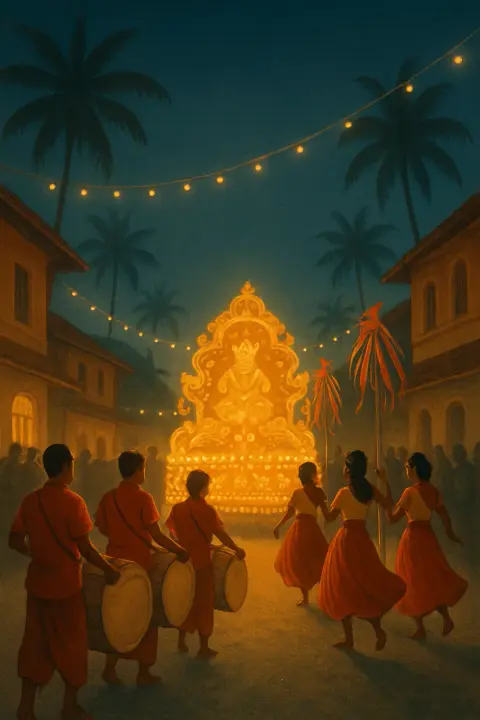
Shigmo in Goa: the village festival behind the parades
Drums at every door, then floats of gods and heroes rolling down the main street
Most people meet Shigmo as a float parade on a town's main street. That is the newer half. The older one belongs to the villages: drummers going from door to door, songs sung in chorus at the temple, a few days of rites around the full moon of Phalguna. The village Shigmo comes around Holika Dahan and Holi (next: 22–23 March 2027); the government parades usually start a day or two after Holi and run for about two weeks. Goa's Department of Tourism publishes the town-by-town dates in late January or early February.
Stand on a town main street in March while carved floats of Ramayana and Mahabharata scenes roll past behind folk troupes with ghumot drums, in the Hindu Goan spring festival that has nothing to do with the beach.
Where to watch
Nineteen town centres in rotation, each with its own evening: Ponda, Panaji, Mapusa, Margao, Vasco, Bicholim, Curchorem, Canacona, Pernem and others. In Panaji the parade runs from the Old Secretariat along the riverfront to the Campal ground (16:00–22:00 in 2026).
Free viewing
- The parades are free and on the open street:
- Panaji: the riverfront road between the Old Secretariat and the Campal ground, from about 16:00 on the city's parade evening
- Other towns: the main road on the evening the government schedule gives that town
- Village naman evenings are community rites, not shows: go only with someone from the village, and ask at the temple first
Programme
Village phase
Villagers assemble at a fixed place and sing naman in chorus; drummers with dhol and taso go house to house, and the households pay them with a song called tali. Talgadi, Hanpet, the lamp dance and Gopha are danced
 Villages across Goa, different days for different areas
Parade phase
The Goa government stages float parades in the main towns on successive evenings: hand-built floats showing mythological scenes, with folk troupes walking between them. Each town gets its own night
Panaji, Margao, Mapusa, Ponda, Vasco, Curchorem, Valpoi and others
Final day
The gade padap, when a spirit is held to enter the dancers, and afterwards the mand davarap, a collective bath that closes the festival
Village mands
Small Shigmo and big Shigmo
Goa keeps two village forms. Dhakto Shigmo, "small Shigmo", is the festival of farmers and labourers: it starts about five days before the Phalguna full moon and ends on it, mostly in the Old Conquests, the coastal talukas under Portuguese rule from the 16th century. Vhadlo Shigmo, "big Shigmo", begins on the full moon and lasts five days, mostly in the inland New Conquests, and is kept by the whole village around its temple: the deity is bathed and dressed in saffron, food is offered, and a feast follows.
The sound comes first. Dhol and taso drums, some of them huge, are carried from house to house; a household puts money on the performers' plate, and they answer with the tali, a song wishing it well. In the evenings villagers gather at a fixed place to sing naman in chorus, and the dances are Talgadi, Hanpet, the lamp dance and Gopha. On the last day, by belief, a spirit called the gade enters the dancers, and the festival ends with the mand davarap, a collective bath.
The temple Shigmos of Jambavali, Fatorpa, Kansarpal and Dhargale are the best known and draw visitors from beyond Goa. For the parades and a recent town schedule, see the main Shigmo page.
How to plan around it
Shigmo moves around the state, so the trick is to stay in the middle and let it come to you.
- Base inland — Panaji or Ponda rather than the beach. Ponda sits among the temple villages of the New Conquests, Panaji has its own parade on the riverfront, and both put most parade towns within reach. One to three nights is enough.
- Village evenings need an invitation — Naman evenings are community rites, not shows. Go only with someone from the village and ask at the temple first.
- One evening per town — Each town gets a single parade night, so check the published schedule and arrive a couple of days early. In Panaji the floats run from the Old Secretariat along the riverfront to the Campal ground, from about 16:00.
- Weather — March in Goa is hot and dry, about 33°C by day and 23°C at night. The sea is open for swimming; the red-flag advisory that closes it runs from June to September.
FAQ
When is Shigmo in Goa?
The village Shigmo falls around the Phalguna full moon; Holika Dahan and Holi are next on 22–23 March 2027. The state float parades usually start a day or two after Holi and run for about two weeks; exact town dates come out in late January or early February.
Why are there two types of Shigmo in Goa?
Dhakto (small) Shigmo is the farmers' festival of songs and dances, ending on the full moon, mostly in the Old Conquests. Vhadlo (big) Shigmo starts on the full moon, lasts five days and centres on the village temple, mostly in the New Conquests.
Where is the best place to see Shigmo?
For parades, Panaji or Margao on their evenings. For the village festival, the temple Shigmos of Jambavali, Fatorpa, Kansarpal and Dhargale are the best known.
Do I need tickets for Shigmo?
No. The parades are free and on the open street. Only rooms in a town on its parade night fill up.
Sources (3)
Facts checked: 8 October 2026. Prices and hours are approximate; check locally.