 India GO
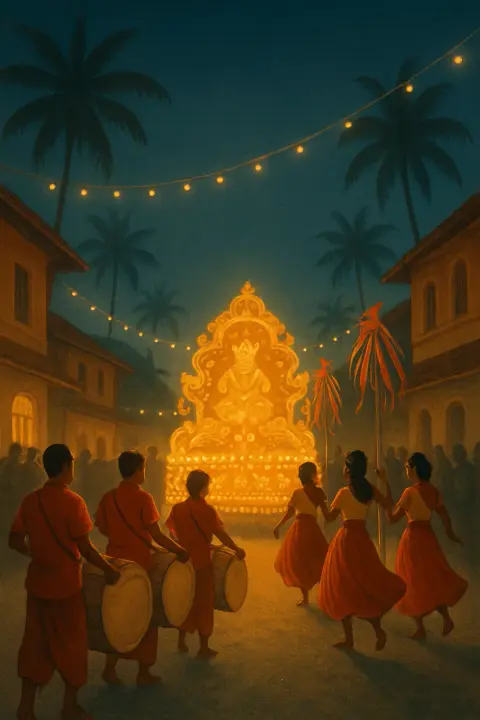
Shigmo: Goa’s spring festival of drums and floats
Drums at every door, then floats of gods and heroes rolling down the main street
Shigmo is the Hindu spring festival of Goa, which takes in Holi. It comes in two halves: drum parties going door to door in the villages around the Phalguna full moon, then about two weeks of evening float parades, one or two towns a night, with carved floats of Ramayana and Mahabharata scenes. The state parades cover about 19 towns. Goa’s Department of Tourism announces each year’s schedule in late January or early February; the parades usually start a day or two after Holi (22–23 March 2027).
Goa's Department of Tourism announces the town-by-town parade dates in late January or early February.
The legend

Shigmo, or Shishirotsava, is the spring festival of Goa's Hindus, and Holi is part of it.
It is a festival of working people: the rice is harvested and stored, and tired farmers gather for song, dance and drums.
Dhakto, the "small" Shigmo, runs five days up to the Phalguna full moon; Vhadlo, the "big" one, five days after, at the village temple.

On the last day a spirit called gade is believed to enter the dancers, and then the village takes a collective bath.
Today the village Shigmo is joined by float parades that the state stages in one town after another.
Customs
Drums at the door
Players carry big dhol and taso drums from door to door; for a gift they sing the tali, a song of good wishes.
Naman
Villagers gather at a fixed spot and sing naman, the festival's songs, in chorus.
Dances
The dances are talgadi, hanpet, the lamp dance and gopha.
A saffron-clad deity
On the first day of the big Shigmo the village deity is bathed and dressed in saffron, and after the offering comes a feast.
Float parade
Floats of mythological scenes roll down the main street behind the romtamel, dancers waving poles tipped with flowers and mango leaves to the drums.
Words of the festival
शिगमो
Shigmo
from the Prakrit suggimaho, from the Sanskrit sugrīṣmaka
naman
songs sung in chorus by villagers gathered at a fixed place
tali
a song wishing well to the household that gives a gift
घुमट
ghumot
Goa's clay drum, declared a state heritage instrument in 2019
romtamel
the drum-and-pole procession that opens the parade
dhakto and vhadlo
the "small" Shigmo of song and dance, and the "big" temple one
True or myth
❌ Myth. In the villages it spreads over a fortnight with different days for different areas, and the float parades move from town to town.
✅ True. In August 2019 the state government declared the ghumot a heritage instrument.
❌ Myth. It is also kept by the Konkani diaspora beyond the state.
Where to celebrate
Two festivals in one
Shigmo has nothing to do with the beach, and that is its charm. The older half is in the villages: around the full moon of Phalguna, drum parties carry dhol and taso drums from door to door, and villagers gather to sing naman, songs in chorus. This village Shigmo is a community rite more than a show, and it is the better part of the festival if you can reach it.
Then the government takes over the main streets. Each town gets one evening. Folk troupes walk ahead with drums, flags and dancers, and behind them roll floats carved and painted with scenes from the Ramayana and the Mahabharata, tall figures of gods and heroes lit against the night. Families line the road from late afternoon, children on shoulders, and the thud of the drums reaches you before the first float does. In Panaji the parade runs from the Old Secretariat along the riverfront to the Campal ground, recently from 16:00 to 22:00.
Parade schedule: how the towns rotate
A recent Government of Goa schedule, evening by evening, as an example of how the towns rotate. Each year’s order and dates are published separately.
| Evening 1 | Ponda |
| Evening 2 | Calangute |
| Evening 3 | Panaji |
| Evening 4 | Mapusa |
| Evening 5 | Curchorem |
| Evening 6 | Bicholim |
| Evening 7 | Sanquelim |
| Evening 8 | Shiroda, Sanguem |
| Evening 9 | Dharbandora, Cuncolim |
| Evening 10 | Margao |
| Evening 11 | Vasco, Porvorim |
| Evening 12 | Valpoi |
| Evening 13 | Quepem, Pernem |
| Evening 14 | Canacona, Mandrem |
How to see it
Watching the parades costs nothing; the planning is all about which town on which night.
- Stay inland — Panaji or Ponda rather than a beach: the parades are in town centres and move around the state, and from the middle you can reach most of them.
- Arrive two days early — Check the published schedule for which town parades when; each gets only one evening.
- Take your spot early — Main roads fill from late afternoon. In Panaji the riverfront between the Old Secretariat and Campal is the stretch to aim for.
- Village naman: only with a local — The naman evenings are community rites, not performances. Go only with someone from the village, and ask at the temple first.
- Book the parade town — Nothing needs a ticket, but rooms in the town on its parade night fill. Book about six weeks ahead, and trains too: the first parades follow straight after Holi, when trains to Goa run full.
Which evening to choose
The Panaji and Margao parades are the peak evenings. Ponda, Mapusa, Vasco and the smaller inland towns such as Sanguem, Curchorem and Valpoi each have their own night on the circuit. Day-by-day plan for the state: Shigmo in Goa.
Shigmo pairs well with the Goa Carnival, a few weeks earlier, with Old Goa, and with the temple circuit around Ponda. By the last parade evening, when the floats are wheeled away and the drums go quiet on a hot March night, the season has turned.
FAQ
When is Shigmo?
Goa’s Department of Tourism publishes the town-by-town schedule in late January or early February. The parades usually start a day or two after Holi (next: 22–23 March 2027) and run for about two weeks, sometimes into early April.
In which state is Shigmo celebrated?
In Goa. It is the Hindu Goan spring festival, also called Shishirotsav.
Where are the Shigmo parades held?
Recently in 19 town centres, from Ponda, Panaji and Mapusa to Margao, Vasco and Canacona, each on its own evening. The village Shigmo happens across rural Goa around the Phalguna full moon.
Is Shigmo the same as the Goa Carnival?
No. The Carnival is the Catholic pre-Lent festival a few weeks earlier; Shigmo is Hindu, follows Holi and draws on the epics and village traditions.
Sources (4)
Facts checked: 8 October 2026. Prices and hours are approximate; check locally.