 India GO
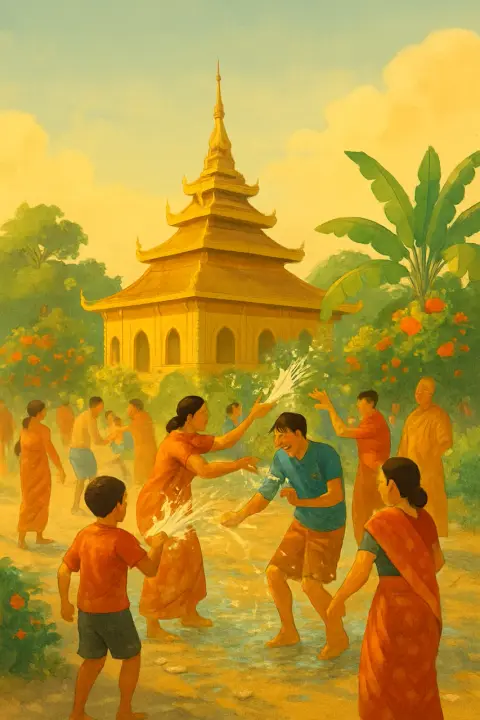
Sangken: the Tai Khamti new year in Namsai, Arunachal Pradesh
The new year comes as water: poured over the Buddha, then sprinkled on everyone
Sangken is the Theravada Buddhist new year of the Tai Khamti and neighbouring communities of Arunachal Pradesh and Assam: three days in which Buddha images are carried out and bathed, and water is poured gently over monks, elders and passers-by. It is held every year from 14 to 16 April; next dates: 14–16 April 2027 (expected). The place to see it is Namsai, around the Golden Pagoda, and you need a permit to get there.
The dates are fixed; the Arunachal Pradesh holiday list, issued in August or September of the previous year, carries them, and the Namsai district announces the programme at the Golden Pagoda.
The legend
Sangken is the New Year of Theravada Buddhists: the Khamti, Singpho, Khamyang and Tangsa of Arunachal, the Tai Phake and Tai Aiton of Assam.

Water is the sign of peace and purity. The festival sees the old year out: it falls in the year's last days, and the new year begins right after it.

A temporary shrine, the Kyongfra, is built for the festival. The water that has bathed the Buddha images is collected and kept as holy water.
Customs
Bathing the Buddha
On the first day the Buddha images are brought out to drums and cymbals, bathed and placed in the Kyongfra, where scented water falls on them through the lungkong fountain.
Water for everyone
People pour water over one another, and gently over the monks too, asking blessings of health and peace for the year.
Poi Sangken
On the last day the images go back to their places, and the new year is welcomed with community prayers, a shared feast and gifts.
Where to celebrate
Namsai
The Tai Khamti new year at Namsai: Buddha images carried out of the monasteries and bathed, water poured gently over monks, elders and passers-by, and dawn rites at the Golden Pagoda.
A Theravada new year, not a water fight
Sangken is kept by the Theravada Buddhist communities of the Lohit plains: the Khamti, Singpho, Khamyang and Tangsa in Arunachal Pradesh, and the Tai Phake and Tai Aiton across the border in Assam. It closes the old year, and the new year begins right after it. The dates are fixed at 14 to 16 April, and the first day is in the Arunachal Pradesh holiday list.
It belongs to the same family of Southeast Asian new-year water festivals as Songkran in Thailand and Thingyan in Myanmar, and visitors who know those will recognise the idea. The tone is different, though. Water is a sign of peace and purity here: the Buddha images are bathed first, water is poured gently over monks and elders, and the sprinkling in the streets is ceremonial rather than a free-for-all.
Where to see it
Namsai district is the centre for visitors. Everything below is free to watch.
Golden Pagoda (Kongmu Kham), Tengapani
A Burmese-style Theravada temple near Namsai, opened in 2010 on a 20-hectare complex. In recent years the district has held its International Maha Sangken here, opening at dawn with the rite of the Buddha's descent to earth, then the washing of monks' and elders' feet and the pouring of water.
Monasteries of the Tai Khamti villages
Where the Buddha images are carried out to drums and cymbals, placed in the temporary Kyongfra shrine and bathed, and where families bring offerings to the monks.
Namsai town and the villages
The public water sprinkling. Expect to get wet, gently.
Namphake, Assam
The Tai Phake village across the state border keeps its own Sangken; it needs no Arunachal permit.
Permits come first
Namsai is in Arunachal Pradesh, which sits behind the Inner Line: you cannot simply drive in from Assam.
Indian citizens: a tourist Inner Line Permit, issued online through the state's eILP portal (eilp.arunachal.gov.in).
Foreign nationals: Arunachal Pradesh is a Protected Area under the Foreigners (Protected Areas) Order, 1958, so you need a Protected Area Permit, applied for separately. The UK Foreign Office advises applying about three months before arrival, through an Indian mission abroad or, in India, the state liaison office or the FRRO, and notes that permit rules can change at any time.
Where to stay and how to get there
Mid-April is busy in upper Assam, so plan in this order.
- Sort the permit
Apply before booking anything you cannot cancel.
- Book a room about three weeks ahead
Namsai has only modest accommodation. Dibrugarh or Tinsukia in Assam are the comfortable bases; the Golden Pagoda is about 68 km from Tinsukia railway station.
- Book transport early
The same days are Bohag (Rongali) Bihu, the Assamese new year, when trains and flights into upper Assam are in demand.
- Arrive the day before
Be there by 13 April for the dawn rites at the Golden Pagoda on the first morning.
Etiquette
Sangken is a religious festival first.
- Pour, do not throw — Water is offered as a blessing for health and peace. Pour or sprinkle it, as the people around you do, and be especially gentle with monks and elders.
- Dress for a temple — Cover shoulders and knees at the monasteries and the pagoda, and take shoes off where others do.
- Protect your phone — Everyone gets wet. Keep phones and documents, including the permit, in a waterproof pouch.
FAQ
In which Indian state is Sangken celebrated?
Mainly in Arunachal Pradesh, in Namsai and the Lohit plains, by the Tai Khamti and neighbouring Theravada Buddhist communities. The Tai Phake and Tai Aiton of Assam keep it too.
When is Sangken?
Every year from 14 to 16 April. Next: 14–16 April 2027 (expected).
Are Sangken and Songkran the same?
They are related but not the same festival. Both are Theravada Buddhist new-year water festivals; Sangken is the form kept by the Tai communities of Arunachal Pradesh and Assam.
Do I need a permit for Sangken in Namsai?
Yes. Indian citizens need an Inner Line Permit from the eILP portal; foreign nationals need a Protected Area Permit. Arrange it before you travel.
Can visitors join the water sprinkling?
Yes, the sprinkling in Namsai town and the villages is open to everyone. Keep it gentle and follow the lead of the people around you.
Sources (6)
Facts checked: 21 October 2026. Prices and hours are approximate; check locally.