 India GO
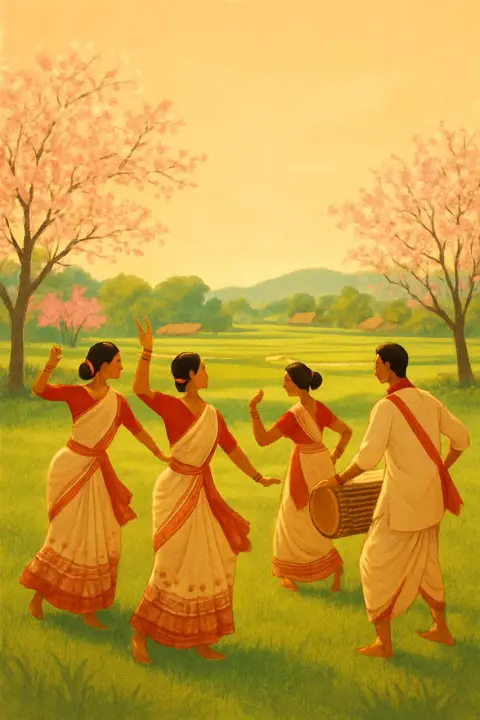
Rongali Bihu: Assam's spring new year, day by day
Drums and songs in every courtyard as spring opens the Assamese year
Rongali Bihu, also called Bohag Bihu, is the Assamese new year and the most important of Assam's three Bihus. It greets spring and the start of the sowing season, and lasts seven days from Goru Bihu, the day the cattle are bathed, on the last day of the month of Chot. Next dates: 14–20 April 2027. The Bihus are celebrated by Assamese people irrespective of religion, caste or creed.
The Assam holiday list, issued between mid-November and early December of the previous year, fixes the Bohag Bihu holidays; Guwahati's Bihu committees announce their stage programmes in March and April.
The legend

Assam has three Bihus a year, and Rongali, or Bohag Bihu, is the main one. It greets spring and the Assamese New Year and opens the sowing season.
It lasts seven days, each with its own name: Chot, Goru, Manuh, Kutum, Senehi, Mela and Chera Bihu.
In the old days it was preceded by Rati Bihu, the night Bihu, when young men and women sang and danced at night under big trees and by the temples.
Customs
Manuh Bihu
On New Year's Day people put on new clothes, honour their elders and give them a bihuwan, a woven gamosa, asking for their blessing.
Husori
Husori bands go round the village from courtyard to courtyard with songs and drums, starting at the namghar, the prayer house.
Fields and stages
Bihu is danced in the open fields, and towns run a week of stages and contests; Guwahati's oldest, Latasil, dates from 1952.
What people eat
Pitha and laru
Pitha rice cakes and laru, balls of rice and coconut.
Where to celebrate
Guwahati
Guwahati marks the Assamese new year on more than 45 Bihu stages, led by Latasil, the oldest (since 1952); the courtyard husori is best seen in a town or village.
The seven days of Bohag Bihu
The week is sometimes called Haat Bihu, the seven Bihus. Each day has its own name (one common list runs Chot, Goru, Manuh, Kutum, Senehi, Mela and Chera Bihu); the first two carry the main rituals, and for the rest of the week husori troupes move from courtyard to courtyard and people dance in the open fields.
| Goru Bihu (last day of Chot) | The cattle are taken to rivers and ponds, washed and smeared with turmeric and other pastes, and touched with sprigs of dighalati and makhiyati leaves. Their old ropes are replaced with new ones, and they roam free for the day. |
| Manuh Bihu (Bohag 1, New Year's Day) | People put on new clothes, honour their elders and give them a bihuwan, a woven gamosa (the Assamese cotton towel), asking for their blessing. |
| Kutum, Senehi, Mela and Chera Bihu | The remaining days, each with its own name, carry the husori, the dancing and the evening stage programmes through to the end of the week. |
Husori, Bihu dance and the stages
What a visitor notices first is the music. Bihu is played on the dhol drum with the pepa, a pipe made of buffalo horn, the bamboo gogona, cymbals (taal), the toka clapper and flutes, and Bihu geet, the folk songs of the season, are mostly about love and spring.
In villages and towns the heart of the week is husori: groups, traditionally of men, go from house to house singing Bihu songs. They start at the namghar, the community prayer house, are welcomed into each courtyard and are given betel leaf and areca nut. Young men and women also dance Bihu in the open fields, dressed in golden muga silk.
In cities the same dance moves onto stages. Guwahati runs more than 45 Bihu stages, with programmes of dance, song and competitions in the evenings and late into the night; one of the oldest, at Latasil playground, has been running since 1952. In 2023 a mass performance in Guwahati entered the Guinness World Records as the largest Bihu dance, with 11,298 participants.
Guwahati gives you scale and the staged competitions; a smaller town such as Jorhat, or a village stay with a host, is the way to see husori in the courtyards and the cattle rites of Goru Bihu.
Three Bihus a year
Assam keeps three Bihus, each tied to a moment in the farming year. Rongali or Bohag Bihu, in April, is the spring festival and the new year, and the most important. Kongali or Kati Bihu, in October or November, is quiet, centred on protecting the growing crop. Bhogali or Magh Bihu, in January, is the harvest festival of community feasts; its name comes from bhog, eating and enjoyment.
In the past Rongali Bihu was preceded by Rati Bihu, the night Bihu, when young men and women sang and danced at night, including in temple grounds.
What people eat
Bihu food is home food made for guests: pitha, rice cakes; laru, balls of rice and coconut; and jolpan. Among some communities rice beer is part of the festival, under names such as apong among the Mising, chuje among the Deori and nam-lao among the Tai-Ahom.
Practical and safety notes
Most of Bihu is free and public, but it is also a family and community festival.
- State holidays — Bihu brings three days of state holidays across Assam, fixed in the Assam holiday list. Offices close; book trains and flights into Guwahati at the same time as the room.
- Courtyards are private — Husori troupes are invited into homes. Watch from the lane unless your hosts bring you in, and ask before photographing people in their own courtyard.
- Passes for some stage nights — Much of the city programme is open to walk into, but some competition nights and stage functions issue passes; check with the committee of the venue.
- Official advice for the Northeast — The UK Foreign Office (FCDO) notes that protests and blockades are common in India's north-eastern states and can happen without warning, and that sudden flare-ups and skirmishes may happen along inter-state borders, including Assam-Meghalaya. Avoid protests, follow local authorities, and see Is India safe? and emergency numbers.
FAQ
When is Rongali Bihu?
Next: 14–20 April 2027. It starts with Goru Bihu on the last day of the month of Chot, and the Assamese new year, Bohag 1, is the next day; the festival lasts seven days in mid-April.
How many types of Bihu are there?
Three: Rongali or Bohag Bihu in April (spring and new year), Kongali or Kati Bihu in October or November, and Bhogali or Magh Bihu, the harvest festival, in January.
Which Bihu is known as Kati Bihu?
Kongali Bihu, held in October or November. It is the quietest of the three, centred on protecting the crop in the fields.
Do people of all religions celebrate Bihu?
Yes. The Bihus are celebrated by Assamese people irrespective of religion, caste or creed, and by the Assamese diaspora abroad.
What is husori?
Groups of singers and drummers who go from house to house during Bihu, starting at the namghar (prayer house). They are welcomed into courtyards and given betel leaf and areca nut.
What food is made for Rongali Bihu?
Pitha (rice cakes), laru (balls of rice and coconut) and jolpan are the classic Bihu foods offered to guests.
Sources (5)
Facts checked: 21 October 2026. Prices and hours are approximate; check locally.