 India GO
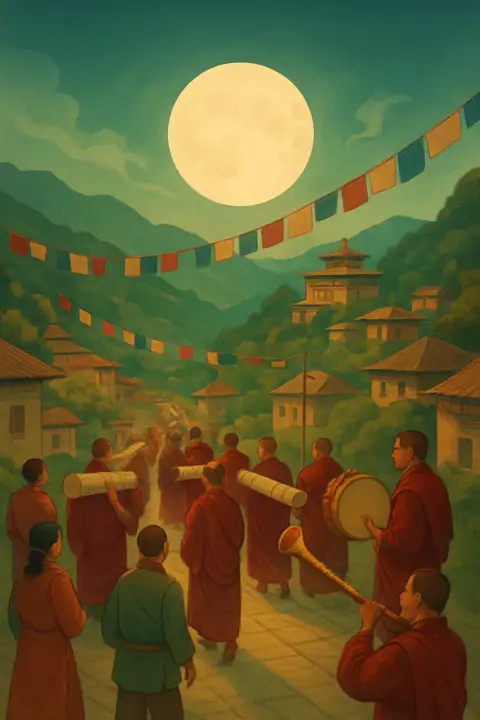
Saga Dawa in Sikkim: the scripture procession in Gangtok
Monks carry the scriptures through Gangtok on the Buddha's full moon
Saga Dawa Duchen is one of the holiest days of the Tibetan Buddhist year, kept on the full moon of the fourth Tibetan month: one day for the Buddha's birth, enlightenment and passing into parinirvana. In Sikkim it is a state holiday, and in Gangtok monks and lay devotees carry the scriptures out of the Tsuklakhang, the royal chapel, in a procession around the town. Date: 18 June 2027 (expected), usually between late May and late June. Foreign visitors need a permit to enter Sikkim; see below.
The Sikkim government fixes the holiday in its notification for the year, published in October or November of the previous year; the state almanac repeats it.
The legend
Saga Dawa is the "triple blessed festival": one day marks the Buddha's birth, his enlightenment and his passing into parinirvana.
For Sikkim's Buddhists it is a whole auspicious month, with prayers in the monasteries throughout, and the main procession on the full moon.
Customs
Scripture procession
Monks playing instruments and devotees carrying holy texts, portraits and statues of the Buddha walk through Gangtok and other towns.
Blessed by the book
People line the streets and touch their heads to the holy scriptures to receive a blessing.
The Bumkor: scriptures through Gangtok
For Sikkim's Buddhists the whole fourth month, Saga Dawa, is a time of prayer in the monasteries, and the full-moon day is its peak. In Gangtok the day starts at the Tsuklakhang, the chapel of the former royal palace. A gong sounds early in the morning, and at around 9 am the procession called Bumkor leaves the gates. Monks with brocade banners lead, to traditional music; behind them come students, women and men, each carrying a volume of scripture (pecha) on one shoulder, with a statue of the Buddha Shakyamuni and the eight auspicious symbols.
In recent years the route has gone through Nam Nang and across MG Marg and back up to the Tsuklakhang, a full circle of the town. People wait along the road and bow their heads to be touched by the books as they pass, which is held to be a blessing. Similar processions take place in other Sikkim towns and at the big monasteries, among them Rumtek, Pemayangtse and Ravangla.
Why it matters
Saga Dawa is the Tibetan form of Vesak, the day Buddhists across Asia keep for the Buddha's birth, enlightenment and death. In the Tibetan calendar it falls a lunar month after the Indian Buddha Purnima in most years, which is why Sikkim's holiday and the national Buddha Jayanti are different days. Many devotees spend the month avoiding killing and eating vegetarian food and spend more time in prayer; in past years the Sikkim government has banned the sale of meat for the holy month. For the wider background, see Buddhism in India.
Permits for Sikkim: what foreigners need
Sikkim borders China, Nepal and Bhutan, and most of it, Gangtok included, is a restricted area for foreign nationals. The rules below are from Sikkim Tourism and the Government of India; they change, so check the official pages before you travel. Indian citizens need a permit only for the protected areas, such as Tsomgo Lake and North Sikkim.
- Restricted Area Permit (RAP)
Every foreigner except people of Bhutanese origin needs a RAP to enter Gangtok, Rumtek, Pemayangtse, Ravangla and the other listed areas. It is free and valid for 30 days; extensions, applied for at least 2 days before expiry, can take the total stay to 60 days.
- How to apply
The official sources currently differ. Indian missions (for example the Embassy of India in Bogotá) state that all PAP and RAP are issued electronically through the e-FRRO portal (indianfrro.gov.in), with no physical permits, and ask for applications at least 30 days ahead, or 15 days if you already live in India. Sikkim Tourism's permit page still describes a form filled in at permit offices, among them Indian missions abroad, airport immigration at Bagdogra and Pakyong, and the tourism offices at Rangpo and Melli. Plan on applying through e-FRRO and confirm the current procedure with Sikkim Tourism before you travel. You need a passport, visa and a photo.
- Register on arrival
Sikkim Tourism says all foreigners must register within 24 hours of arriving in the state, and record their exit at the Foreigners Registration Office when they leave.
- Protected areas need more
Tsomgo Lake and the Lachen, Lachung, Yumthang and Thangu valleys of North Sikkim need a separate Protected Area Permit, arranged through a travel agency registered with Sikkim Tourism, for groups of two or more foreigners. North Sikkim permits run from 3 days/2 nights to 5 days/4 nights.
- Some nationalities need prior clearance
Nationals or people of Pakistani, Afghan or Chinese origin (including Hong Kong and Macau) need prior approval from India's Ministry of Home Affairs; nationals of Myanmar and Nigeria need prior clearance from the Ministry or Sikkim's Home Department.
Watching respectfully
- Give the procession the road — Stand at the side; do not cut through the line of monks and book-bearers for a photo.
- Inside monasteries — Shoes off where asked, walk clockwise around shrines and stupas, and ask before photographing monks or rituals. See what to wear.
- Expect vegetarian menus — In past years the state has banned meat sales for the holy month, so menus may be vegetarian; check locally.
FAQ
When is Saga Dawa in Sikkim?
Next: 18 June 2027 (expected). It is the full moon of the fourth Tibetan month, usually between late May and late June; the Sikkim government confirms the holiday in its list for the year.
What does Saga Dawa mean?
Saga Dawa is the name of the fourth month of the Tibetan calendar. Its full moon, Saga Dawa Duchen, marks the Buddha's birth, enlightenment and parinirvana.
How long does Saga Dawa last?
The holiday and the Gangtok procession are on the full-moon day, but for Sikkim's Buddhists the whole lunar month is a time of prayer and merit-making.
Do foreigners need a permit to see Saga Dawa in Gangtok?
Yes. Gangtok is in Sikkim's restricted area, so foreign nationals need a Restricted Area Permit, free and valid for 30 days. Indian missions say it is now issued only through the e-FRRO portal, while Sikkim Tourism's page still lists permit offices, so confirm before you travel.
Is Saga Dawa the same as Buddha Purnima?
It marks the same events, but follows the Tibetan calendar, so in most years it falls a month after the Indian Buddha Purnima.
Sources (6)
Facts checked: 22 October 2026. Prices and hours are approximate; check locally.