 India GO
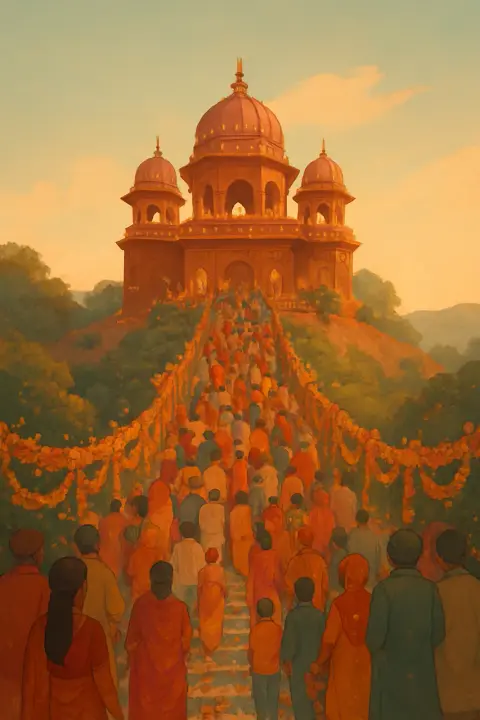
Radha Ashtami: Radha's birthday on Barsana's hill
Pre-dawn chants on the hilltop and a queue that fills every stair below
Radha Ashtami marks the birth of Radha, Krishna's beloved and, for many Vaishnavas, his own divine power. It falls on the eighth lunar day (ashtami) of the bright half of Bhadrapada, fifteen days after Janmashtami. Its centre is the Shriji temple on Bhanugarh hill in Barsana, revered as Radha's home, where the day begins with an abhishek, a ritual bathing of the image, at about 4 am. Next: 8 September 2027 (expected).
Radha Ashtami falls on the eighth day of the bright half of Bhadrapada and marks Radha's birth. It is the biggest day of the year at the Shriji temple in Barsana, revered as her birthplace: the temple is decorated, the image is bathed in a special abhishek, and a chhappan bhog of fifty-six dishes is offered and then given out.
The day follows the lunar calendar and is in the almanacs years ahead; the Barsana temples announce their programmes in the week before.
The legend
Legend says Vrishabhanu, a chief of the Braj cowherds, found his daughter on a thousand-petalled lotus floating on the Yamuna.
Vrishabhanu and his wife Kirtida raise the girl. The Puranas place her birth at midday on the eighth day of the bright half of Bhadrapada.

Fleeing King Kamsa, the family leaves Rawal for Barsana, and Vrishabhanu makes his home on Bhanugarh hill.
Radha grows up there while Krishna grows up next door in Nandgaon. That is how Barsana became Radha's town.

Fifteen days after Janmashtami, Braj celebrates Radha's birthday, and the temple on top of Bhanugarh is dressed in flowers.
Meaning
Rawal
A Yamuna village near Gokul also honours itself as Radha's birthplace: it has its own temple, and pilgrims arrive singing kirtan.
Vaishnavas
For many Vaishnavas Radha is Krishna's own power, and worship of Krishna without her is held to be incomplete.
Vrindavan
Radha Ashtami is kept in nearly every Vrindavan temple; at the Radha Vallabh temple the goswamis sing as turmeric curd is poured over them.
Customs
Abhishek
In the early morning the image is bathed in panchamrit, milk, curd, ghee, honey and sugar, to Vedic chanting.
Badhai songs
Samaj singers from Barsana and Nandgaon sing congratulations to Radha's parents in the temple courtyard for two hours, then embrace.
The white pavilion
In the evening Radha is carried out under the white marble pavilion on the temple roof. This happens three times a year: Radha Ashtami, Holi and Hariyali Teej.
Round Gahvar Van
On the day pilgrims walk round the Gahvar Van grove on the hill, and Barsana stays busy all night.
What people eat
Chhappan bhog
56 dishes offered to the gods, shared out as prasad after the aarti
Words of the festival
लाडली जी
Ladli ji
"beloved daughter", Braj's fond name for Radha; the temple honours the pair as Ladli Lal
श्रीजी
Shriji
a respectful name for Radha and for her temple on Bhanugarh hill
बधाई
badhai
"congratulations"; also the songs that greet a birth
पंचामृत
panchamrit
"five nectars": the mix of milk, curd, ghee, honey and sugar used to bathe the deity
समाज गायन
samaj gayan
choral singing by Braj temple singers, two villages answering each other in turn
True or myth
❌ Myth. Krishna is said to have been born at midnight, but the Puranas place Radha's birth at midday on the eighth of Bhadrapada.
❌ Myth. The Yamuna village of Rawal near Gokul also claims her birth, and Barsana is where Radha grew up.
✅ True. On Radha Ashtami, at Holi and on Hariyali Teej.
Where to celebrate
Barsana
Radha's birthday at the Shriji temple on Barsana's hill: an abhishek at about 4 am, flowers everywhere, and in 2026 a crowd the district planned for at around 25 lakh.
The day in Barsana
This is the biggest day of the year at the Shri Radha Rani temple, also called Shriji or Ladli Ji temple, where Radha and Krishna are worshipped together as Ladli Lal. The temple is decorated with flowers, and the day runs roughly in this order.
- Before dawn: the abhishek
At about 4 am the image is bathed in panchamrit, the "five nectars" of milk, curd, ghee, honey and sugar, to Vedic chanting.
- Badhai in the courtyard
Samaj singers from Barsana and Nandgaon, two villages answering each other in turn, sing badhai, songs of congratulation to Radha's parents, in the temple courtyard for about two hours, then embrace.
- Chhappan bhog
Fifty-six dishes are offered to the deity and then shared out as prasad after the aarti.
- Evening: the white pavilion
Radha is carried out under the white marble pavilion on the temple roof, which happens only three times a year: on Radha Ashtami, at Holi and on Hariyali Teej.
- Through the night
Pilgrims walk round the Gahvar Van grove on the hill, the decorated lanes and stairs stay full, and Barsana stays busy all night.
Elsewhere in Braj and beyond
Radha Ashtami is kept in nearly every temple of Vrindavan. At the Radha Vallabh temple the celebrations run over several days, and the goswamis (temple priests) sing as turmeric curd is poured over them. Rawal, a village on the Yamuna near Gokul, also honours itself as Radha's birthplace, with its own temple, and pilgrims arrive there singing kirtan; Barsana is where Radha grew up, close to Krishna's Nandgaon.
At home and in temples elsewhere, devotees often keep a fast until midday, the hour the Puranas give for Radha's birth (Krishna's, by contrast, is marked at midnight). Images of Radha and Krishna are dressed in flowers, bathed in panchamrit and offered food, which is then shared as prasad, and ISKCON temples hold a mahabhishek, a grand ritual bath.
Planning the trip
The crowds on Barsana's hill are enormous: in a recent year the district planned for around 25 lakh (2.5 million) visitors and deployed about 3,000 police.
- Where to stay — Barsana has only dharamshalas and ashrams, filled by pilgrims; you need one of those beds to be at the temple for the 4 am abhishek, so book well ahead. Otherwise stay in Mathura or Vrindavan, about 45–47 km away, and come for the day's darshan rather than the dawn rite.
- Arrive the day before — On the day outside vehicles are stopped at parking areas well short of the town, so the last stretch and the stairs up the hill (more than 200 steps) are on foot. A ropeway also runs up the hill, but it does not always operate: ask locally.
- Getting to Mathura — Mathura has two railway stations, Mathura Junction and Mathura Cantt, and is about 145 km by road from Delhi and 56 km from Agra; the nearest airport is at Agra, about 62 km away.
- In the queue — Darshan is free; the queue climbs the stairs of the hill. Dress modestly and agree a meeting point in case you are separated. The UK government's travel advice for India notes that stampedes have occurred at large religious gatherings; follow police instructions. See is India safe.
FAQ
When is Radha Ashtami?
Next: 8 September 2027 (expected). It falls on the eighth day of the bright half of Bhadrapada, fifteen days after Janmashtami, usually between late August and late September.
What is Radha Ashtami?
The birth anniversary of Radha, Krishna's beloved. It is celebrated most of all in Barsana and across Braj, around Mathura and Vrindavan.
How many days after Janmashtami is Radha Ashtami?
Fifteen days: Janmashtami is on the eighth day of the dark half of Bhadrapada, Radha Ashtami on the eighth day of the bright half. More on Janmashtami.
Is Radha Ashtami celebrated at midnight like Janmashtami?
No. The Puranas place Radha's birth at midday, so the fast is often kept until noon; at Barsana the main rite, the abhishek, is at about 4 am.
Where was Radha born?
Tradition names two places: Barsana, revered as her birthplace and where she grew up, and Rawal, a village on the Yamuna near Gokul.
Sources (6)
Facts checked: 21 October 2026. Prices and hours are approximate; check locally.