 India GO
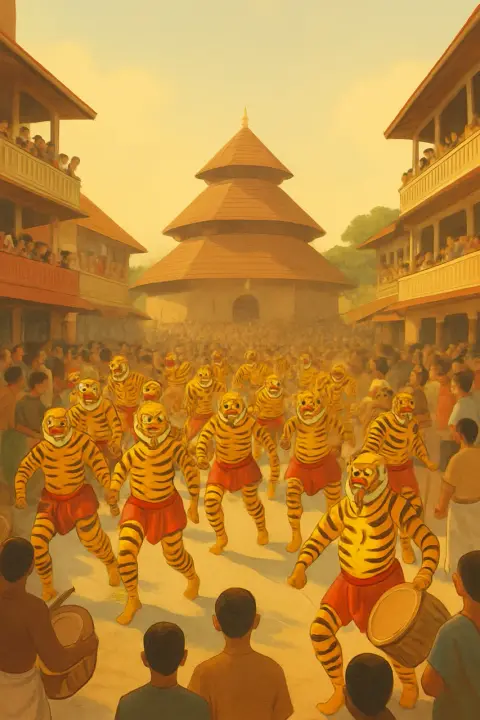
Pulikali: the painted tigers of Thrissur's Swaraj Round
Tiger faces painted on bellies, rolling to the drums around the town's great circle
Pulikali, "the play of tigers", is the folk art of Onam in which troupes of men painted as tigers and leopards dance through Thrissur to the drums. It takes place on the fourth day of Onam, a few days after Thiruvonam, on the Swaraj Round, the ring road around the Vadakkunnathan temple in the city centre. Next: 15 September 2027 (expected); the Thrissur municipal corporation fixes the day six to seven weeks ahead.
The day follows Onam; the Thrissur municipal corporation fixes and funds the event six to seven weeks ahead.
The legend
Pulikali is Malayalam for the play of tigers, a folk art of Onam: on the festival's fourth day dancers come out painted as tigers and leopards.

It was once called Pulikkettikali, and dancers painted everything, faces included. Today they add masks, false fangs, beards and a belt of bells.
Since 2004 Thrissur's troupes have had a joint coordination committee, and the city gives each a grant. In 2016 women danced for the first time.
Customs
The painting
From early morning artists lay two coats of tempera mixed with varnish or enamel on the dancers; the whole process takes five to seven hours.
Tigers on Swaraj Round
In the afternoon the troupes, or sangams, dance in from every corner of Thrissur to the drums, bellies shaking, towards Swaraj Round, with floats from each village.
A coconut for Ganapati
At Naduvilal, before the Vadakkunnathan temple, each troupe offers a coconut to Ganapati before going round the circle.
Words of the festival
പുലിക്കളി
Pulikali
"The tiger play": from Malayalam puli, tiger, and kali, play.
Where to celebrate
Thrissur
On the fourth day of Onam, troupes of performers painted as tigers and leopards dance round Thrissur's Swaraj Round to drums, from late afternoon into the night.
How the day runs
Pulikali is one long day that builds from quiet neighbourhood courtyards in the morning to a packed ring road at night. All of it happens on public streets.
- Morning: the painting
Each troupe, or sangam, is painted at its base in its own neighbourhood, starting early in the morning. Artists lay a base coat of tempera powder mixed with varnish or enamel, let it dry for two to three hours, then add a second, more detailed coat: five to seven hours in all. Masks, false fangs, beards and a belt of bells go on last.
- Afternoon: dancing in
In the afternoon the troupes set off dancing towards the centre along Palace Road, Shornur Road, MG Road and the other roads into the Round, bellies shaking to the chenda, thakil and udukku drums, with floats from each locality. Along the way they act out tigers stalking prey and hunters chasing tigers.
- Evening: the Round
At Naduvilal, in front of the Vadakkunnathan temple, each troupe offers a coconut at the Ganapati shrine before going round the circle. Judges sit near the Paramekkavu temple, on MO Road and at Naduvilal Junction, where the troupes stop to perform. The parade on the Round runs from late afternoon into the night; the corporation announces the exact timings each year.
Where to watch
Everything is free and there are no tickets. Come by early afternoon to get a place on the Round.
Naduvilal Junction
The coconut offering at the Ganapati shrine and a judging point. In recent years the corporation has set up a viewing pavilion here for foreign visitors.
Paramekkavu temple and MO Road
The other judging points, where troupes stop and perform in full rather than dancing past.
The approach roads
In the afternoon on Palace Road, Shornur Road and MG Road you can see the troupes close up, with more room than on the Round.
Where the tigers come from
The art is said to have been introduced about two hundred years ago by Sakthan Thampuran, the Maharaja of Cochin. Kerala Tourism also traces its oldest form to the Pancha ceremony of Pattani Muslims. It was once called Pulikkettikali, and dancers painted everything, faces included; ready-made masks came later. Kerala Tourism notes that many troupes keep a 41-day fast before the performance, from the first day of the month of Karkidakam.
Since 2004 Thrissur's troupes have had a joint coordination committee, and the corporation gives each a grant. In 2016 women danced for the first time, three of them in a 51-member team. Unlike much of Onam, which happens at home, Pulikali is entirely public, and it is the festival's loudest and least solemn day.
Getting there and staying
Onam is Kerala's biggest holiday week, so the long-distance part of the trip is the hard part.
- A day trip from Kochi works — Thrissur is about 75 km from Kochi (Ernakulam). Local trains and buses run all day without booking.
- Or stay the night — The parade ends late, so a night in Thrissur saves the trip back. Book a room about a month ahead; everything is within walking distance of the Round.
- Book trains into Kerala at 60 days — Booking opens 60 days ahead, and trains into Kerala for Onam fill up quickly.
- In the crowd — Roads around the Round close to traffic for the parade. The UK government's travel advice for India warns of pickpockets in crowded tourist areas; keep valuables in a front pocket. See is India safe.
FAQ
When is Pulikali?
Next: 15 September 2027 (expected). It is held on the fourth day of Onam, a few days after Thiruvonam, and the Thrissur corporation confirms the day six to seven weeks ahead.
What time does Pulikali start?
The painting starts early in the morning, the troupes dance in during the afternoon, and the parade on Swaraj Round runs from late afternoon into the night. The corporation announces the exact timings each year.
Which district is famous for Pulikali?
Thrissur. The main event is on the Swaraj Round in Thrissur city.
What is the story behind Pulikali?
It is said to have been introduced about two hundred years ago by Sakthan Thampuran, the Maharaja of Cochin; Kerala Tourism also links its oldest form to the Pancha ceremony of Pattani Muslims.
Is Pulikali free to watch?
Yes. It runs on public streets and the Swaraj Round is open to everyone.
Sources (6)
Facts checked: 21 October 2026. Prices and hours are approximate; check locally.