 India GO
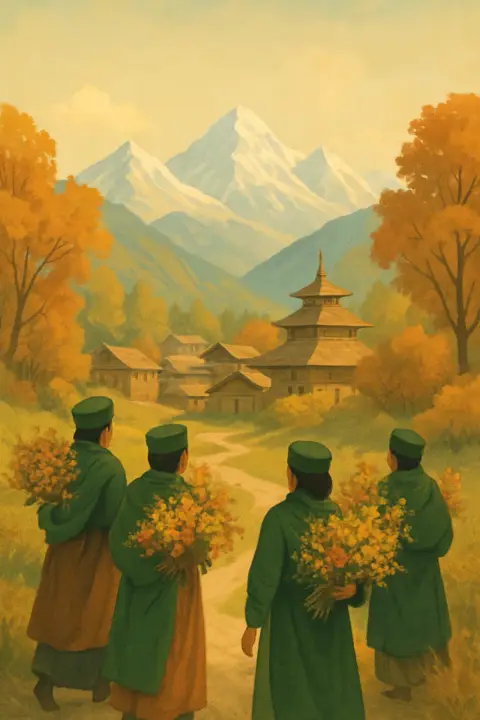
Phulaich: the flower festival of Kinnaur
The last wild flowers of the year carried down from the high pastures
Phulaich, also called Ukhyang, is the flower festival of Kinnaur district in Himachal Pradesh. In September, as the monsoon withdraws, villagers walk up to the high meadows to gather the last wild flowers of the year and offer them to the village deities and to their ancestors; singing, dancing and feasting follow. There is no single date: each village keeps its own day, and Kalpa holds the best-known celebration.
Each village sets its own day by the local calendar, and the dates are known locally shortly before; the Kinnaur district administration in Reckong Peo can advise in August.
The legend

When the monsoon rains withdraw in September, the Kinnaur meadows bloom with rare wild flowers, and Phulaich, the flower festival, is held for them.
The flowers are a gift to the village deities and to the ancestors. Kalpa keeps the liveliest festival, with a special larger one every twelve years.
Customs
Up for the flowers
Villagers walk a long way up to the high meadows for the flowers, offer them to the deities, and then come songs, dances and feasting.
What happens at Phulaich
Himachal Tourism describes the festival simply: when the rains withdraw, the meadows of the Kinnaur mountains come alive with a rare crop of wild flowers, and villagers walk long distances to gather them and offer them to the deities. A party from each village goes up to the high pastures, and the main day is the second, when the flowers are carried down. The festival lasts about three days.
The flowers are a gift both to the village gods and to the village’s own dead, so Phulaich is part celebration, part remembrance. Kalpa, near the district headquarters at Reckong Peo, has the most vibrant celebrations, and every twelve years it holds a larger, special festival. Moorang and Kanam, further up the Sutlej, keep it too (Kanam lies in the permit area, see below).
When it is held
Phulaich falls in September, village by village, around the sixteenth day of the local month that matches Bhadrapada in the Hindu calendar. Each village sets its day by its own calendar and the dates are known locally only shortly before, so the festival is best treated as a bonus to a September trip to Kinnaur rather than something to plan around. The district administration in Reckong Peo can advise in August.
Permits: what the Kinnaur administration says
Upper Kinnaur lies close to the border with Tibet. By the Kinnaur district administration’s tourist guidelines, the area between the Inner Line and the international border is a protected area, and no foreigner may enter or stay there without a Protected Area Permit.
- Foreign visitors: groups of two or more, sponsored by a recognised Indian travel agency with a planned itinerary, may be allowed to visit listed places for 30 days. In Kinnaur these are villages of Pooh block, including Kanam, Nako, Pooh, Chango and Leo.
- Kalpa, Reckong Peo, the Sangla valley and Moorang are not on that list of places.
- Who issues permits: among others, the DM or ADM of Kinnaur and the SDMs at Kalpa and Pooh; the district page gives the Inner Line Permit fee at an e-Governance centre as about ₹200 per person, plus the agency’s service charge.
- In the notified area: carry a valid identity card, keep away from and do not photograph military installations, and expect no access on the roads towards Shipki La and Kaurik.
Rules change; confirm them with the SDM office at Kalpa, in Reckong Peo, before you go.
Getting to Kinnaur and when to go
Kinnaur is reached by National Highway 5 from Shimla, the old Hindustan–Tibet road up the Sutlej valley; Reckong Peo is the district headquarters and Kalpa is close by. The lower Sutlej and Baspa valleys get monsoon rain from July to September and some stretches are prone to landslides, so leave slack in the plan. If you are in the region later in the autumn, the Lavi Fair at Rampur, the gateway town to Kinnaur, is held in November.
Phulaich is the villages’ own festival for their deities and ancestors. Follow the lead of local people at the shrines and ask before photographing anyone.
FAQ
What is Phulaich?
The flower festival of Kinnaur in Himachal Pradesh: villagers gather wild flowers from the high meadows in September and offer them to the village deities and to their ancestors, followed by songs, dances and feasting.
Which state celebrates the Phulaich flower festival?
Himachal Pradesh, in the villages of Kinnaur district.
When is Phulaich celebrated?
In September, on a day each village sets by its own calendar, around the sixteenth day of the local month matching Bhadrapada. Dates are known locally only shortly before.
Where is the best place to see Phulaich?
Kalpa, by Himachal Tourism’s account, has the most vibrant celebrations, with a larger special festival every twelve years.
Do foreigners need a permit for Kinnaur?
For the protected area between the Inner Line and the border, such as Kanam, Nako and Pooh in Pooh block. Kalpa, Reckong Peo and the Sangla valley are not on the district’s list of protected places.
Facts checked: 22 October 2026. Prices and hours are approximate; check locally.