 India GO
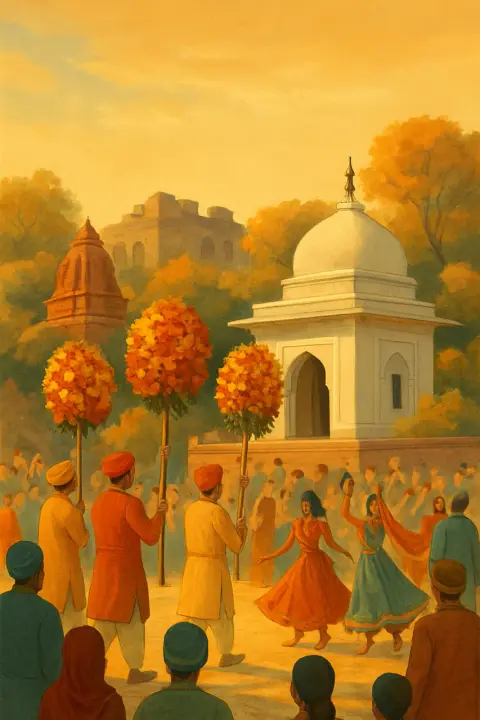
Phool Walon Ki Sair: flower fans for a temple and a Sufi shrine
Flower fans carried to a temple and a Sufi shrine on the same day
Phool Walon Ki Sair, "the florists' outing", is a festival of Delhi's flower sellers held in Mehrauli, in the south of the city. For about a week, usually in October, great fans (pankhas) worked with flowers are carried to the dargah of the Sufi saint Khwaja Bakhtiyar Kaki and to the Yogmaya temple, Hindus and Muslims together. The dates are not fixed: the organising society announces them each year, a few weeks ahead.
Anjuman Sair-e-Gul Faroshan sets the dates each year once the Mehrauli venue is cleared and publishes the programme a few weeks ahead; the Delhi government declares a half-day holiday for the procession.
The legend
Delhi, 1812, under the last Mughals. Prince Mirza Jahangir, son of Akbar Shah II, is exiled to Allahabad for an outrage against the British Resident.
His mother, Mumtaz Mahal Begum, makes a vow: if her son comes home, she will offer a sheet of flowers at the dargah of the saint Bakhtiyar Kaki in Mehrauli.
The son is freed, and the court and all of Delhi follow the Begum to Mehrauli: seven days of swings in the mango groves, kites and wrestling.

At the emperor's wish a floral fan is also carried to the Yogmaya temple. From then on the festival is yearly, with gifts for both the dargah and the temple.
The British ban the festival in 1942; Nehru revives it in 1961–62. Since then its chief patron has been the Prime Minister of India.
Meaning
Shared Delhi
The festival is seen as an example of Delhi's composite culture, still celebrated by Hindus and Muslims alike.
Every state
Under Indira Gandhi every state was invited. Their troupes sing, dance and act at the Lodi-era Jahaz Mahal beside the Hauz Shamsi tank.
Customs
Flower fans
The florists carry great pankha fans worked with flowers and pray for a good flower season in the year ahead.
To the shehnai
Shehnai players and dancers lead the procession, first to the Yogmaya temple, then through Mehrauli bazaar to the dargah.
A chadar for the saint
At Bakhtiyar Kaki's dargah a chadar, a sheet for the tomb, goes with the fan; the Yogmaya temple receives a fan and flowers.
Fans for officials
A similar floral fan is presented to the President of India, the Chief Minister of Delhi and the city's Lieutenant Governor.
Words of the festival
پھول والوں کی سیر
Phool Walon Ki Sair
"the florists' outing", the festival's name
پنکھا
pankha
a fan; at the festival it is made of flowers and carried to the shrines
چادر
chadar
the sheet laid over a saint's tomb in a dargah
Sair-e-Gul Faroshan
the festival's other name, also borne by the society that organises it
True or myth
✅ True. Bahadur Shah Zafar, the last Mughal emperor, kept the festival even then; it was the last under the Mughals.
❌ Myth. The British stopped it in 1942, and it was revived only in 1961–62.
✅ True. After the revival he attended every festival up to 1964.
What happens during the week
The festival is organised by the Anjuman Sair-e-Gul Faroshan, the society that has run it since its revival in 1961–62; Sair-e-Gul Faroshan is also the festival's Urdu name. Its programme spreads over about a week, one or two events a day, mostly in Mehrauli. A typical programme, as the organiser has published it, runs like this:
- Opening days. A children's painting competition, and shehnai players taking a floral pankha to the Lieutenant Governor and other city officials. Similar fans go to the President of India and the Chief Minister of Delhi.
- The procession. Shehnai players and dancers set out with the pankhas from the Gauri Shankar temple in Chandni Chowk, the old city, and carry them to Mehrauli. The Delhi government has declared a half-day holiday for the procession.
- Dangal. Traditional wrestling (kushti) in the park at Aam Bagh, near the Hauz-e-Shamsi tank.
- The offerings. A floral chadar (the sheet laid over a saint's tomb) and a pankha are presented at the dargah of Khwaja Bakhtiyar Kaki, and a pankha and a floral canopy (chhatra) at the Yogmaya temple.
- The last evening. Cultural troupes from Indian states perform at Jahaz Mahal, a pavilion beside Hauz-e-Shamsi believed to date from the Lodi era, followed by a pankha procession, prizes and qawwali.
The florists pray for a good flower season in the year ahead, and the festival is held up as an example of Delhi's shared Hindu and Muslim culture.
Two hundred years, with a twenty-year gap
The festival dates from 1812, under Akbar Shah II, one of the last Mughal emperors. It began with a mother's vow at the dargah of Bakhtiyar Kaki for her exiled son, and at the emperor's wish a fan went to the Yogmaya temple too; the story is told in full above. Under the Mughals it lasted seven days, with swings in the mango groves, kite flying and wrestling. Bahadur Shah Zafar, the last emperor, kept it even in 1857, with Delhi under siege.
The British stopped the festival in 1942, during the Quit India Movement. Jawaharlal Nehru revived it in 1961–62 and came every year until his death in 1964; since then the Prime Minister of India has been its chief patron. Under Indira Gandhi every state was invited to send a troupe, which is why the last evening at Jahaz Mahal is a parade of regional music and dance.
How to fit it into a Delhi trip
This is a small neighbourhood festival rather than a city-wide event, so treat it as a bonus if it falls during your stay.
- Watch for the announcement — The society sets the dates once the Mehrauli venue is cleared and publishes the programme on its website a few weeks ahead. In recent years the dates have moved: one edition was postponed by several months and held in spring.
- Choose the Mehrauli days — The offerings at the dargah and the temple and the last evening at Jahaz Mahal all happen in Mehrauli, close to the Qutub Minar and the Mehrauli Archaeological Park, so they combine easily with a day of sightseeing there.
- Two places of worship — The Yogmaya temple asks for modest dress and shoes off at the step. At the dargah, follow what the people around you do, and do not push forward for photos during the offering.
- Crowds — Processions and the dargah can be packed. The UK government's travel advice for India warns of pickpockets in tourist areas and of crushes at large religious gatherings: keep valuables in a front pocket and agree a meeting point. See also is India safe.
FAQ
When is Phool Walon Ki Sair held?
Usually for about a week in October, though the dates are not fixed and have shifted in recent years. The Anjuman Sair-e-Gul Faroshan announces them a few weeks ahead.
What does Phool Walon Ki Sair mean?
"The florists' outing". Its other name, Sair-e-Gul Faroshan, means the same in Urdu and is also the name of the society that organises it.
Where is Phool Walon Ki Sair celebrated?
In Mehrauli, south Delhi: at the dargah of Khwaja Bakhtiyar Kaki, the Yogmaya temple and Jahaz Mahal by the Hauz-e-Shamsi tank. The procession starts in Chandni Chowk.
Why is Phool Walon Ki Sair celebrated?
It began in 1812 with a vow by the mother of an exiled Mughal prince, fulfilled at the dargah of Bakhtiyar Kaki, with a fan sent to the Yogmaya temple too. It is kept as a festival shared by Hindus and Muslims.
Has the festival run without a break since 1812?
No. The British stopped it in 1942, and Nehru revived it in 1961–62.
Sources (4)
Facts checked: 21 October 2026. Prices and hours are approximate; check locally.