 India GO
Pawl Kut: the Mizo festival of straw
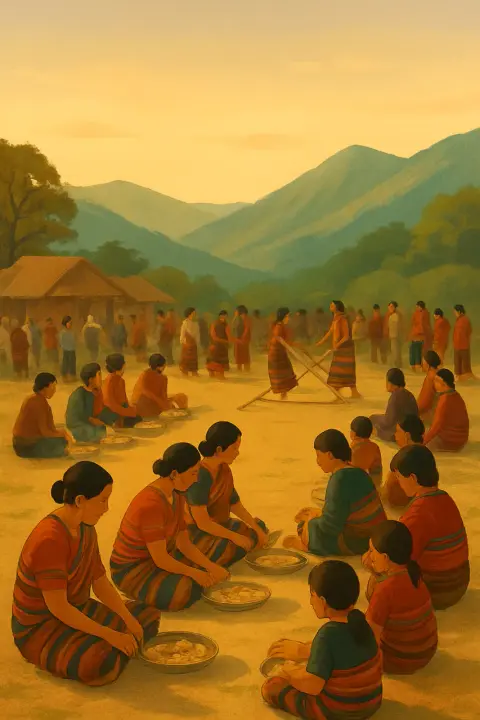
Mothers and children feed each other by hand on a platform before the village
Pawl Kut is the post-harvest festival of the Mizo people of Mizoram, held in December or January once all the rice is in from the fields. Mizoram Tourism calls it the greatest of all the festivals celebrated in the state. It is a thanksgiving with community feasts, songs and dances, and its best-known rite is Chhawnghnawt, when mothers and their children sit together on a platform and feed each other by hand. There is no single statewide date: communities set their own days after the harvest.
Village communities hold it after the harvest and set their own days; there is no public announcement.
The legend
Pawl Kut is the Mizo "festival of straw", kept in December or January once all the rice is in from the fields.
By tradition it began when a community, after two years of famine, brought in a rich harvest and gathered for a shared feast of thanks.
It is one of the three main kuts of the Mizo farming year, alongside the spring Chapchar Kut and Mim Kut, and closes the year with thanksgiving.
Customs
Chhawnghnawt
Mothers and their children sit together on a specially built platform and feed each other by hand, a sign of family bonds.
Songs and dances
The feasting comes with group singing, folk dances and games; in Aizawl the days bring official cultural programmes.
What Pawl Kut is
Pawl means straw and kut means festival, so the name is usually rendered as the festival of straw. It is one of the three main kuts of the Mizo year, and all three follow the farming cycle: Chapchar Kut in spring after the jungle is cleared for jhum (shifting) cultivation, Mim Kut in August or September after the maize harvest, and Pawl Kut after the rice harvest, when, in the words of the state's Information and Public Relations department, the difficult task of tilling and harvesting is over.
By long-standing oral tradition the festival began several centuries ago, when a community that had lived through two years of famine was blessed with a rich harvest in the third and gave thanks with a shared feast. The Governor of Mizoram, opening an official celebration, described it as having been a festival centred on youth and children in the past, before Christianity spread in Mizoram.
How it is kept
Pawl Kut is typically two days of festivities, sometimes three.
- Feast
Households and communities hold feasts, with meat and eggs as the principal foods.
- Chhawnghnawt
Mothers and their children sit together on a platform and feed each other portions of meat and egg by hand, a sign of family bonds. The same custom is also performed at Chapchar Kut.
- Songs, dances and games
Feasting comes with group singing, folk dances and games. In Aizawl the days bring official cultural programmes; one official celebration, organised by the state Social Welfare Department, was held at the Lammual ground.
- A day of rest
Traditionally, the days of festivity are followed by a day of complete rest, when no one goes out to work.
Permits for Mizoram
Visitors from outside Mizoram need a permit to enter the state. Arrange it first.
- Indian nationals: Inner Line Pass — Required for entry into Mizoram. Mizoram Tourism says it can be obtained from the Mizoram government's liaison officers in Kolkata, Silchar, Shillong, Guwahati and New Delhi, or on arrival at Lengpui airport. The state also runs an online portal, ilp.mizoram.gov.in.
- Foreign nationals: Protected Area Permit — All foreigners need a Protected Area Permit before coming to Mizoram, applied for online through the e-FRRO portal; Mizoram Tourism notes that you can apply only after reaching India. After entering Mizoram you must register online within 24 hours of arrival, and your hotel or host must enter your details on the Form C portal within 24 hours.
- Rules change — The FCDO says permit rules can change at any time and advises applying three months before arrival.
Rules and etiquette
A few things that differ from a festival elsewhere in India.
- A dry state — Rice beer belonged to the old festival, but today the FCDO lists Mizoram among the states where the consumption, production or transport of alcohol is illegal, and warns that you could be arrested and held without bail. Do not bring alcohol in.
- A family rite — Chhawnghnawt is a moment between mothers and children. Watch from a distance and ask before photographing.
- Roads in the north-east — The FCDO notes that protests and blockades are common in the north-eastern states and can disrupt highways, and it advises against all but essential travel to neighbouring Manipur. See Is India safe?.
FAQ
When is Pawl Kut celebrated?
In December or January, after the rice harvest. There is no statewide date: communities choose their own days, and official programmes are announced locally.
Which state celebrates Pawl Kut?
Mizoram, in north-east India. It is the festival of the Mizo people.
What does Pawl Kut mean?
Pawl means straw and kut means festival: the festival of straw, held after the rice harvest.
What food is eaten at Pawl Kut?
Meat and eggs are the principal foods of the feast, and mothers and children feed each other portions of them at Chhawnghnawt.
Which festival is famous in Mizoram?
The three main festivals are Chapchar Kut in spring, Mim Kut in August or September and Pawl Kut in December or January. Mizoram Tourism calls Pawl Kut the greatest.
What is Mim Kut?
The third main Mizo festival, held in August or September after the maize harvest and is dedicated to the memory of dead relatives, with the first harvest offered on a raised platform.
Sources (9)
- Mizoram Tourism: Fairs and festivals
- Mizoram Tourism: Entry formality
- Government of Mizoram: Inner Line Pass portal
- DIPR Mizoram: Festivals
- DIPR Mizoram: Governor graces celebration of Pawl Kut festival
- Pawl Kut
- FCDO: India entry requirements (access permits)
- FCDO: India safety and security (alcohol laws)
- FCDO: India regional risks
Facts checked: 21 October 2026. Prices and hours are approximate; check locally.