 India GO
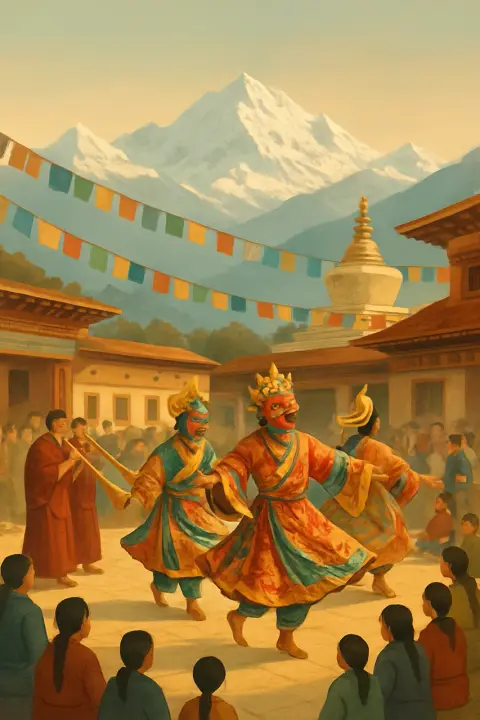
Pang Lhabsol: Sikkim's festival of Khangchendzonga
Dancers in armour salute the mountain that guards Sikkim
Pang Lhabsol is a festival found only in Sikkim: it honours Mount Khangchendzonga, the third-highest peak on earth, as the guardian deity of the state, and recalls the oath of brotherhood between the Lepcha and Bhutia peoples. It falls on the full moon of the seventh Tibetan month; next: 15 September 2027 (expected). The best-known celebration is in the courtyard of the Tsuklakhang, the royal chapel in Gangtok, where dancers in armour perform the Pangtoed cham, and it is free to watch.
The Sikkim government fixes the holiday in its notification for the year, published in October or November of the previous year; the state almanac repeats it.
The legend
Pang Lhabsol belongs to Sikkim alone: it marks the consecration of Mount Khangchendzonga as the land's guardian, and its deity is still asked to protect Sikkim.
According to the biography of Lhatsun Chenpo, who spread Buddhism in Sikkim, visions sent by the mountain god led him to Demajong, the hidden valley of rice.
The festival also remembers the oath of brotherhood the Lepcha and the Bhutia swore to each other at Kabi in the 15th century.
Customs
The warrior dance
The Pangtoed, the masked warrior dance in armour, was choreographed by Sikkim's third Chogyal, Chakdor Namgyal; it is said to have come to him in a vision.
At the Tsuklakhang
In the morning monks invoke the mountain at the Tsuklakhang, Gangtok's palace chapel; around midday the cham fills the courtyard, then a cultural programme and Sikkimese food follow.
Where to celebrate
Gangtok
On the full moon of the seventh Tibetan month Gangtok's palace chapel honours Khangchendzonga as Sikkim's guardian, and masked dancers in armour perform the Pangtoed cham in its courtyard.
A festival for a mountain
Most Himalayan festivals honour a deity or a teacher. Pang Lhabsol honours a mountain. In the Sikkimese account, while Lhatsun Chenpo, who brought Buddhism to Sikkim, was meditating in a cave at Dzongri in West Sikkim, the mountain god Khangchendzonga appeared to him, and he declared the mountain the guardian deity of the land. For the Lepchas the mountain is also their place of origin.
The festival is said to go back further, to the blood-brotherhood pact sworn at Kabi between the Lepcha chief Thekong Tek and Khye Bumsa, ancestor of the Namgyal kings of Sikkim. The third Chogyal (king), Chakdor Namgyal, introduced the Pangtoed dance and dedicated it to Khangchendzonga as a war deity. Today Bhutias, Lepchas and Nepalis celebrate together, and the day is a state holiday in Sikkim.
The Pangtoed cham
The cham is a masked dance combined with a warrior dance. Khangchendzonga is played by a dancer in a red mask crowned with five skulls and flags; Yabdu, his supreme commander, wears a black mask; and the warriors around them are in traditional Sikkimese battle dress, with helmets, swords and shields. The high point is the entry of Mahakala, protector of the faith, who commands Khangchendzonga and Yabdu to defend it and bring peace to Sikkim.
At the Tsuklakhang in Gangtok the day runs in three parts: in the morning monks invoke the mountain inside the chapel, around midday the cham fills the courtyard, and in the afternoon there is a cultural programme with Sikkimese food in the palace grounds. The cham is also performed at other monasteries across Sikkim; Ravangla (Rabong) in South Sikkim keeps its own celebration with a Pangtoed cham, a separate trip from Gangtok.
Watching the dance
Pang Lhabsol is a religious festival held at a working royal chapel, and visitors are welcome to watch.
- Free, from the public area — The cham is free to watch from the public area around the Tsuklakhang courtyard. Come by late morning to find a place at the edge.
- Leave the front to monks and elders — The front rows belong to monks and elders. Stay out of the dancers' space and follow the stewards.
- Easy to reach — The Tsuklakhang is in the palace grounds, a short walk from MG Marg in central Gangtok.
Planning the trip
Gangtok has plenty of hotels, so a month ahead is enough for rooms, trains to New Jalpaiguri and flights to Bagdogra. The harder part is the season.
- Keep a spare day
The festival falls in the monsoon, when landslides can close the NH10 road from Siliguri for hours or days. Arrive the day before and keep a spare day on either side; the UK Foreign Office warns that monsoon flash floods and landslides, particularly in mountain areas, can come with limited warning.
- Permit for foreign nationals
Sikkim lies partly in India's protected and partly in its restricted areas, so foreign nationals need a special permit to visit. Permit rules and the way to apply change, so check the current procedure with Sikkim Tourism or the FRRO well before you go.
- Confirm the date
The Sikkim government fixes the holiday in its list for the year, published in October or November of the year before.
FAQ
When is Pang Lhabsol?
On the full moon, the fifteenth day, of the seventh Tibetan month, which falls between late August and late September. Next: 15 September 2027 (expected).
Who celebrates Pang Lhabsol?
The people of Sikkim: Bhutias, Lepchas and Nepalis celebrate together, and the day is a Sikkim state holiday. The festival is unique to Sikkim.
Where is the best place to see Pang Lhabsol?
The courtyard of the Tsuklakhang (Palace Monastery) in Gangtok, where the Pangtoed cham is danced from about midday. Ravangla in South Sikkim has its own celebration.
What is the Pangtoed dance?
A masked warrior dance introduced by the third Chogyal, Chakdor Namgyal: dancers in Sikkimese battle dress, with helmets, swords and shields, accompany Khangchendzonga in a red mask and his commander Yabdu in a black one.
Do I need a permit to visit Sikkim for the festival?
Foreign nationals need a special permit to visit Sikkim. The rules and the way to apply change, so check the current procedure with Sikkim Tourism or the FRRO before travel.
Sources (8)
- Pang Lhabsol, Utsav (Ministry of Tourism, Government of India)
- Festivals in Sikkim, Government of Sikkim
- Restricted Area Permit, Sikkim Tourism
- FCDO travel advice: India, entry requirements (access permits)
- FCDO travel advice: India, safety and security (monsoons)
- Tsuklakhang Palace (Wikipedia)
- Pang Lhabsol festival celebrated with grandeur in Sikkim, ThePrint
- Protected Area Permit (Wikipedia)
Facts checked: 21 October 2026. Prices and hours are approximate; check locally.