 India GO
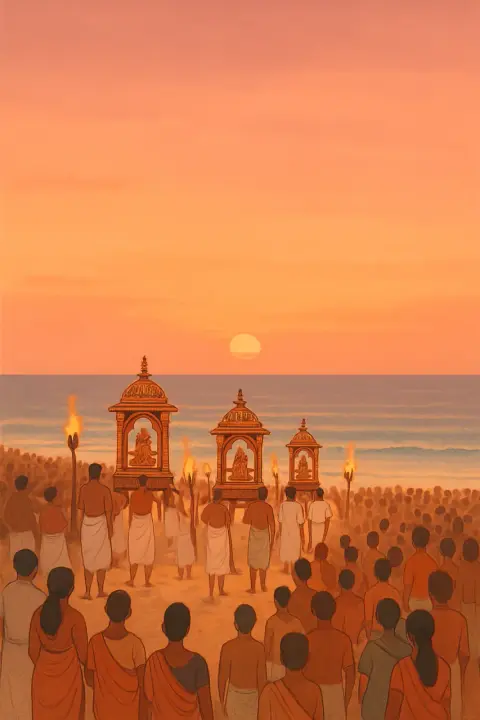
Padmanabhaswamy Arattu: the god's walk to the sea
A royal house walks its god to the sea across a silent runway
Twice a year the Sree Padmanabhaswamy Temple in Thiruvananthapuram holds a ten-day festival, Painkuni in March or April and Alpashy in October or November, and each ends with the Arattu: the temple's deities are carried about 6 km to Shanghumugham beach for a ritual bath in the sea, escorted by the head of the Travancore royal house, and the city's airport closes its runway to let them cross. Next festival: 11–19 April 2027 (expected). The procession is on public roads and anyone can watch it.
The temple fixes both festivals. Thiruvananthapuram airport closes its runway for the procession and publishes the notice one to seven days before; that notice is the surest public confirmation.
The legend
Padmanabha is Vishnu reclining on the serpent, with a lotus bearing Brahma rising from his navel; hence the name, from padma, lotus, and nabha, navel.
In 1750 Marthanda Varma gave the kingdom of Travancore to Padmanabha; its rulers have since been styled Sree Padmanabha Dasa, servants of the god.

So the head of the Travancore house still walks behind the deity to the sea: the Arattu is the purifying immersion of the images in the ocean.
Customs
Pallivetta
On the ninth day the head of the royal house escorts the deities to the Pallivetta, the ritual hunt, and shoots an arrow at a tender coconut.
Procession to the sea
On the tenth day the images of Padmanabha, Narasimha and Krishna are carried about 6 km to Shanghumugham beach; the airport closes its runway to let them pass.
Torchlit return
After the bath the images are taken back to the temple in a procession lit by traditional torches, which closes the festival.
Where to celebrate
Thiruvananthapuram
Twice a year the temple's deities are carried about 6 km to the sea at Shanghumugham, the head of the Travancore royal house walking behind, and the airport closes its runway to let them cross.
Two festivals, one ending
Padmanabha is Vishnu reclining on the serpent Ananta, with a lotus rising from his navel: the name comes from padma, lotus, and nabha, navel. The temple's ties to the Travancore royal house run deep. In 1750 Marthanda Varma dedicated his kingdom to Padmanabha, and the rulers have since called themselves Sree Padmanabha Dasa, servants of the god. That is why the head of the house still escorts the deity to the sea.
The temple's own history records the Alpasi Utsavam, the ten-day festival of October and November, as already held in 1375. Alpashy falls in the Malayalam month of Thulam, with the Arattu on the Thiruvonam star. Painkuni is held in March and April, in Meenam. Both follow the same pattern: kodiyettu (flag hoisting) on the first day, rituals and processions inside the temple each day, the Pallivetta on the ninth evening and the Arattu on the tenth. During Painkuni, large fibreglass figures of the five Pandava brothers of the Mahabharata stand at the eastern entrance; Kerala Tourism notes they are believed to propitiate Indra, the god of rain.
The last two days
Everything below happens outside the temple and can be watched by anyone. Times are from recent festivals and shift from year to year.
- Day 9, evening: Pallivetta
The royal hunt. The head of the royal house escorts the deities to the Fort area near the Vettakorumakan temple and shoots an arrow at a tender coconut.
- Day 10, late afternoon: the procession leaves
The festival images of the deities are carried out of the temple. The head of the royal house leads the procession with a sword, with caparisoned elephants and mounted and armed police, and thousands of devotees line the streets.
- Across the runway
The route to Shanghumugham, about 6 km, crosses the runway of Thiruvananthapuram International Airport. The airport, built by the Travancore royal family in 1932, suspends operations twice a year so that the procession can pass.
- Dusk: the sea bath
At the Arattu mandapam on Shanghumugham beach the deities are given their ritual bath in the sea. Expect large crowds along the route and on the beach.
- Night: the torchlit return
After dark the procession carries the deities back to the temple by traditional torchlight, and the festival closes.
Flying on Arattu day
On the Arattu evening Thiruvananthapuram airport stops operations for several hours, in recent years from about 16:45 to 21:00, and flights in that window are rescheduled. The airport publishes the closure one to seven days ahead. If you fly in or out that day, check the new times with your airline.
Visiting the temple during the festival
Inside the temple its own rules apply. Kerala Tourism, the state tourism department, states that only Hindus are permitted inside the temple. The dress code below is as published on the temple's official website; for anything else about entry, ask at the temple.
- Who may enter — Only Hindus are permitted inside the temple, according to Kerala Tourism. The festival events outside are open to everyone.
- Men — A dhoti, with an angavastram (upper cloth) optional. Nothing may cover the head.
- Women — A sari, a dhoti wrapped over trousers, or a pavada (long skirt) with blouse, or other coverings appropriate to age. Salwar sets and other modern dress are not allowed, and no other kind of dress may be worn or taken inside.
- Darshan hours change — On festival days the temple changes its darshan (viewing) hours and posts the special timings on its website. Check them before you go.
- Outside the temple — The Pandava figures at the east entrance during Painkuni, the Pallivetta in the Fort area and the whole Arattu route are public. Keep clear of the elephants and follow police instructions; emergency number 112.
FAQ
When is the Padmanabhaswamy Arattu?
Twice a year, on the tenth day of the Painkuni festival (March or April) and the Alpashy festival (October or November). Next festival: 11–19 April 2027 (expected); the Arattu is on its last day.
Where is the Sree Padmanabhaswamy Temple?
In the East Fort area of Thiruvananthapuram, Kerala's capital. The Arattu procession goes from there about 6 km to Shanghumugham beach.
Can anyone watch the Arattu?
Yes. The procession, the Pallivetta and the sea bath at Shanghumugham take place in public spaces. Entry to the temple itself is for Hindus only, according to Kerala Tourism, and its dress code applies inside.
Can non-Hindus enter the Padmanabhaswamy Temple?
No. Kerala Tourism states that only Hindus are permitted inside the temple. The Arattu procession, the Pallivetta and the sea bath at Shanghumugham are in public places and open to all.
Why does the airport close for the Arattu?
The procession route to the sea crosses the runway of the airport, which the Travancore royal family built in 1932. On each Arattu evening the airport suspends operations for several hours, recently from about 16:45 to 21:00.
What is the dress code at Padmanabhaswamy Temple?
Per the temple's website: men wear a dhoti and keep the head uncovered; women wear a sari, a dhoti over trousers, or a pavada with blouse. Salwar sets and other modern dress are not allowed.
Sources (10)
- Sree Padmanabhaswamy Temple (Kerala Tourism)
- Sree Padmanabha Swamy Temple: dress code (official)
- Painkuni Festival (Kerala Tourism)
- Padmanabhaswamy Temple (Wikipedia)
- Temple history (Sree Padmanabha Swamy Temple, official site)
- 10-day Alpashy fest concludes with arattu ceremony (The New Indian Express)
- When runways bow to ritual (The Tribune / ANI)
- Aaraattu (Wikipedia)
- Thiruvananthapuram airport will shut for five hours (Onmanorama)
- Darshan timings, incl. festival-day changes (Sree Padmanabha Swamy Temple, official site, home page)
Facts checked: 22 October 2026. Prices and hours are approximate; check locally.